
LSAW Steel Pipes for Pipeline and Structural Applications
Longitudinal Submerged Arc Welded (LSAW) steel pipes are manufactured from steel plates through forming and double-sided submerged arc welding. Their large-diameter and thick-wall capabilities make them suitable for pipeline transportation and structural engineering.
LSAW pipes are mainly used in two sectors:
- Oil and Gas Transmission: Line pipes for long-distance oil and natural gas transportation, commonly specified to API 5L.
- Offshore and Structural Engineering: Tubular piles, platform members, and other load-bearing components, with API 2B applicable to structural steel pipe fabrication for offshore structures.
JCOE Manufacturing Process
The JCOE process forms steel plates progressively into J, C, and O shapes before longitudinal submerged arc welding. Mechanical expansion follows welding to improve pipe roundness and dimensional accuracy.
Main production stages:
- Steel plate preparation and edge milling
- J-C-O progressive forming
- Internal and external submerged arc welding
- Mechanical expansion
- Non-destructive testing and final inspection
API 5L LSAW Steel Pipes for Oil and Gas Pipelines
API 5L specifies requirements for seamless and welded line pipe used in petroleum and natural gas transportation systems. For LSAW pipes, compliance covers material properties, weld quality, dimensional requirements, and pressure integrity.
API 5L PSL1 vs. PSL2
API 5L defines two Product Specification Levels (PSL). PSL2 generally has stricter requirements for chemical composition, mechanical properties, testing, and traceability.
| Requirement | PSL1 | PSL2 |
| Chemical Composition | Specified limits according to steel grade | Additional composition controls and restrictions |
| Mechanical Properties | Specified tensile requirements | Additional requirements and tighter controls |
| Impact Testing | Not generally mandatory for all products | Required under applicable PSL2 requirements |
| NDT | Applicable inspection requirements | Additional and more stringent inspection requirements |
| Traceability | Identification and documentation requirements |
Actual acceptance and testing requirements depend on the API 5L edition, steel grade, delivery condition, and purchase specification.
Common API 5L Steel Grades
API 5L LSAW pipes are available in various steel grades to meet different pipeline design conditions.
| Steel Grade | Minimum Yield Strength |
| X42 | 42 ksi (290 MPa) |
| X52 | 52 ksi (360 MPa) |
| X60 | 60 ksi (415 MPa) |
| X65 | 65 ksi (450 MPa) |
| X70 | 70 ksi (485 MPa) |
| X80 | 80 ksi (555 MPa) |
The grade designation represents the specified minimum yield strength in ksi. For example, API 5L X70 has a minimum specified yield strength of 70 ksi (485 MPa).
Chemical Composition and Inspection Requirements
API 5L compliance requires verification of both material properties and finished pipe quality. Key inspection items include:
- Chemical analysis: Carbon, manganese, phosphorus, sulfur, and specified alloying elements.
- Mechanical testing: Yield strength, tensile strength, and elongation.
- Impact testing: Charpy V-notch testing when required by the applicable specification.
- Weld inspection:Ultrasonic testing (UT) and/or radiographic testing (RT), as specified by the applicable API 5L requirements and purchase specification.
API 5L Compliance vs. API Monogram License
| Item | Meaning |
| API 5L compliance | The supplied pipe meets the requirements of the specified API 5L edition. |
| API Monogram license | Authorizes an eligible manufacturing facility to apply the API Monogram within its approved scope. |
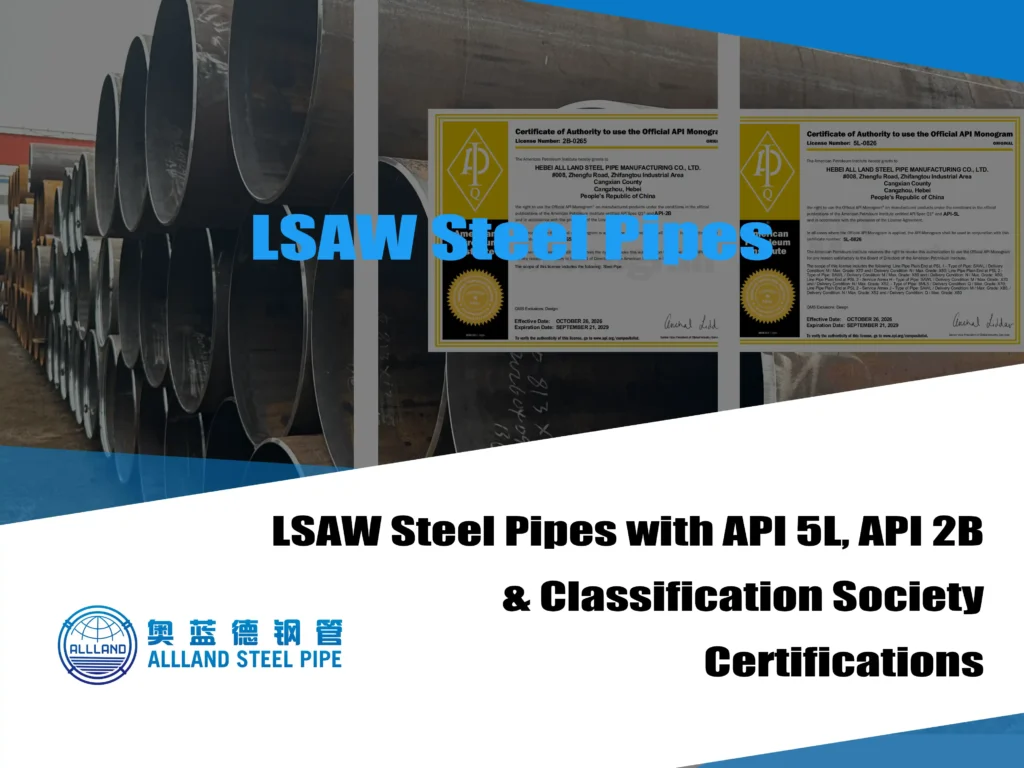
An MTC stating API 5L compliance does not, by itself, prove that the manufacturer holds an active API Monogram license. Buyers should verify the license status and approved product scope separately.
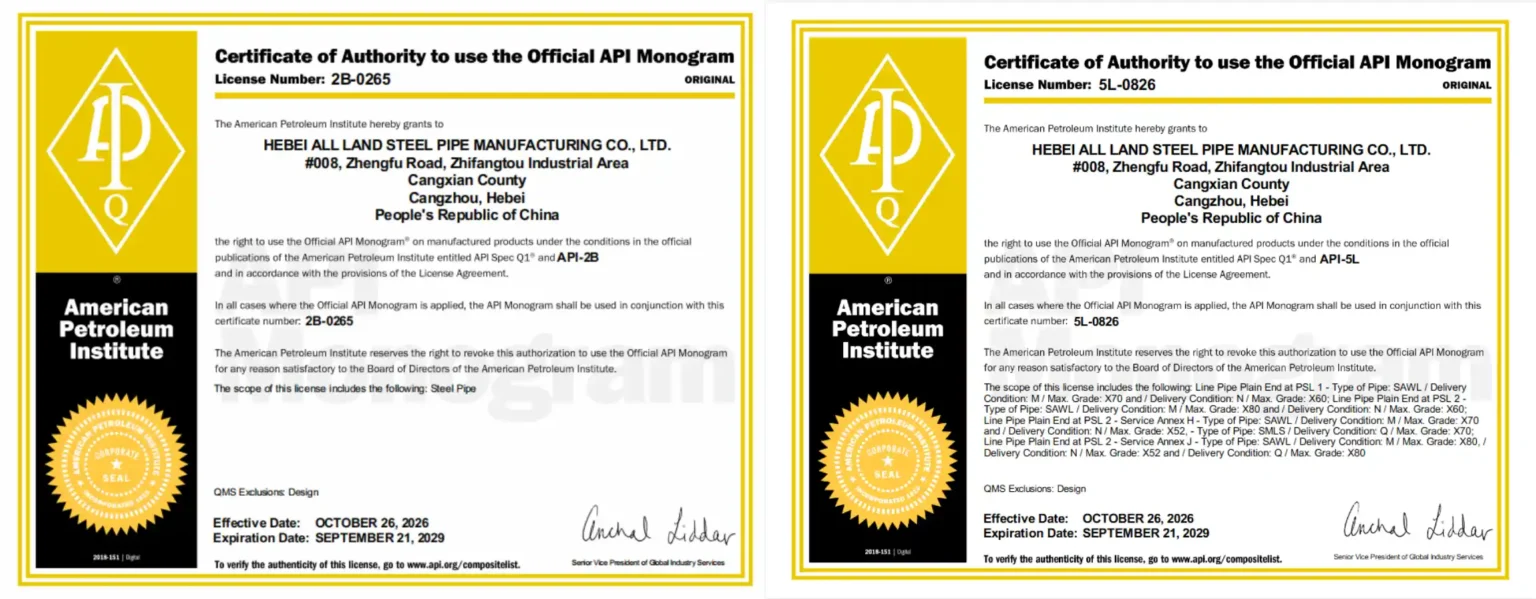
API 2B Structural Steel Pipes for Offshore Engineering
API 2B, Specification for the Fabrication of Structural Steel Pipe, establishes fabrication requirements for structural steel pipe used in offshore structures.
Unlike API 5L line pipes, which are designed for fluid transportation, API 2B structural pipes serve load-bearing functions in offshore engineering.
Typical API 2B Applications
- Offshore Platform Piles and Foundations:Tubular foundation components transferring platform loads to the seabed.
- Tubular Structural Members:Large-diameter components used in platform jackets, bracing systems, and offshore support frameworks.
API 5L vs. API 2B: Key Differences
| Comparison | API 5L | API 2B |
| Primary purpose | Fluid transportation | Structural load-bearing |
| Main industry | Oil and gas pipelines | Offshore engineering |
| Product type | Line pipe | Structural steel pipe |
| Main focus | Material properties and pressure integrity | Fabrication, weld quality, and dimensional accuracy |
| Typical applications | Transmission pipelines | Offshore platforms and foundations |
Important: API 5L and API 2B are not interchangeable. A pipe meeting one standard does not automatically comply with the other. Dual compliance must be demonstrated separately against both applicable specifications.
Classification Society Certifications for LSAW Steel Pipes
For offshore engineering, marine construction, and shipbuilding, LSAW steel pipes may need to meet classification society rules or project-specific certification requirements.
Depending on the project, the required approval may cover individual products, manufacturing facilities, or specified production and inspection activities.
Major Classification Societies
| Abbreviation | Full Name |
| ABS | American Bureau of Shipping |
| DNV | Det Norske Veritas |
| BV | Bureau Veritas |
| LR | Lloyd’s Register |
| CCS | China Classification Society |
| ClassNK | Nippon Kaiji Kyokai |
The applicable certification scope depends on the classification society’s rules, product category, manufacturing facility, and project requirements.
Product Certification vs. Factory Approval vs. Third-Party Inspection
| Type | What It Verifies |
| Classification Society Product Certification | Product conformity within the scope of the applicable certificate |
| Factory Approval | Manufacturing facility, production process, and quality control for specified products or activities |
| Third-Party Inspection | Agreed manufacturing, inspection, and testing activities |
Not every certificate covers every LSAW pipe. Buyers should check the certificate holder, factory, product category, applicable standards, validity period, and approved scope.
Documents Buyers Should Verify
- Applicable API licenses or Monogram authorization, where required and within the approved scope
- API 2B fabrication records and project-specific compliance documents
- Classification society product certificates or factory approval documents
- EN 10204 Type 3.1 Mill Test Certificates
- Welding Procedure Specifications (WPS) and Procedure Qualification Records (PQR)
- NDT reports and hydrostatic test records
- Third-party inspection reports and project-specific quality documents
ALLLAND LSAW Steel Pipe Specifications
ALLLAND manufactures large-diameter LSAW steel pipes using JCOE forming and double-sided submerged arc welding. Our production range covers 406–1524 mm outside diameter and 6–60 mm wall thickness, supporting pipeline transportation, offshore engineering, and structural applications.
LSAW Steel Pipe Manufacturing Specifications
| Parameter | ALLLAND Manufacturing Range |
| Manufacturing Process | JCOE / LSAW |
| Outside Diameter (OD) | 406–1524 mm (16″–60″) |
| Wall Thickness (WT) | 6–60 mm (1/4″–2.36″) |
| Pipe Length | 3–12.5 m |
| Pipe Ends | Plain End, Beveled End |
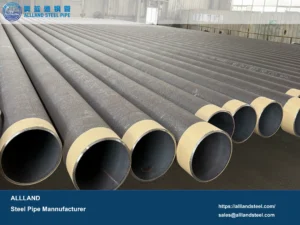
| Surface Treatment | Bare, Black Painted, FBE, 3LPE, 3LPP |
| Inspection | UT, RT, Hydrostatic Testing, Dimensional Inspection |
| Documentation | EN 10204 3.1 MTC, Inspection and Test Reports |
Pipe dimensions, steel grades, and inspection requirements can be specified according to individual project needs.
Steel Grades and Applicable Standards
ALLLAND LSAW pipes can be manufactured to different international product standards, subject to material, dimensional, and production requirements.
| Standard | Typical Steel Grades |
| API 5L | Gr. B, X42, X46, X52, X56, X60, X65, X70, X80 |
| API 2B | Structural steel plate grades specified by the applicable edition and project |
| ASTM A252 | Grade 1, Grade 2, Grade 3 |
| ASTM A671 / A672 | CA55, CB60, CB65, CB70, CC60, CC65, CC70 |
| EN 10219 / EN 10210 | S235JR, S275JR, S355JR and other applicable grades |
| GB/T 9711 | L245, L290, L320, L360, L390, L415, L450, L485, L555 |
ALLLAND LSAW Steel Pipe Specifications
ALLLAND’s project experience covers pipeline transportation, industrial infrastructure, and oil and gas development. The following references illustrate different combinations of pipe dimensions, steel grades, coatings, and inspection requirements.
Selected Project References
1. Australian Aluminium Plant – Australia
ALLLAND supplied API 5L X42 PSL1 LSAW pipes measuring 762 × 15.88 mm for an Australian aluminium plant project.
2. Orinoco Oil Belt Revitalization Plan – Venezuela
The project involved 4,500 tonnes of API 5L L245M LSAW pipes (610 × 9.53 mm) with 300 μm FBE coating, supporting approximately 25 km of municipal and industrial water supply pipelines in Carabobo.
3. North Africa Municipal Pipeline Infrastructure
ALLLAND supplied API 5L PSL2 X65M LSAW pipes measuring 914 × 18 mm for municipal pipeline infrastructure.
4. ADNOC P5 Production Expansion Project – UAE
ALLLAND supplied API 5L X60MS PSL2 LSAW pipes (508 × 15.88 mm) for sour-service applications, with project requirements covering API 5L Annex H, NACE MR0175 / ISO 15156, HIC and SSC testing.