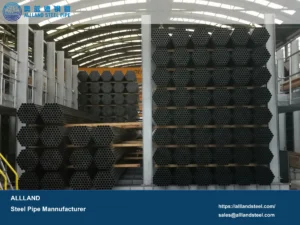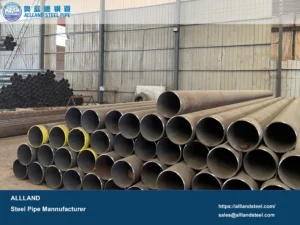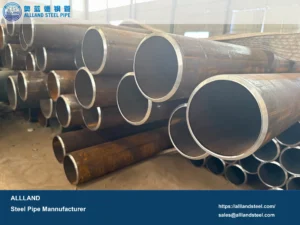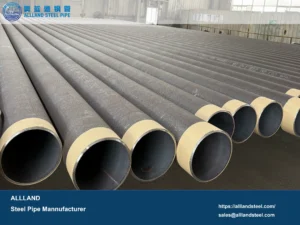

LSAW water pipe refers to a large-diameter steel pipe manufactured using the Longitudinal Submerged Arc Welding (LSAW) process.For water transmission, LSAW water pipes are primarily used to transport large volumes of water over medium and long distances. Typical applications include municipal water transmission, raw-water pipelines, water treatment plants, industrial water systems, irrigation projects, and other large-scale water infrastructure.
ALLLAND supplies large-diameter LSAW steel pipe for water transmission and other pipeline applications. The following sections provide detailed technical data for our LSAW water pipe, including pipe sizes, dimensions, wall thickness, weight, steel grades, applicable standards, testing, and coating options.
LSAW Water Pipe Specifications by ALLLAND Supply
| Item | Typical Range / Requirement |
| Pipe Type | LSAW |
| Manufacturing | JCOE / UOE |
| Outside Diameter | 406–1524 mm* |
| Wall Thickness | 6–60 mm* |
| Length | 6–12 m / customized |
| Steel Grade | Grade B, X42, X52, X60, X65, X70 |
| End Type | Plain End / Beveled End |
| Weld Type | Longitudinal SAW |
| Inspection | UT / RT / Hydrostatic Test |
| External Coating | 3LPE / 3LPP / FBE |
| Internal Coating | Epoxy / Cement Mortar / FBE |
The table above lists standard production specifications; please contact us if you have requirements for special specifications.
LSAW Water Pipe Size Chart
For large-diameter water transmission projects, common pipe sizes may range from approximately DN300 to DN1800, with outside diameters typically starting from about 406 mm and extending to 1820 mm or larger, depending on the manufacturing capability, applicable standard, and project specification.
| Nominal Diameter | Outside Diameter | Wall Thickness | Approx. Weight |
| DN300 | 323.9 mm | 6 mm | 47.3 kg/m |
| DN350 | 355.6 mm | 6 mm | 51.9 kg/m |
| DN400 | 406.4 mm | 6 mm | 59.7 kg/m |
| DN450 | 457.2 mm | 8 mm | 88.9 kg/m |
| DN500 | 508 mm | 8 mm | 99.4 kg/m |
| DN600 | 610 mm | 10 mm | 149.0 kg/m |
| DN700 | 711 mm | 10 mm | 173.8 kg/m |
| DN800 | 813 mm | 12 mm | 237.1 kg/m |
| DN900 | 914 mm | 12 mm | 267.0 kg/m |
| DN1000 | 1016 mm | 14 mm | 348.7 kg/m |
| DN1200 | 1219 mm | 16 mm | 476.0 kg/m |
| DN1400 | 1420 mm | 18 mm | 630.1 kg/m |
| DN1500 | 1524 mm | 20 mm | 745.5 kg/m |
| DN1600 | 1620 mm | 22 mm | 875.0 kg/m |
| DN1800 | 1820 mm | 25 mm | 1113.0 kg/m |
Wall Thickness Requirements for LSAW Water Pipes
Wall thickness is one of the most important parameters when selecting an LSAW water pipe. For large-diameter water transmission pipelines, wall thickness is not selected simply according to pipe diameter. A DN1000 pipe, for example, may require different wall thicknesses depending on its design pressure, steel grade, installation depth, external loads, water hammer conditions, and corrosion allowance.
It affects the pipe’s pressure resistance, structural strength, weight, welding requirements, transportation cost, and overall project cost.
| Pipe Diameter | Common Wall Thickness Range* | Typical Consideration |
| DN400–DN600 | 6–12 mm | Distribution and lower-pressure transmission |
| DN700–DN900 | 8–16 mm | Water transmission |
| DN1000–DN1200 | 10–20 mm | Large-volume transmission |
| DN1400–DN1600 | 14–25 mm | Large water transmission systems |
| DN1800 and above | 16–30+ mm | Large-scale transmission / special projects |
*These are representative engineering ranges, not mandatory values specified by one standard. The final wall thickness must be calculated and verified according to the project design, applicable standard, steel grade, pressure, external loads, and manufacturing requirements. Pipe Wall Thickness Calculator
LSAW Water Pipe Coating
For large-diameter water transmission pipelines, coating selection normally needs to consider internal water quality, external soil conditions, operating temperature, design pressure, installation method, cathodic protection, hydraulic performance, abrasion, field joint protection, and project service life.
| External Coating | Typical Application | Main Function |
| 3LPE | Buried water transmission pipelines | External corrosion protection |
| 3LPP | Higher-temperature or demanding buried pipelines | External corrosion protection |
| FBE | Buried or exposed steel pipe | Barrier protection |
| Liquid Epoxy | Field or shop coating | Corrosion protection and repair |
| Polyolefin Tape | Buried/underwater applications | External corrosion protection |
| Polyurethane | Aboveground or buried applications | Corrosion and mechanical protection |
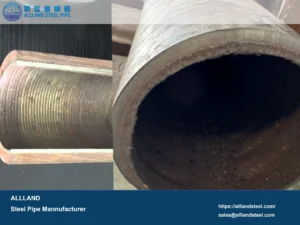
In addition to the aforementioned coatings, we offer CCO (Chromium Carbide Overlay) coated piping. Designed primarily for high-wear applications, these pipes effectively enhance wear resistance and extend service life, making them suitable for sectors such as mining, slurry transport, cement production, and power generation. ALLLAND is the only manufacturer of CCO-coated piping in China.
LSAW Water Pipe Standards
| Standard | Main Scope | Typical Relevance |
| API 5L | Line Pipe | Water / pipeline projects where specified |
| ASTM A53 | Steel Pipe | General pressure/mechanical applications |
| AWWA C200 | Steel Water Pipe | Water transmission |
| EN 10224 | Steel tubes for water and other aqueous liquids | Water applications |
| ISO 3183 | Line Pipe | Pipeline applications |
While various standards have been listed above, there are distinct differences to consider when selecting LSAW water pipes. The following section details the key differences between these standards, which we hope you find useful.
AWWA C200 is a standard specifically dedicated to steel water pipes; it covers steel water pipes with diameters of 6 inches (150 mm) and larger, intended for use in systems transporting potable water, raw water, reclaimed water, wastewater, and other water-related infrastructure. The current version listed in the AWWA standards catalog is C200-23.
EN 10224 is also a product standard directly aimed at water conveyance—specifically titled “Non-alloy steel tubes and fittings for the conveyance of water and other aqueous liquids“—and it specifies the technical delivery conditions for seamless and welded non-alloy steel pipes and associated fittings used for transporting water and other aqueous liquids.
API 5L and ISO 3183 serve a different purpose, as they primarily focus on line pipe for oil and natural gas pipeline transportation systems. ISO 3183:2019 explicitly outlines the requirements for seamless and welded steel pipes used in pipeline transportation systems within the oil and gas industry, utilizing two product specification levels: PSL 1 and PSL 2. Additionally, ISO 3183:2019 supplements the requirements set forth in the 46th edition of API Spec 5L.
Why is the LSAW manufacturing process used for water transmission pipes?
Large water transmission projects often require pipe diameters of several hundred millimeters to more than 1,000 mm. Increasing pipe diameter allows a pipeline to transport a larger flow rate without requiring excessive water velocity.
Water transmission pipelines are not selected based on diameter alone.
The pipe wall must also be sufficiently thick to withstand:
- internal water pressure;
- pressure fluctuations;
- water hammer;
- soil loads;
- traffic loads;
- handling and lifting;
- installation stresses;
- external pressure;
- local buckling risks.
LSAW is well suited to these requirements because the pipe is formed from steel plate and welded longitudinally.
ALLLAND can manufacture and supply LSAW water transmission pipe according to these project-specific technical requirements, from pipe body production and weld inspection to internal/external corrosion protection and final delivery.