Welcome to ALLLAND Steel Pipe Co., Ltd.
Application
Whether used in municipal water supply, industrial facilities, agricultural irrigation, or long-distance water transmission
Water transport steel pipes play an essential role in modern water infrastructure, providing a reliable solution for transporting large volumes of water over short and long distances. From municipal water supply networks and industrial water systems to large-scale irrigation projects and raw water transmission pipelines, steel pipes are widely used where structural strength, pressure resistance, and long-term operational reliability are required.
Compared with some alternative piping materials, steel pipes offer high mechanical strength, excellent structural performance, and considerable flexibility in diameter and wall thickness selection. They can be manufactured in large diameters to accommodate high-volume water transmission requirements and designed to withstand different internal pressures, external loads, and installation conditions.
As a professional steel pipe manufacturer, ALLLAND supplies LSAW, SSAW, ERW, and seamless steel pipes for different water transportation requirements. Our products can be manufactured according to applicable international standards and project specifications, with different steel grades, dimensions, and anti-corrosion coating systems available.
Different water transmission projects require different steel pipe manufacturing methods. Pipe selection generally depends on diameter, design pressure, project specifications, installation conditions, and overall project cost.
The main types of steel pipes used in water transportation include LSAW, SSAW, ERW, and seamless steel pipes.
| Pipe Type | Main Characteristics | Typical Applications |
|---|---|---|
| LSAW | Large-diameter capability, dimensional control | Water transmission mains, municipal pipelines |
| SSAW | Flexible diameter production, suitable for large projects | Long-distance water pipelines, irrigation |
| ERW | Consistent dimensions, efficient production | Water distribution, industrial water supply |
| Seamless | No welded seam, uniform pipe body | Specialized industrial water systems |
Steel water transmission pipelines must comply with the technical requirements specified by the project, including material properties, manufacturing tolerances, welding quality, testing, and corrosion protection.
Several international standards are commonly referenced in water pipeline projects. However, it is important to distinguish between product standards and coating or lining standards.
| Standard | Main Scope | Application |
|---|---|---|
| AWWA C200 | Welded steel water pipe | Steel water transmission pipes |
| AWWA C205 | Cement-mortar lining and coating | Internal and external protection |
| AWWA C210 | Liquid-epoxy coating | Internal and external corrosion protection |
| AWWA C213 | Fusion-bonded epoxy coating | Internal and external FBE protection |
| EN 10224 | Non-alloy steel tubes and fittings | Water conveyance |
| API 5L | Line pipe | Projects specifying API line pipe requirements |
Steel Water Pipe vs Ductile Iron Pipe vs HDPE: Which Is Best for Water Transmission?
Drinking Water Transmission Pipe Manufacturer | Steel Water Pipes
SSAW Pipe in Transmission Pipelines
LSAW Water Pipes Supply and Selection
AWWA C200-23 — Steel Water Pipe
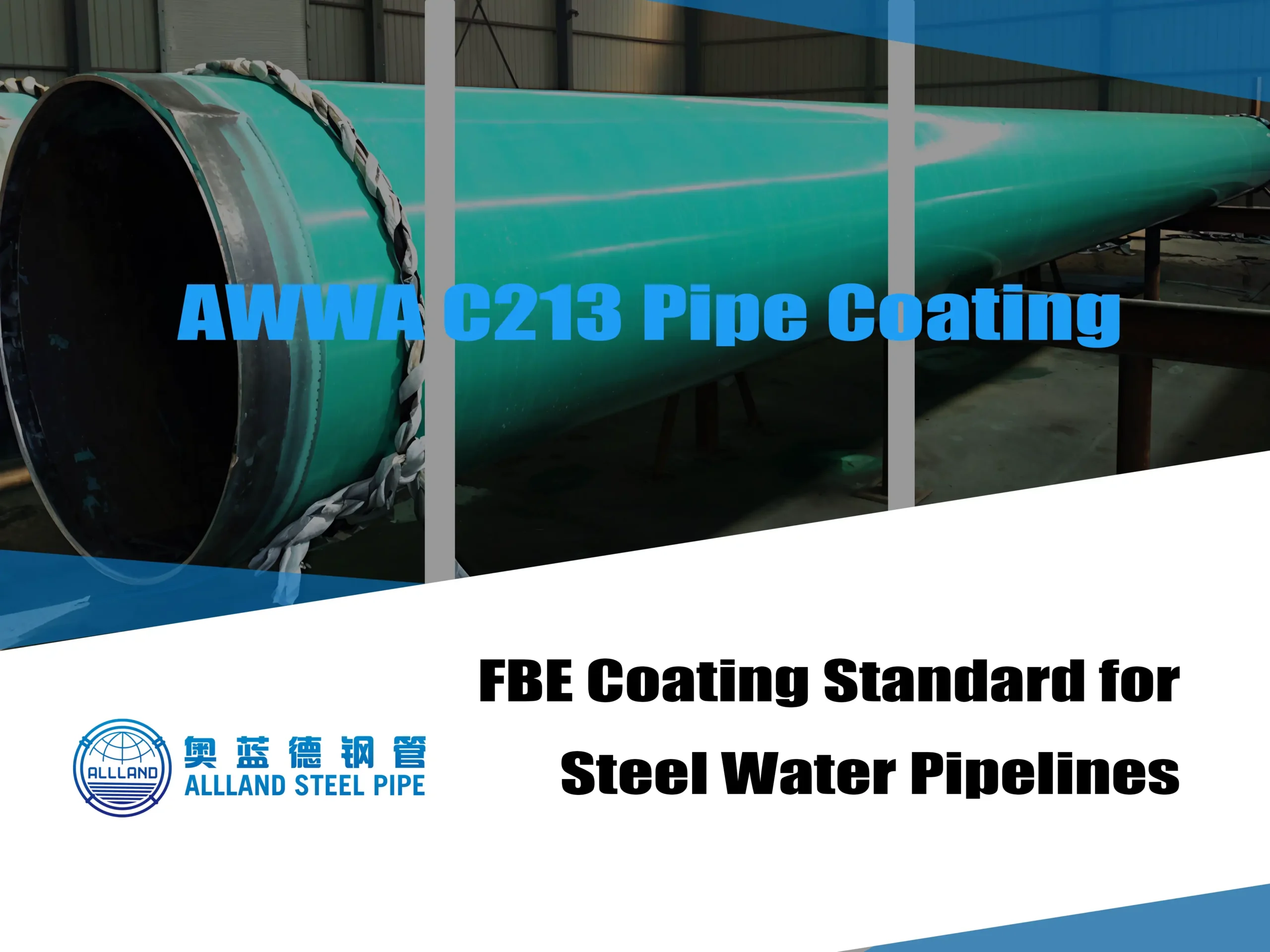
AWWA C213 Pipe Coating: FBE Coating Standard for Steel Water Pipelines
Steel pipes are used in a wide range of water infrastructure projects. Their mechanical strength and ability to accommodate large diameters make them suitable for systems that require reliable water transportation.
Municipal water supply systems transport treated water from treatment plants to distribution networks and residential areas.
Large-diameter steel pipes are commonly used for main transmission pipelines, while smaller pipes may be used in distribution and connection systems.
Typical requirements include:
Stable operating pressure.
Reliable pipe joints and weld quality.
Suitable internal lining for water contact.
External corrosion protection.
Compliance with local water supply regulations.
Common pipe types: LSAW, SSAW, and ERW.
Long-distance water transmission pipelines transport water from reservoirs, rivers, lakes, or other sources to cities and industrial regions.
These projects often require large-diameter pipes to accommodate high flow rates over extended distances.
Steel pipes are suitable for such applications because they can be designed for different pressure conditions and installation environments.
Typical requirements include:
Large pipe diameters.
Pressure-resistant pipe structures.
Longitudinal and circumferential weld integrity.
External corrosion protection.
Hydraulic and structural design verification.
Common pipe types: LSAW and SSAW.
Industrial facilities require reliable water supply for cooling, processing, cleaning, and other production activities.
Power plants, steel mills, chemical facilities, and manufacturing plants may use steel pipelines to transport process water and cooling water.
The pipe material and lining system should be selected according to water chemistry, temperature, pressure, and potential chemical exposure.
Common pipe types: LSAW, ERW, and seamless steel pipes.
Large-scale irrigation projects use pipelines to distribute water from reservoirs, rivers, and pumping stations to agricultural areas.
Steel pipes are used in main irrigation pipelines where high flow capacity and structural strength are required.
Typical considerations include:
Water flow requirements.
Installation conditions.
Internal and external corrosion protection.
Pipeline pressure.
Connection and maintenance requirements.
Common pipe types: SSAW, LSAW, and ERW.
Raw water pipelines transport untreated water from natural sources to water treatment plants.
Depending on the source, transported water may contain suspended solids, sediment, and other substances that affect internal corrosion and abrasion.
Pipe selection should consider water quality, flow velocity, sediment content, and the appropriate internal protective system.
Common pipe types: LSAW and SSAW.
Desalination facilities require pipelines to transport seawater, pretreated water, and desalinated water through different stages of the treatment process.
Seawater environments present additional corrosion challenges because of their high chloride content.
Steel pipes may be used when supported by an appropriate material selection and protective coating or lining system. The specific corrosion strategy must consider seawater exposure, water chemistry, and operating conditions.
Common pipe types: LSAW and SSAW, subject to project material and corrosion requirements.
Fill in the form below and our team will be happy to assist you