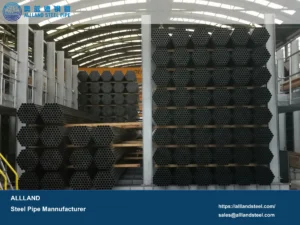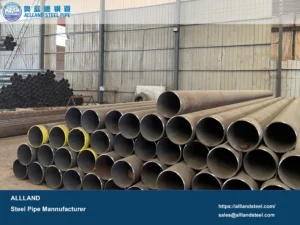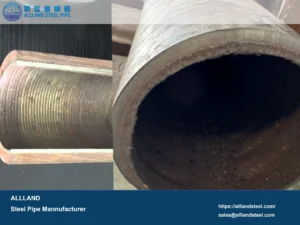



Low Carbon Steel has excellent weldability, which is why low-carbon steel is widely used as the raw material for ERW, LSAW, and SSAW steel pipes. In the following sections, we will analyze the properties of low carbon steel, including its chemical properties, weldability, and the typical chemical compositions and carbon equivalents of common steel grades.
What Is Low Carbon Steel?
Low Carbon Steel is a type of carbon steel characterized by a relatively low carbon content. In general engineering and metallurgical practice, low carbon steel is commonly understood as steel containing approximately 0.05% to 0.25% carbon by mass.
However, there is no single universal carbon-content limit that applies to every steel standard, grade, or engineering application. Depending on the classification system, material specification, and industry practice, steels containing up to approximately 0.30% carbon may also be described as low-carbon steel(Explained at the end of the article).
Low Carbon Steel Properties
| Element | Typical Content in Low Carbon Steel | Primary Function |
| Carbon (C) | 0.05–0.25% | Strength, hardness, hardenability |
| Manganese (Mn) | 0.30–1.50% | Strength, toughness, deoxidation |
| Silicon (Si) | 0.05–0.40% | Deoxidation, strength |
| Phosphorus (P) | ≤0.035–0.045% | Generally controlled as an impurity |
| Sulfur (S) | ≤0.035–0.045% | Generally controlled as an impurity |
| Copper (Cu) | ≤0.20–0.55%* | Corrosion resistance / residual element |
| Chromium (Cr) | ≤0.20–0.30%* | Usually residual; increases hardenability |
| Nickel (Ni) | ≤0.20–0.30%* | Toughness / residual element |
| Molybdenum (Mo) | Usually very low / not specified | Hardenability |
| Vanadium (V) | Usually very low / not specified | Grain refinement / precipitation strengthening |
| Titanium (Ti) | Usually very low / grade-dependent | Grain refinement / nitrogen fixation |
| Niobium (Nb) | Usually very low / grade-dependent | Grain refinement / precipitation strengthening |
| Nitrogen (N) | Typically ≤0.012–0.015% in many grades | Interstitial element; controlled for toughness and aging |
* These are typical ranges or residual-element limits, not universal limits for all low-carbon steels.
* The table above is a general metallurgical reference, not a specification for purchasing steel.
* A low-carbon steel does not need to contain all of the elements listed above at specified levels. For example, some product standards may specify only C, Mn, P and S, while other grades additionally control Si, Cu, Ni, Cr, N, Nb, V, Ti or other elements.
Chemical Composition of Low Carbon Steel Properties
Carbon (C) is one of the most important alloying elements in carbon steel. Even relatively small changes in carbon content can significantly affect the steel’s strength, hardness, ductility, toughness, formability, and weldability.
How Does Carbon Affect Steel Properties?
In general, as carbon content increases, the strength and hardness of carbon steel tend to increase, while ductility and weldability tend to decrease.
| Property | Effect of Increasing Carbon Content | Main Reason |
| Tensile Strength | ↑ Generally increases | Increased carbon strengthens the ferrite/pearlite matrix |
| Yield Strength | ↑ Generally increases | Greater resistance to plastic deformation |
| Hardness | ↑ Increases | Higher carbon promotes harder microstructural constituents |
| Elongation | ↓ Decreases | Plastic deformation becomes more restricted |
| Ductility | ↓ Decreases | Higher carbon reduces the ability to undergo plastic deformation |
| Toughness | ↓ Generally decreases | Higher-strength/harder structures can be less resistant to fracture |
| Weldability | ↓ Decreases | Greater hardenability and increased risk of HAZ cracking |
| Formability | ↓ Decreases | Higher strength and lower ductility make forming more difficult |
As shown in the table above, the tensile strength, yield strength, and hardness of steel generally increase as the carbon content increases, while toughness, formability, and weldability tend to decrease. However, it is important to distinguish carbon content from carbon equivalent (CE). Carbon content refers specifically to the proportion of carbon in the steel, while carbon equivalent considers the combined effect of carbon and other alloying elements on the steel’s hardenability and weldability.
Carbon Equivalent (CE)
Because carbon is not the only element affecting weldability, engineers often use Carbon Equivalent (CE) to estimate the combined effect of carbon and other alloying elements on the hardenability and weldability of steel.
A commonly used formula is the IIW Carbon Equivalent:
CE(IIW) = C + Mn/6 + (Cr + Mo + V)/5 + (Ni + Cu)/15
where all element concentrations are expressed as percentages by mass.
For example, consider a hypothetical steel with:
- C = 0.20%
- Mn = 1.00%
- Cr = 0.20%
- Mo = 0.10%
- V = 0.05%
- Ni = 0.10%
- Cu = 0.20%
The calculation would be:
CE = 0.20 + 1.00/6 + (0.20 + 0.10 + 0.05)/5 + (0.10 + 0.20)/15
CE ≈ 0.20 + 0.167 + 0.070 + 0.020
CE ≈ 0.457
This example demonstrates why carbon content alone is not sufficient to evaluate weldability.
A steel containing 0.20% carbon can have a substantially different welding behavior depending on its manganese and alloying-element contents.
Manganese (Mn) Affect Steel Properties
The Role of Mnanganese (Mn) in Low Carbon Steel
- Increases strength
- Improves hardenability
- Combines with sulfur (S) to form MnS inclusions
- Improves machinability to some extent
Silicon (Si) Affect Steel Properties
Main Functions of Silicon (Si)
- Acts as a deoxidizer
- Increases strength
- Improves deoxidation of molten steel
- However, excessive Si content may negatively affect certain processing and welding properties.
Sulfur (S) and Phosphorus (P)
Main Functions of Silicon (Si)
- Acts as a deoxidizer
- Increases strength
- Improves deoxidation of molten steel
- However, excessive Si content may negatively affect certain processing and welding properties.
Properties of Typical Low Carbon Steel Grades
| Standard | Grade | C (%) | Si (%) | Mn (%) | P (%) | S (%) | Cr (%) | Ni (%) | Cu (%) | N (%) |
| ASTM A36 | A36 | ≤0.26* | ≤0.40 | — / grade-dependent | ≤0.040 | ≤0.050 | — | — | — / specified in some cases | — |
| ASTM A53 | Grade B | ≤0.30 | — | ≤1.20 | ≤0.05 | ≤0.045 | ≤0.40 | ≤0.40 | ≤0.40 | — |
| EN 10025-2 | S235JR | ≤0.17** | — | ≤1.40 | ≤0.035 | ≤0.035 | — | — | ≤0.55 | ≤0.012 |
| EN 10025-2 | S275JR | ≤0.21** | — | ≤1.50 | ≤0.035 | ≤0.035 | — | — | ≤0.55 | ≤0.012 |
| JIS G3444 | STK400 | ≤0.25 | — | — | ≤0.040 | ≤0.040 | — | — | — | — |
| JIS G3444 | STK490 | ≤0.18 | ≤0.55 | ≤1.65 | ≤0.035 | ≤0.035 | — | — | — | — |
| GB/T 8163 | 10 | 0.07–0.13 | 0.17–0.37 | 0.35–0.65 | ≤0.030 | ≤0.030 | ≤0.15 | ≤0.30 | ≤0.20 | ≤0.008*** |
| GB/T 8163 | 20 | 0.17–0.23 | 0.17–0.37 | 0.35–0.65 | ≤0.030 | ≤0.030 | ≤0.25 | ≤0.30 | ≤0.20 | ≤0.008*** |
* ASTM specifies heat-analysis requirements for C, Mn, P, S, Si and Cu.
* EN 10025-2 limits can vary with thickness and deoxidation condition. For S235JR, for example, C is ≤0.17% under the commonly referenced condition and can vary with product thickness/condition.
* For GB/T 8163, the nitrogen requirement applies to steel melted by the oxygen-converter process under the stated condition
Weldability of Low Carbon Steel
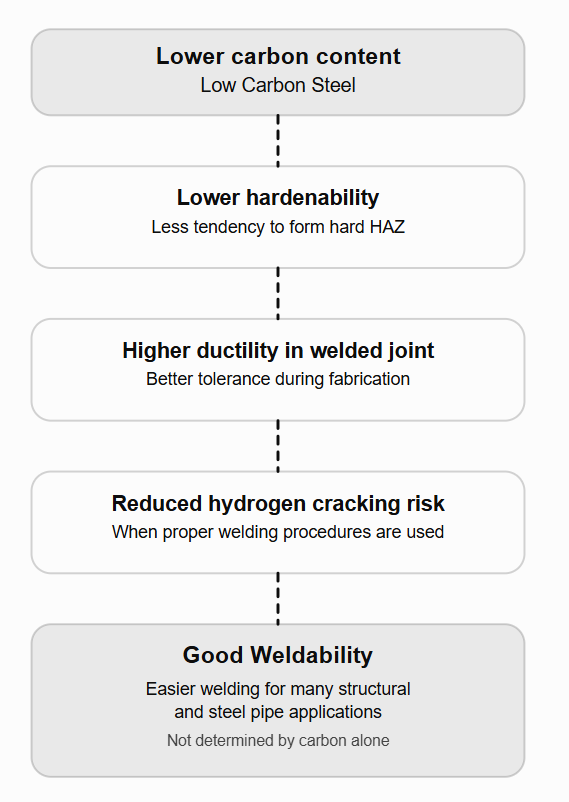
One of the most important properties of low carbon steel is its excellent weldability. Compared with medium-carbon and high-carbon steels, low carbon steel is generally easier to weld because its relatively low carbon content reduces hardenability and lowers the tendency to form brittle microstructures in the heat-affected zone during welding.
However, weldability is not determined by carbon content alone. The actual welding behavior of a steel also depends on its chemical composition, carbon equivalent, plate or pipe thickness, cooling rate, welding heat input, hydrogen level, joint restraint, and the applicable welding procedure.
For steel pipe manufacturing, these factors are particularly important because welded products such as ERW, LSAW, SSAW, structural steel pipes, and fabricated pipeline systems all rely on consistent welding quality to achieve the required mechanical performance and service reliability.
Why ≤0.30% C Is Commonly Used to Define Low Carbon Steel
The ≤0.30% C limit generally comes from general metallurgical and engineering classifications, rather than from a single, universally applicable steel pipe standard.
It can generally be traced to three main sources:
1. Metallurgy / Materials Science Textbooks
In materials science and metallurgy textbooks, carbon steel is commonly classified into low, medium, and high carbon steel based on carbon content. The upper limit for low carbon steel may be defined as 0.25%, 0.30%, or a similar range, depending on the classification system used.
2. General Engineering References
In mechanical engineering, material selection, welding engineering, and other technical references, limits such as <0.30% C are sometimes used as practical guidelines for material classification. The purpose is mainly to evaluate the material’s strength, ductility, and welding tendency, rather than to establish specific product acceptance requirements.
3. Welding / Fabrication Practice
In welding and fabrication, engineers often pay greater attention to Carbon Equivalent (CE) rather than simply determining whether the carbon content is above or below 0.25%. Therefore, 0.25% and 0.30% should not be considered absolute thresholds at which the material’s properties suddenly change. They are practical classification boundaries used for engineering and material-selection purposes.