
Carbon Equivalent Calculator for Steel Pipes

Carbon Equivalent Calculator for Steel Pipes

Carbon Equivalent Formula:
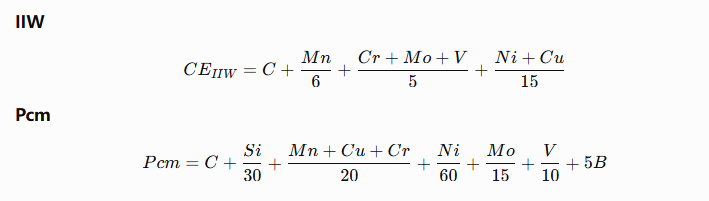
carbon equivalent

Carbon Equivalent Calculator

Calculate Carbon Equivalent (CE) for Carbon Steel and Low Alloy Steel

Chemical Composition

Enter chemical composition in wt.%

%
%
%
%
%
%
%
%
%
%
%
Carbon Equivalent
0.000 %
CE (IIW)
Weldability: —

Calculation

CEIIW = C + Mn/6 + (Cr + Mo + V)/5 + (Ni + Cu)/15
Enter the chemical composition and click “Calculate”.

General Weldability Guide

CE Value General Indication
≤ 0.35% Excellent weldability
0.36–0.45% Good weldability
0.46–0.60% Moderate weldability
> 0.60% Lower weldability; additional welding controls may be required
Note: Carbon Equivalent is an important indicator of steel weldability, but it should not be used as the sole basis for determining welding procedures or preheating requirements. Actual welding conditions depend on chemical composition, pipe wall thickness, hydrogen level, heat input, welding process, restraint conditions, steel grade, and applicable standards or project specifications.

Why Is Carbon Equivalent Important?

Carbon Equivalent (CE) is an important indicator used to evaluate the weldability and hardening tendency of carbon steel and low-alloy steel.


Although carbon content (C) has a significant effect on steel weldability, the behavior of steel during welding is not determined by carbon alone. Elements such as Mn, Cr, Mo, V, Ni, and Cu can also affect hardenability and the microstructure of the heat-affected zone (HAZ).


Carbon Equivalent combines the effects of these alloying elements into a single value, making it easier to compare the relative weldability of different steel grades.

For steel pipe manufacturing and fabrication, CE is particularly useful when evaluating:

  • Weldability
  • HAZ hardening
  • Hydrogen cracking susceptibility
  • Preheating requirements
  • Interpass temperature control
  • Welding procedure selection

Other Articles by the Author

SSAW Pipe in Transmission Pipelines

SSAW pipe is used in selected large-diameter transmission pipeline projects where pipe dimensions, material properties, weld quality, and corrosion protection must meet defined engineering requirements. Manufactured through spiral forming and

Is Density a Physical Property?

Is Density a Physical Property? Yes, density is a physical property because it can be measured without changing a material’s chemical composition. In steel pipe manufacturing, density is important for

how to connect galvanized pipe without threads?

How to Connect Galvanized Pipe Without Threads? When galvanized steel pipes are unthreaded, different connection methods can be selected based on the pipe’s application, diameter, operating pressure, and installation environment.

Get A Quote Now

Fill in the form below and our team will be happy to assist you