

Where Are Structural Steel Tubes Used in Transmission Towers?
1. Main Load-Bearing Members
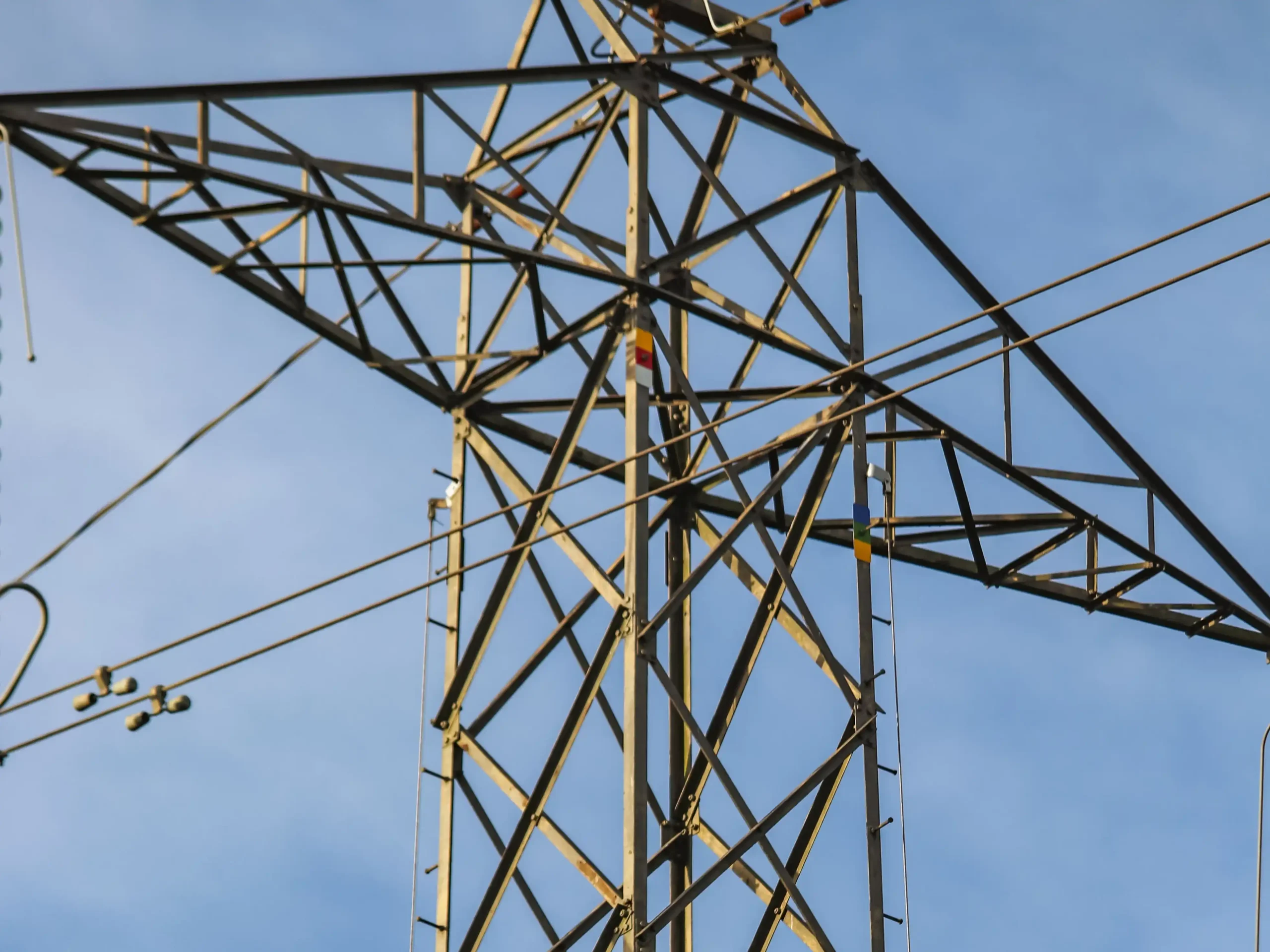
Main load-bearing steel tubes transfer tower self-weight, conductor tension, and wind loads to the foundations. Their axial strength and bending resistance are essential for structural performance. Common material grades include S235JR and S355JR, with selection based on tower height, loading conditions, and structural design requirements.
2. Bracing Members for Structural Stability
Diagonal and horizontal steel tubes connect the main tower members and help resist lateral deformation. Their design focuses on member slenderness, compression buckling, and local stability. These requirements can be evaluated according to EN 1993-1-1 or the applicable transmission tower design code.
3. Tubular Transmission Poles and Monopoles
Tubular steel poles are commonly manufactured as monopole or multi-section structures. Large-diameter welded steel pipes, including LSAW pipes, can be used to produce tapered pole sections. Flange joints and slip-fit connections allow separate sections to be assembled and installed on-site. Manufacturing processes must ensure consistent taper geometry and accurate joint dimensions.
4. Crossarms and Structural Connection Assemblies
Steel tubes are also used in tubular crossarms, equipment supports, and auxiliary connection assemblies. Fabrication involves precision cutting, beveling, drilling, and welding to achieve accurate component dimensions and proper assembly. Welded connections should meet applicable project requirements, with AWS D1.1/D1.1M serving as a reference where specified.
Common Types of Steel Tubes for Transmission Towers
Steel tubes used in transmission tower structures are commonly manufactured through different welding processes. ERW, LSAW, and SSAW pipes offer different dimensional ranges and manufacturing characteristics for tubular structural applications.
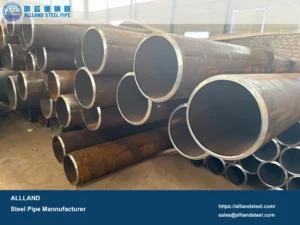
ERW Steel Pipes: Suitable for small- and medium-diameter tubular structural members.
LSAW Steel Pipes: Suitable for large-diameter and heavy-wall structural applications.
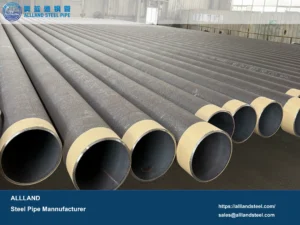
SSAW steel Pipes: Offer flexible diameter options for selected large-diameter tubular structures.
ALLLAND provides the following steel pipe specifications:
| Pipe Type | Outside Diameter | Wall Thickness |
| ERW | 21.3–660 mm | 1.5–25 mm |
| LSAW | 406–1524 mm | 6–60 mm |
| SSAW | 219–3500 mm | 5–25 mm |
The ranges represent ALLLAND’s published manufacturing capabilities. Actual size combinations and availability depend on project requirements.
Hot-Dip Galvanized Steel Tubes for Outdoor Corrosion Protection
Transmission towers are exposed to rain, humidity, and changing atmospheric conditions throughout their service life. Hot-dip galvanizing forms a protective zinc coating to reduce corrosion and improve the durability of outdoor steel components.
According to EN ISO 1461, the minimum mean zinc coating thickness is 85 μm for steel articles thicker than 6 mm, 70 μm for steel thicknesses above 3 mm and up to 6 mm, and 55 μm for steel thicknesses from 1.5 mm to 3 mm. Actual coating requirements should be determined by the applicable standard and project specifications.
Steel Tube Selection Requirements for Transmission Towers
Steel tube specifications for transmission towers should be determined by the structural design code and project-specific material requirements. The following standards and project specifications provide practical references for material selection and quality control.
Structural Steel Grades and Mechanical Properties
For tubular transmission poles, ASTM A572 is one material standard referenced in utility specifications. The Snohomish County PUD 115 kV transmission pole specification accepts ASTM A572 Grade 50, 55, 60, and 65 for pole shafts, attachment plates, and brackets.
For reference, ASTM A572 Grade 50 has a minimum yield strength of 50 ksi (345 MPa). The same project specification also requires structural plate material to meet a Charpy V-Notch impact value of 15 ft·lbf (approximately 20 J) at −20°F (−29°C).
Structural Steel Tube Product Standards
| Standard | Scope | Application |
| ASTM A500/A500M | Cold-formed welded and seamless carbon steel structural tubing | Circular, square, and rectangular structural tubes |
| EN 10219-1/-2 | Cold-formed welded structural hollow sections | Cold-formed welded structural tubes |
| EN 10210-1/-2 | Hot-finished structural hollow sections | Hot-finished structural tubes |
| ASTM A572/A572M | High-strength low-alloy structural steel | Structural steel plates and sections |
ASTM A500, EN 10219, and EN 10210 directly specify structural hollow section products, while ASTM A572/A572M primarily covers structural steel material requirements and does not replace a structural tube product standard.
Carbon Equivalent and Weldability
For galvanized transmission pole structures, the same 115 kV project specification limits the carbon equivalent (CE) of structural plate or coil used for pole shafts, flanges, base plates, and brackets to 0.45.
This requirement is particularly relevant when selecting steel for welded tubular structures that will undergo hot-dip galvanizing. Chemical composition and carbon equivalent should therefore be verified through mill test certificates before fabrication.
Pole Geometry and Connection Dimensions
The 115 kV project specification also provides practical dimensional requirements for tubular pole fabrication:
| Technical Parameter | Project Specification |
| Minimum pole taper | 0.14 in/ft |
| Maximum pole taper | 0.45 in/ft |
| Minimum slip-joint length | 1.5 × maximum shaft diameter |
| Minimum structural steel thickness | 1/4 in (6.35 mm) |
These requirements help control pole geometry, section overlap, and structural assembly. They are project-specific values rather than universal limits for all transmission towers.
Applicable Design and Product Standards
| Standard | Application |
| ASCE/SEI 48-19 | Design, detailing, fabrication, and assembly of tubular steel transmission poles |
| ASCE/SEI 10-15 | Design of latticed steel transmission structures |
| ASTM A572 | High-strength low-alloy structural steel |
| ASTM A500 | Cold-formed welded and seamless carbon steel structural tubing |
| AWS D1.1/D1.1M | Structural steel welding |
ASCE/SEI 48-19 specifically covers tubular transmission pole structures, while ASCE/SEI 10-15 addresses latticed transmission structures. They should not be treated as interchangeable.
FAQ
ERW, LSAW and SSAW steel pipes can be used in tubular transmission structures, depending on diameter, wall thickness, structural design and fabrication requirements. ERW is generally suitable for smaller tubular members, while LSAW and SSAW can accommodate larger diameters.
Common structural steel grades include S235JR, S355JR and ASTM A572 Grade 50. The appropriate grade depends on design loads, required strength, impact properties, weldability and the project specification.
Inspection may include chemical composition analysis, tensile testing, dimensional checks, weld inspection and non-destructive testing. Additional requirements, such as impact testing and coating-thickness measurement, should be specified according to the project standard and purchase order.
Hot-dip galvanizing provides a zinc coating that protects steel against atmospheric corrosion. It is particularly important for transmission structures exposed to rain, humidity and outdoor environmental conditions. Coating thickness should meet the applicable standard and project requirements.