


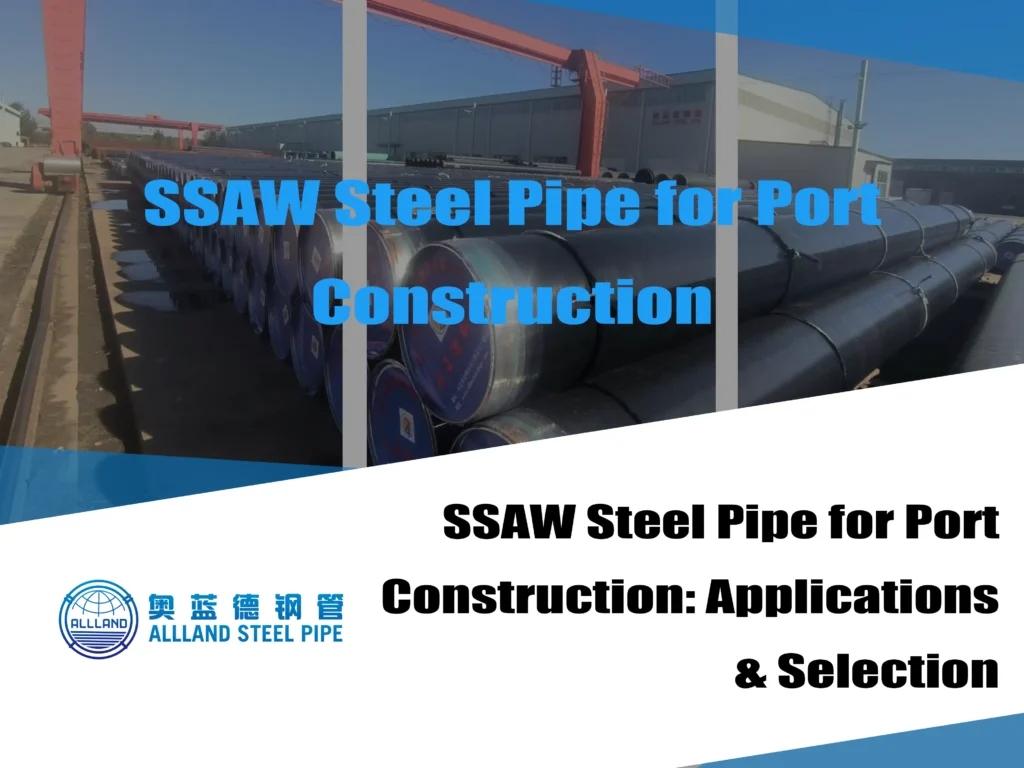
SSAW steel pipe is used in selected port construction projects, including marine foundations, structural support, and water transportation systems. Its large-diameter manufacturing capability makes it suitable for projects requiring specific pipe dimensions and mechanical properties.
For port applications, pipe selection depends on structural loads, installation conditions, weld quality, and marine corrosion risks. These factors should be evaluated alongside the required dimensions, steel grade, and applicable project standards.
What Is SSAW Steel Pipe?
SSAW (Spiral Submerged Arc Welded) steel pipe is manufactured by forming steel strip or plate into a spiral shape and welding the helical seam using submerged arc welding. The process supports the production of large-diameter pipes for infrastructure and industrial applications.
In port construction, SSAW steel pipe may be used for foundation piles, structural members, and selected fluid transportation systems. Each application requires different specifications based on its intended function and operating conditions.
Key Applications of SSAW Steel Pipe in Port Construction
SSAW Steel Pipe Piles for Quay Walls and Marine Foundations
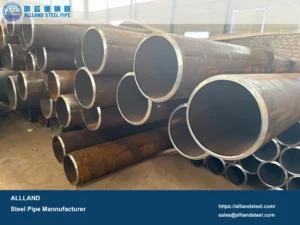
SSAW steel pipe piles are used in port foundations and quay wall structures where large diameters and project-specific dimensions are required.
Standard: ASTM A252 covers welded and seamless steel pipe piles, including pipes with helical weld seams.
Steel grades: ASTM A252 Grade 2 and Grade 3 provide minimum yield strengths of 240 MPa and 310 MPa, respectively.
Key advantage: Large diameters and adjustable wall thicknesses allow engineers to specify pile dimensions according to structural loads and ground conditions.
Marine durability: External protective coatings and, where required, cathodic protection help reduce corrosion risks in seawater and tidal zones.
Final specifications should follow the project design, installation requirements, and applicable material standards.
SSAW Steel Pipe for Port Structural Support
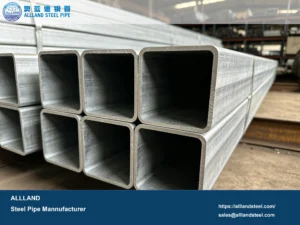
SSAW steel pipes can serve as tubular members in port platforms, access trestles, and marine support structures. Key design considerations include axial loads, bending resistance, and structural stability.
| Item | Reference |
| Structural steel grade | S355J2H* |
| Key design factors | Axial load, bending, buckling |
| Main advantage | Large-diameter tubular sections with customizable dimensions |
*S355J2H is a grade associated with EN 10219 structural hollow sections. Confirm applicability before specifying it for a particular SSAW product.
SSAW Steel Pipe for Dredging and Water Transmission
For dredging discharge, seawater intake, and port water transmission, pipe selection depends on flow rate, operating pressure, and the abrasiveness or corrosiveness of the conveyed medium.
- Pipe dimensions: Large diameters can accommodate high-volume flow requirements.
- Operating conditions: Wall thickness is selected according to pressure, flow conditions, and installation requirements.
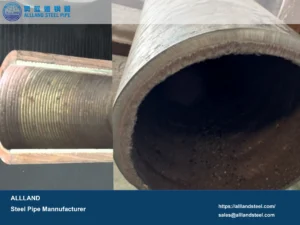
- Protection requirements: Internal lining helps address abrasion and internal corrosion; external coating protects against the surrounding environment.
Relevant standard: ASTM A139 covers straight-seam and spiral-seam electric-fusion-welded steel pipe for conveying fluids and gases. Confirm the standard’s suitability for the intended service and project specification before listing it as the governing standard.
Typical SSAW Steel Pipe Sizes for Port Construction
SSAW steel pipe dimensions vary according to the application, structural loads, installation method, and project specifications. For port construction, the main parameters are outside diameter (OD), wall thickness (WT), and pipe length.
Reference Dimensions for SSAW Steel Pipe
| Application | Reference OD Range | Reference WT Range | Selection Considerations |
| Marine foundation and port piling | 219–1,219 mm | 6–25 mm | Check axial and bending loads, soil conditions, pile-driving stresses, and corrosion protection. |
| Large-diameter structural and foundation applications | 1,220–2,032 mm | 8–25 mm | Verify structural stability, wall thickness, connection details, lifting requirements, and installation feasibility. |
| Dredging and water transmission | 323.9–1,220 mm | 6–25.4 mm | Assess flow rate, operating pressure, abrasion, conveyed medium, and internal and external corrosion protection. |
These ranges are indicative references compiled from published product information. They are not universal design limits or a confirmed ALLLAND supply range. Actual availability depends on manufacturing capabilities, steel grade, wall thickness, and order requirements.
Corrosion Protection for SSAW Steel Pipe in Marine Environments
Marine steel pipes face different corrosion risks depending on seawater contact, salt exposure, humidity, and wet-dry cycles. Protection should be selected according to the pipe’s exposure zone, service life, and maintenance requirements.
Corrosion Risks Across Marine Exposure Zones
| Exposure zone | Main corrosion concern |
| Atmospheric zone | Salt deposits, humidity, and coating degradation |
| Splash and tidal zones | Repeated wetting, drying, and high oxygen exposure |
| Submerged zone | Continuous seawater exposure and marine corrosion |
| Buried or seabed zone | Soil or sediment corrosion and coating damage |
Protective Coatings for Marine Steel Pipes
Common coating options include:
- FBE:A fusion-bonded epoxy coating used for corrosion protection on prepared steel surfaces.
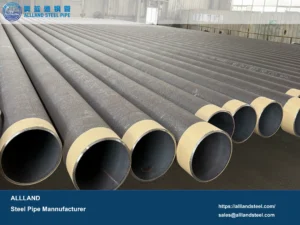
- 3LPE:A three-layer polyethylene system combining an epoxy primer, adhesive layer, and polyethylene outer layer.
- 3LPP:A polypropylene-based multilayer coating suited to applications requiring higher temperature resistance than conventional polyethylene systems.
Coating selection should consider operating temperature, mechanical damage risk, installation conditions, and the applicable coating specification. Surface preparation, coating thickness, holiday testing, and field-joint protection are also important quality controls.
Cathodic Protection for Submerged and Buried Steel Structures
For steel pipes exposed to seawater or buried in corrosive environments, combining protective coatings with cathodic protection provides an additional layer of corrosion control.
ALLLAND’s Dual Corrosion Protection System
ALLLAND combines 3PE coating with cathodic protection to help reduce corrosion and extend pipeline service life. According to the company’s technical profile, this system has been applied to major projects, including the West–East Gas Pipeline III and the China–Russia Eastern Gas Pipeline, with a stated service life of up to 50 years.
| Protection measure | Function |
| 3PE coating | Provides a protective barrier against the surrounding environment |
| Cathodic protection | Helps control corrosion at exposed steel areas and coating defects |
| Combined system | Provides complementary corrosion protection for long-term pipeline service |
For port and marine projects, the protection system should be designed according to the exposure zone, seawater conditions, installation method, and project-specific service-life requirements.
FAQ
Is SSAW steel pipe suitable for port foundation piles?
SSAW steel pipe can be used for port foundation piles, quay walls, and other marine foundation applications when its dimensions, steel grade, weld quality, and structural performance meet the project requirements. Suitability depends on the design loads, soil conditions, installation method, and applicable pile specification. For driven piles, installation stresses and potential coating damage must also be evaluated.
How do you select the wall thickness of SSAW steel pipe for port construction?
Wall thickness should be determined by structural or pressure-design calculations, installation requirements, manufacturing tolerances, and corrosion provisions. For foundation piles, engineers should check axial loads, bending, local buckling, and driving stresses. For dredging and water transmission, pressure, external loads, and the conveyed medium must also be considered. Corrosion allowance should follow the applicable design method rather than being added automatically to every pipe specification.
What corrosion protection is suitable for SSAW steel pipe in marine environments?
The appropriate protection system depends on the exposure zone, design life, installation method, and maintenance requirements. FBE, 3LPE, and 3LPP coatings may be considered where their performance meets the project specification. Cathodic protection can provide additional corrosion control for submerged or buried steel structures. For driven piles, coating resistance to impact and abrasion during installation should be assessed, together with field-joint protection and repair requirements.