



Introduction
Carbon steel is one of the most widely used engineering materials in construction, oil and gas pipelines, structural projects, and industrial applications.
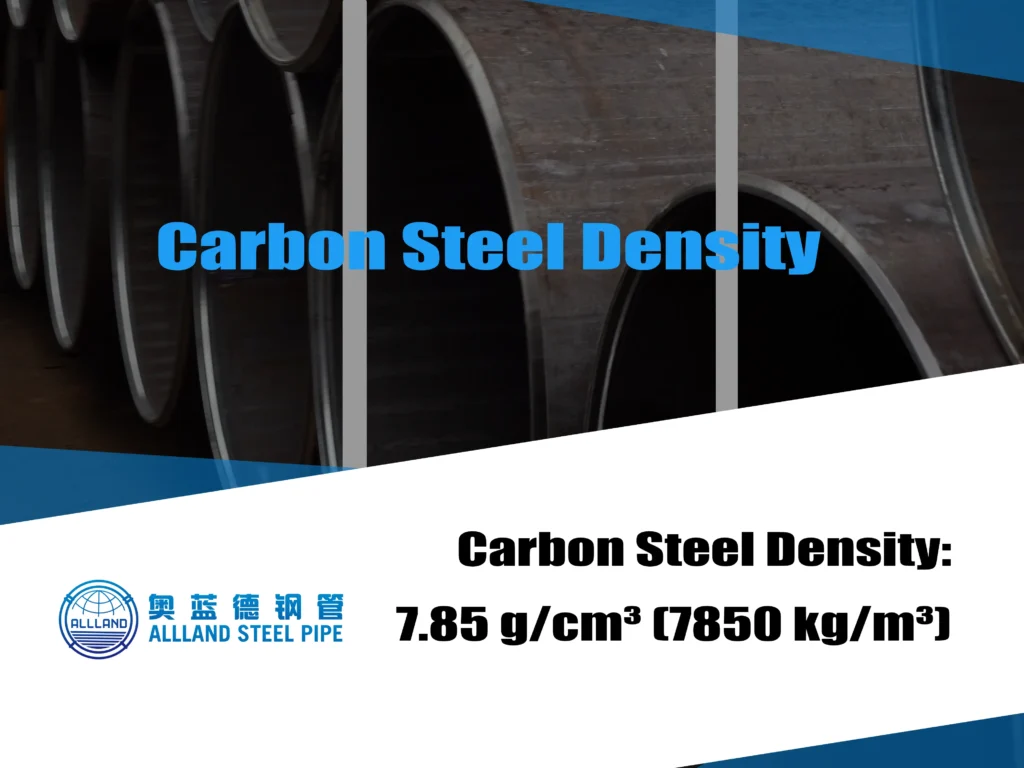
The standard density of carbon steel is approximately 7.85 g/cm³ (7850 kg/m³). This value is commonly used for calculating the theoretical weight of carbon steel pipes, plates, tubes, and structural sections.
Understanding carbon steel density helps engineers, fabricators, and buyers estimate:
- Material weight
- Transportation requirements
- Structural load
- Project cost
What Is the Density of Carbon Steel?
Density refers to the mass contained in a specific volume of material.
The formula is:
Density = Mass ÷ Volume
For most carbon steel products, the accepted engineering density value is:
ρ = 7850 kg/m³
Although carbon content and alloying elements can slightly affect density, the variation is very small. Therefore, 7.85 g/cm³ is the standard value used for engineering calculations worldwide.
Carbon Steel Density in Different Units
| Material | Density |
| Carbon Steel | 7.85 g/cm³ |
| Carbon Steel | 7850 kg/m³ |
| Carbon Steel | 0.283 lb/in³ |
Carbon Steel Pipe Density and Weight Calculation
For carbon steel pipes, density is mainly used to calculate theoretical pipe weight.
The basic principle is:
Pipe Weight = Steel Volume × Density
For most carbon steel pipes:
ρ = 7850 kg/m³
For example, most carbon steel pipes under standards such as API 5L, ASTM A53, ASTM A106, ASTM A500, EN 10219 use 7.85 g/cm³ for theoretical weight calculation.
Carbon Steel Pipe Weight Formula
The commonly used pipe weight formula:
W=4/π×(OD2−ID2)×L×ρ
- W= pipe weight (kg)
- OD= outside diameter (mm)
- ID= Inside diameter (mm)
- L= pipe length (m)
- ρ= carbon steel density (7850 kg/m³)
For practical steel pipe calculations, the simplified formula is often used:
W=4/π×(OD2−ID2)×L×ρ
Where:
- OD = Outside diameter (mm)
- WT = Wall thickness (mm)
Note:
- Carbon steel density is slightly affected by carbon content and alloying elements, but the difference is very small.
- For engineering calculations, 85 g/cm³is the standard value used worldwide.
How to Calculate Carbon Steel Weight Using Density?
The general formula is:
Weight=Density×Volume
For steel plates:
Weight(kg)=Length(m)×Width(m)×Thickness(mm)×7.85
Example:
Steel plate:
- Length: 6 m
- Width: 2 m
- Thickness: 10 mm
Calculation:
6×2×10×7.85
=942 kg
Use our carbon steel pipe weight calculator to quickly estimate theoretical pipe weight.
Carbon Steel Density vs Other Steel Materials
Carbon Steel Density vs Stainless Steel Density
| Material | Density |
| Carbon Steel | 7.85 g/cm³ |
| Stainless Steel 304 | 8.00 g/cm³ |
| Stainless Steel 316 | 8.00 g/cm³ |
| Aluminum | 2.70 g/cm³ |
| Copper | 8.96 g/cm³ |
Carbon steel is slightly lighter than stainless steel but provides excellent strength-to-cost performance.
Does Carbon Content Affect Steel Density?
Yes, but only slightly.
Increasing carbon content mainly affects:
- Tensile strength
- Hardness
- Heat treatment response
- Weldability
It has minimal impact on density.For engineering applications, carbon steel density remains approximately:7.85 g/cm³ (7850 kg/m³)
Carbon Steel Density for Common Standards
| Standard | Product | Density Used |
| API 5L | Line Pipe | 7850 kg/m³ |
| ASTM A53 | Carbon Steel Pipe | 7850 kg/m³ |
| ASTM A106 | Seamless Pipe | 7850 kg/m³ |
| ASTM A500 | Structural Tube | 7850 kg/m³ |
| EN 10219 | Hollow Section | 7850 kg/m³ |
FAQ
What is the density of carbon steel?
The density of carbon steel is approximately 7.85 g/cm³ (7850 kg/m³).
Is carbon steel density the same as mild steel density?
Yes. Mild steel is a type of low-carbon steel, and its density is approximately 7.85 g/cm³.
How do you calculate carbon steel pipe weight?
Carbon steel pipe weight is calculated by multiplying steel volume by density:
Weight = Volume × 7850 kg/m³.
Conclusion
Carbon steel density is a fundamental engineering value used for material estimation and weight calculation. With a standard density of 7.85 g/cm³, engineers and buyers can accurately estimate carbon steel plates, pipes, and structural sections.
For carbon steel pipe applications, density combined with OD, wall thickness, and length helps determine theoretical weight and transportation requirements.