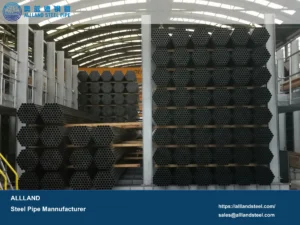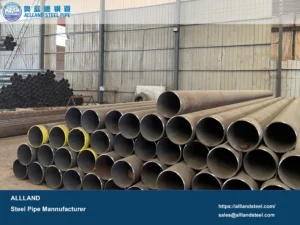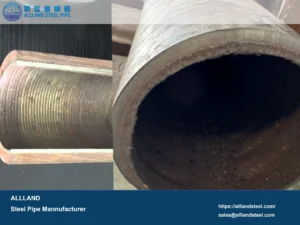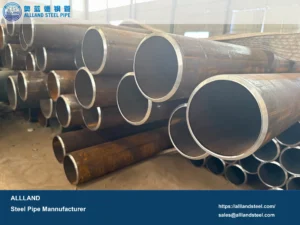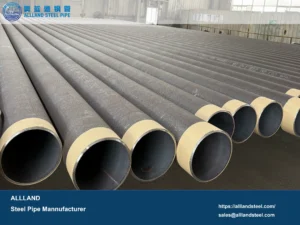




Schedule 120 pipe, commonly written as SCH 120 pipe, is a heavy-wall steel pipe designation used to specify the wall thickness of a pipe according to its nominal pipe size (NPS).
What Is Schedule 120 Pipe?
Unlike the nominal pipe size itself, Schedule 120 does not directly define the outside diameter of the pipe. For a given NPS, the outside diameter remains standardized, while the Schedule determines the wall thickness and therefore affects the inside diameter, cross-sectional area, pipe weight, pressure resistance and flow characteristics.
The dimensional data below is based on Schedule 120 data commonly used in the ASME B36.10M system. For detailed data, please click this link: ASME B36.10M Schedule 120.
Schedule 120 Pipe Dimensions
The following table shows commonly specified Schedule 120 steel pipe dimensions.
| NPS | DN | OD (in.) | OD (mm) | Wall Thickness (in.) | Wall Thickness (mm) | ID Approx. (mm) | Weight Approx. (kg/m) |
| 4″ | DN100 | 4.5 | 114.3 | 0.438 | 11.13 | 92 | 28.32 |
| 5″ | DN125 | 5.563 | 141.3 | 0.5 | 12.7 | 115.9 | 40.28 |
| 6″ | DN150 | 6.625 | 168.3 | 0.562 | 14.27 | 139.7 | 54.2 |
| 8″ | DN200 | 8.625 | 219.1 | 0.719 | 18.26 | 182.6 | 90.44 |
| 10″ | DN250 | 10.75 | 273 | 0.844 | 21.44 | 230.1 | 133.06 |
| 12″ | DN300 | 12.75 | 323.9 | 1 | 25.4 | 273.1 | 186.97 |
| 14″ | DN350 | 14 | 355.6 | 1.094 | 27.79 | 300 | 224.66 |
| 16″ | DN400 | 16 | 406.4 | 1.219 | 30.96 | 344.5 | 286.64 |
| 18″ | DN450 | 18 | 457.2 | 1.375 | 34.93 | 387.3 | 363.66 |
| 20″ | DN500 | 20 | 508 | 1.5 | 38.1 | 431.8 | 441.52 |
| 22″ | DN550 | 22 | 558.8 | 1.625 | 41.28 | 476.3 | 526.73 |
| 24″ | DN600 | 24 | 609.6 | 1.812 | 46.02 | 517.6 | 639.62 |
Note:
Inside Diameter = Outside Diameter − 2 × Wall Thickness
Why Is Schedule 120 Considered a Heavy-Wall Pipe?
The defining characteristic of Schedule 120 is its relatively large wall thickness.
For example, an NPS 12 pipe has an outside diameter of approximately 323.85 mm, regardless of whether the pipe is specified as Schedule 40, 80, 120 or 160. What changes is primarily the wall thickness.
In SCHEDULE dimensions,
Pipe Schedule changes wall thickness, not nominal pipe size.
As wall thickness increases:
- Internal diameter decreases.
- Steel cross-sectional area increases.
- Pipe weight increases.
- Resistance to internal pressure generally increases, subject to material grade, design code, temperature and allowable stress.
- External pressure and mechanical robustness can also improve.
- Internal flow area decreases.
Therefore, selecting Schedule 120 is not simply a matter of choosing a “stronger pipe.” It is a balance between pressure requirements, mechanical loads, flow capacity, corrosion allowance, temperature, fabrication requirements and material cost.
Does Schedule 120 Mean a Specific Pressure Rating?
This is one of the most important points when discussing Schedule 120 pipe.
A pipe Schedule is primarily a dimensional designation. It should not be interpreted as a universal pressure rating.
For example, two NPS 12 Schedule 120 pipes manufactured from different steel grades may have the same nominal dimensions but different allowable operating pressures.
The allowable pressure of a Schedule 120 pipe depends on multiple variables, including:
- Pipe material
- Yield strength
- Tensile strength
- Design temperature
- Allowable stress
- Outside diameter
- Wall thickness
- Welded or seamless construction
- Manufacturing tolerance
- Corrosion allowance
- Design code
- Joint efficiency
- Service conditions
For process piping, the engineer may need to consider ASME B31.3. For power piping, ASME B31.1 may be applicable. Other services may require different design codes.
Does Schedule 120 Mean a Specific Pressure Rating?
Schedule 80, Schedule 120 and Schedule 160 are often compared when designing high-pressure piping systems.
The difference becomes more significant as pipe size increases.
For example, for NPS 6:
| Parameter | SCH 80 | SCH 120 | SCH 160 |
| OD | 168.3 mm | 168.3 mm | 168.3 mm |
| WT | ~10.97 mm | 14.27 mm | ~18.26 mm |
| ID | ~146.3 mm | ~139.7 mm | ~131.8 mm |
| Relative wall thickness | Lower | Medium-high | Very high |
For NPS 12:
| Parameter | SCH 80 | SCH 120 | SCH 160 |
| OD | 323.9 mm | 323.9 mm | 323.9 mm |
| WT | ~17.48 mm | 25.40 mm | ~33.32 mm |
| ID | ~288.9 mm | ~273.1 mm | ~257.2 mm |
The transition from Schedule 80 to Schedule 120 therefore represents a significant increase in steel cross-section.
For an NPS 12 pipe, increasing wall thickness from approximately 17.5 mm to 25.4 mm adds a substantial amount of steel while reducing the internal diameter by approximately 16 mm.
This is why Schedule 120 can occupy an important engineering position between Schedule 80 and Schedule 160.
Schedule 120 Pipe Applications
Schedule 120 is generally considered when the project requires a relatively heavy pipe wall.
Potential applications include:
- High-Pressure Piping
Heavy-wall pipe can be used in piping systems where the required design pressure exceeds the capability or economic efficiency of lighter schedules.
- Steam and Thermal Systems
The combination of high temperature and pressure can increase the required wall thickness after code-based design.
- Oil and Gas Facilities
Schedule 120 pipe may be specified for certain process, utility and high-pressure piping systems, depending on the project design code and material specification.
- Refinery and Petrochemical Piping
Heavy-wall piping can be used in process systems where pressure, temperature, mechanical loading and corrosion allowance must be considered simultaneously.
- Industrial Water and Utility Systems
Where high mechanical strength or pressure resistance is required, Schedule 120 may be considered as an alternative to lighter-wall pipe.
- Mechanical and Structural Applications
The increased wall thickness can provide additional resistance to:
- Impact
- Local deformation
- External mechanical loads
- Wear
- Handling damage
However, the actual suitability must always be verified against the project specification.
FAQ
What does Schedule 120 mean in pipe?
Schedule 120 is a standardized wall-thickness designation for steel pipe. For a given NPS, it defines a relatively heavy wall thickness while the outside diameter remains standardized.
What is the wall thickness of 12-inch Schedule 120 pipe?
For NPS 12, Schedule 120 wall thickness is approximately 25.40 mm (1.000 in.) under the commonly referenced ASME B36.10M dimensional system.