
Quick Comparison: ERW vs SSAW vs LSAW
ERW, SSAW, and LSAW steel pipes differ in forming methods, weld seam configuration, and manufacturing capabilities. Selecting the right type requires more than comparing maximum pipe dimensions; the specified steel grade, applicable standard, and project requirements must also be considered.
| Specification | ERW Steel Pipe | SSAW Steel Pipe | LSAW Steel Pipe |
| Full name | Electric Resistance Welded | Spiral Submerged Arc Welded | Longitudinal Submerged Arc Welded |
| Raw material | Steel strip or coil | Steel strip or coil | Steel plate |
| Weld seam | Longitudinal | Spiral | Longitudinal |
| Outside diameter (OD) | 21.3–660 mm | 219–3,500 mm | 406–1,524 mm |
| Wall thickness (WT) | 1.5–25 mm | 5–25 mm | 6–60 mm |
| Key manufacturing characteristic | Efficient continuous production | Flexible large-diameter forming | Suitable for large diameters and heavy walls |
| Common applications | Structural, mechanical, and fluid transmission piping | Water transmission, piling, and selected pipeline projects | Transmission pipelines and demanding infrastructure |
The dimensions above reflect ALLLAND’s stated manufacturing capabilities for general reference. Actual availability depends on the OD/WT combination, steel grade, applicable standard, and order requirements.
The Difference Is More Than the Weld Seam
The main distinction lies in how each pipe is formed and welded. These processes influence production methods, dimensional capabilities, and the requirements for manufacturing control.
ERW: Steel strip is continuously roll-formed into a cylindrical shape. High-frequency electrical resistance heating and pressure join the edges along a longitudinal seam.
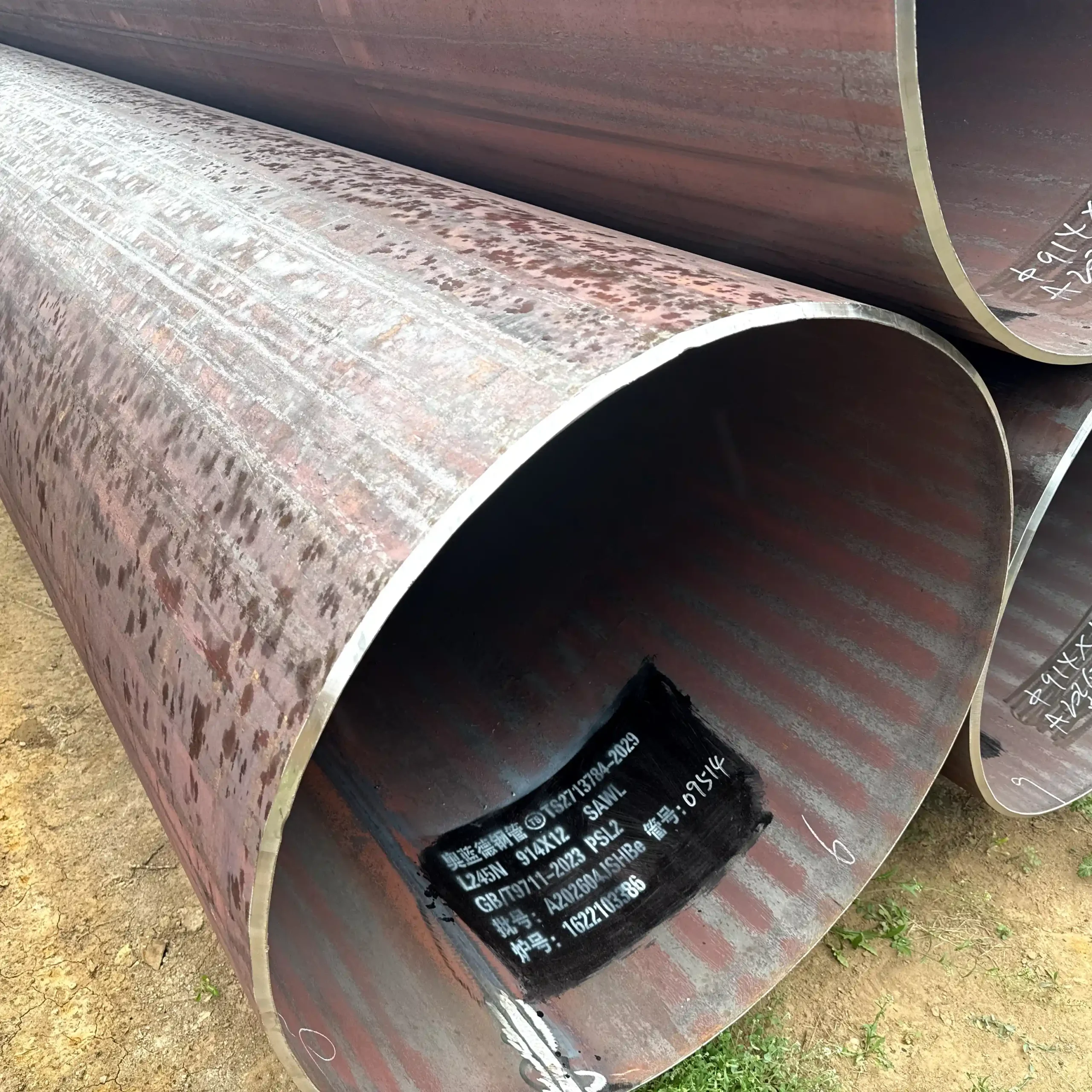
SSAW: Steel strip is formed helically, and the adjoining edges are joined by submerged arc welding to create a spiral seam.
LSAW: Steel plate is formed into a cylindrical shape, commonly through JCOE or UOE processes, and joined along a longitudinal seam using submerged arc welding.
How Manufacturing Method Affects Selection
ERW is often suitable for standardized specifications and efficient continuous production.
SSAW offers flexibility in manufacturing large-diameter pipes from steel strip, while LSAW can accommodate substantial wall thicknesses and demanding dimensional requirements.
These are manufacturing characteristics, not automatic rankings of strength or quality. Actual performance depends on material properties, pipe dimensions, welding quality, manufacturing qualification, and compliance with the governing specification.
For a closer look at how each process works, explore the ERW steel pipe manufacturing process, SSAW steel pipe manufacturing process, and LSAW steel pipe manufacturing process.
How to Choose the Right Pipe for Your Project
Instead of selecting a pipe solely by its manufacturing method, start with the project requirements and then verify which processes can meet them.
| Project Requirement | Pipe Types to Evaluate | What to Verify |
| Standardized dimensions and high production volumes | ERW | Available size range, tolerances, steel grade, and applicable standard |
| Large-diameter water transmission | SSAW or LSAW | Design pressure, wall thickness, hydraulic requirements, and corrosion protection |
| Foundation piling | SSAW or LSAW | Structural loads, pile dimensions, driving conditions, and project specifications |
| Oil and gas transmission | ERW, SSAW, or LSAW, where permitted | Pipeline code, steel grade, service conditions, weld acceptance criteria, and inspection requirements |
| Heavy-wall pipe requirements | LSAW is a key option to evaluate | Required wall thickness, dimensional feasibility, material properties, and production qualification |
ERW vs SSAW vs LSAW for Water Transmission
SSAW and LSAW are common options for large-diameter water pipelines. SSAW offers flexible diameter production, while LSAW is worth considering for specific wall thickness and dimensional requirements. Final selection depends on design pressure, corrosion protection, and installation conditions.
ERW vs SSAW vs LSAW for Oil and Gas Pipelines
For oil and gas transmission, the applicable pipeline standard and service conditions determine suitability. ERW, SSAW, and LSAW can all be considered where permitted by the project specification. Verify steel grade, wall thickness, weld acceptance criteria, and required inspection before selection.
Check OD and Wall Thickness Together
Maximum OD does not guarantee manufacturing feasibility. The required OD, wall thickness, steel grade, and pipe length must be confirmed as a combination to ensure compliance with the project specification.
Verify Weld Quality and Inspection Requirements
Pipe type alone does not determine quality or pressure suitability. Confirm the required UT, RT, hydrostatic testing, dimensional inspection, and acceptance criteria against the applicable standard and project specification.
| Inspection or Document | Purpose |
| Ultrasonic testing (UT) | Detects specified internal or weld-related discontinuities, depending on the method and procedure |
| Radiographic testing (RT) | Evaluates weld integrity for applicable defect types and acceptance criteria |
| Hydrostatic testing | Verifies pressure integrity under the specified test conditions |
| Dimensional inspection | Confirms OD, wall thickness, length, and required tolerances |
| Material Test Certificate (MTC) | Documents material chemistry and mechanical properties, as applicable |
The required testing method, coverage, and acceptance criteria depend on the governing standard and purchase specification. No single inspection method replaces the full quality assurance program.
Cost Comparison: What Determines the Final Price?
There is no universal price ranking for ERW, SSAW, and LSAW steel pipes. The most economical option depends on the specified product and the requirements that must be met.
| Cost Driver | Impact on the Quotation |
| Dimensions and steel grade | Affect material consumption and manufacturing feasibility |
| Production method and order quantity | Influence production efficiency, setup, and available capacity |
| Inspection requirements | Additional NDT, testing, and third-party inspection may increase costs |
| Coating and lining | Depend on the specified protection system, thickness, and surface preparation |
| Logistics and delivery | Depend on pipe length, loading, destination, and delivery terms |
A lower price per ton does not necessarily mean a lower total project cost. Compare quotations only after confirming that the dimensions, material grade, standards, inspection scope, coating system, and delivery terms are equivalent.
FAQ
Is ERW, SSAW, or LSAW better for high-pressure pipelines?
None is universally superior. Suitability depends on the governing pipeline code, steel grade, wall thickness, design conditions, manufacturing qualification, and specified inspection requirements. The selected product must be permitted by the applicable specification for the intended service.
Can SSAW steel pipe replace LSAW steel pipe?
Not automatically. A proposed alternative must meet the project’s dimensional, material, design, welding, and inspection requirements. Approval from the purchaser, engineer, or project owner may be necessary.
Why is the maximum outside diameter not enough to confirm manufacturing feasibility?
Maximum OD and maximum wall thickness may represent different production limits. The manufacturer must verify the requested dimensions, steel grade, pipe length, tolerances, and applicable standard as a complete specification.
Conclusion
Choosing between ERW, SSAW, and LSAW steel pipes requires more than comparing manufacturing methods or maximum diameters. Buyers should evaluate application suitability, dimensional feasibility, applicable standards, weld inspection requirements, and total delivered cost before making a final decision.
ALLLAND manufactures ERW, SSAW, and LSAW steel pipes for industrial and infrastructure applications. Explore our steel pipe products and manufacturing capabilities to learn more.