Schedule 40 Wall Thickness
The Schedule 40 Wall Thickness defines the standard wall thickness of a steel pipe for each nominal pipe size. Unlike a fixed-thickness pipe series, Schedule 40 uses different wall thicknesses for different NPS sizes.
Schedule 40 is a standardized pipe wall-thickness designation. It does not mean that every Schedule 40 pipe has the same wall thickness.
The relationship can be summarized as:
Schedule 40 + NPS → Standard Wall Thickness
This means that the pipe size must be identified before determining its Schedule 40 wall thickness.
Schedule 40 Wall Thickness Chart
| NPS | DN | OD (mm) | Schedule 40 Wall Thickness (mm) |
| 1/8″ | DN6 | 10.3 | 1.73 |
| 1/4″ | DN8 | 13.7 | 2.24 |
| 3/8″ | DN10 | 17.1 | 2.31 |
| 1/2″ | DN15 | 21.3 | 2.77 |
| 3/4″ | DN20 | 26.7 | 2.87 |
| 1″ | DN25 | 33.4 | 3.38 |
| 1-1/4″ | DN32 | 42.2 | 3.56 |
| 1-1/2″ | DN40 | 48.3 | 3.68 |
| 2″ | DN50 | 60.3 | 3.91 |
| 2-1/2″ | DN65 | 73 | 5.16 |
| 3″ | DN80 | 88.9 | 5.49 |
| 4″ | DN100 | 114.3 | 6.02 |
| 5″ | DN125 | 141.3 | 6.55 |
| 6″ | DN150 | 168.3 | 7.11 |
| 8″ | DN200 | 219.1 | 8.18 |
| 10″ | DN250 | 273.1 | 9.27 |
| 12″ | DN300 | 323.9 | 9.53 |
| 14″ | DN350 | 355.6 | 9.53 |
| 16″ | DN400 | 406.4 | 9.53 |
| 18″ | DN450 | 457.2 | 9.53 |
| 20″ | DN500 | 508 | 9.53 |
| 22″ | DN550 | 558.8 | 9.53 |
| 24″ | DN600 | 609.6 | 9.53 |
Schedule 40 Wall Thickness vs. Schedule 80
Schedule 80 generally provides a thicker wall than Schedule 40 for the same NPS.
For example, for a 2-inch steel pipe, the outside diameter remains the same:
| NPS | Schedule 40 | Schedule 80 |
| 2″ | 3.91 mm | 5.54 mm |
The thicker Schedule 80 wall generally results in a smaller internal diameter and greater pipe weight.
The appropriate schedule should be selected according to the design pressure, temperature, mechanical requirements, applicable code, and project specification.
Relationship Between Wall Thickness and Pressure
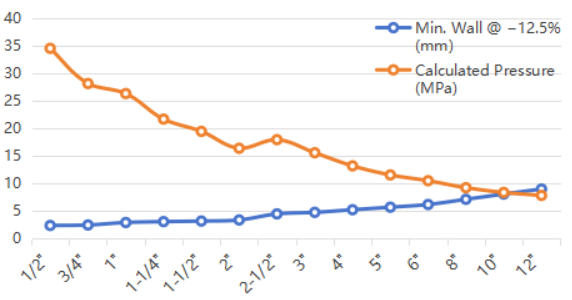
In general, when all other conditions remain the same, a thicker pipe wall provides greater resistance to internal pressure. However, this relationship is not simply proportional—doubling the wall thickness does not necessarily double the pressure capacity. As wall thickness increases, the additional pressure capacity may provide diminishing returns under certain engineering conditions.
The chart below illustrates the design pressure trend for ASTM A106 Grade B seamless carbon steel pipe. Actual design pressure should be determined based on specific conditions, including pipe size, wall thickness, material properties, temperature, design code, and other applicable factors. The values shown in the chart are for reference only.