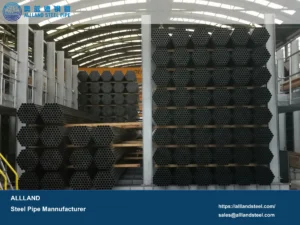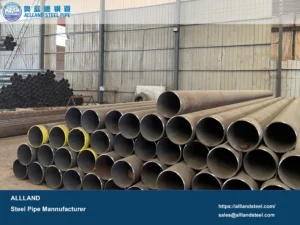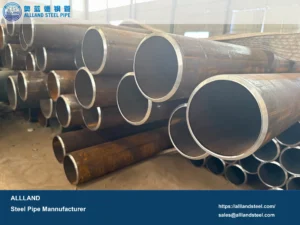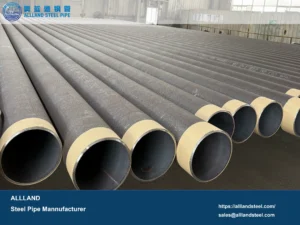


ERW Red Fire Pipe is a carbon steel pipe manufactured using the Electric Resistance Welding (ERW) process and coated with a red protective coating. It is generally manufactured in accordance with fire pipe standards, such as ASTM A795, and is designed to meet the requirements of fire protection piping systems.
In this article, ALLLAND, a professional steel pipe manufacturer, will introduce the common sizes, applicable standards, manufacturing process, and other key information about ERW Red Fire Pipe. If you are looking for this type of pipe, please contact ALLLAND directly for product details and a quotation.
ERW Red Fire Pipe size
| NPS | OD | SCH 10 WT | SCH 40 WT | Approx. Weight SCH 10 | Approx. Weight SCH 40 |
| 1″ | 33.4 mm | 2.77 mm | 3.38 mm | 2.09 kg/m | 2.50 kg/m |
| 1/4″ | 42.2 mm | 2.77 mm | 3.56 mm | 2.69 kg/m | 3.39 kg/m |
| 1/2″ | 48.3 mm | 2.77 mm | 3.68 mm | 3.11 kg/m | 4.05 kg/m |
| 2″ | 60.3 mm | 2.77 mm | 3.91 mm | 3.93 kg/m | 5.03 kg/m |
| 2/2″ | 73.0 mm | 3.05 mm | 5.16 mm | 5.40 kg/m | 8.63 kg/m |
| 3″ | 88.9 mm | 3.05 mm | 5.49 mm | 6.58 kg/m | 11.29 kg/m |
| 4″ | 114.3 mm | 3.05 mm | 6.02 mm | 8.47 kg/m | 16.07 kg/m |
| 5″ | 141.3 mm | 3.40 mm | 6.55 mm | 11.65 kg/m | 21.77 kg/m |
| 6″ | 168.3 mm | 3.40 mm | 7.11 mm | 13.88 kg/m | 28.26 kg/m |
| 8″ | 219.1 mm | 3.76 mm | 8.18 mm | 20.00 kg/m | 42.55 kg/m |
| 10″ | 273.0 mm | 4.19 mm | 9.27 mm | 27.80 kg/m | 60.29 kg/m |
| 12″ | 323.9 mm | 4.57 mm | 9.53 mm | 36.27 kg/m | 73.77 kg/m |
Note: The wall thicknesses listed above are common examples based on ASME B36.10M Schedule dimensions. For actual fire protection projects, the applicable product standards, design codes, certification requirements, and purchase specifications shall prevail. The weights are theoretical calculated values, and actual weights may vary due to manufacturing tolerances, coating thickness, and the specific material used.
Why Are Fire Pipes Painted Red?
Red is widely used to identify fire protection piping because it allows fire sprinkler and fire protection systems to be quickly distinguished from other building services. In a complex building, many different piping systems may run through the same ceiling, mechanical room, utility corridor, or plant area.
However, the red color itself does not make a steel pipe a fire protection pipe and does not indicate that the pipe is automatically UL Listed or FM Approved. The pipe still needs to comply with the applicable product specifications, pressure requirements, installation requirements, and project certification requirements.
How Is ERW Red Fire Pipe Manufactured?
ERW Red Fire Pipe is manufactured using the high-frequency electric resistance welding (ERW) process, with additional inspection and testing procedures specifically designed for fire protection piping. The following section describes the manufacturing process of high-frequency ERW steel pipes. For detailed manufacturing information and dimensional specifications,please visit our product page.
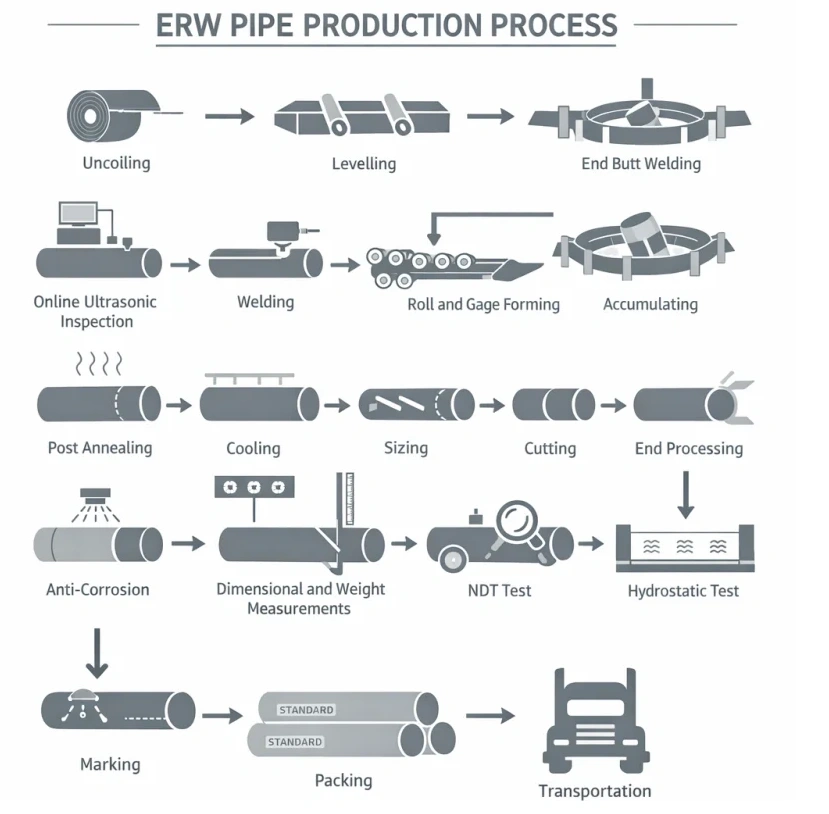
From “Welded Pipe” to “Fire Protection Pipe”
A welded pipe becomes a fire protection product only after it passes the required quality controls.
For fire protection service, the important question is not simply:
“Was the pipe welded?” It is: Can the finished pipe consistently withstand the requirements of the intended fire protection system?”
Dimensional Inspection
Typical dimensional checks include:
- Outside diameter
- Wall thickness
- Ovality
- Straightness
- Pipe length
- End condition
This is important because fire sprinkler systems often use mechanical couplings, threaded connections, or other standardized joining methods. ASTM A795, for example, identifies joining methods including rolled grooves, cut grooves, threading, welding, and fittings depending on the pipe type and dimensions.
Weld Inspection- ERW Fire Pipe
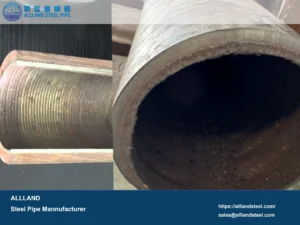
The longitudinal ERW seam needs particular attention.
Depending on the applicable specification and production system, inspection may include:
- Visual inspection
- Eddy current testing
- Ultrasonic testing
- Other non-destructive examination methods
The purpose is to identify potential weld discontinuities before the pipe reaches the customer.
This is one of the most important differences between a professional ERW production line and a simple “form and weld” process.
Hydrostatic Testing
For fire protection pipe, pressure integrity is particularly important.
ASTM A795 requires each length of pipe to undergo a hydrostatic test without leakage through the pipe wall; the standard also provides for an accepted non-destructive electrical test as an alternative under specified conditions.
The basic objective is:
Verify that the finished pipe can withstand the specified test pressure without leakage.
This makes hydrostatic testing an important bridge between manufacturing quality and actual fire-system performance.
Fire pipes are commonly painted red primarily for identification. In buildings and industrial facilities where multiple piping systems are installed together, the distinctive red finish allows fire protection piping to be recognized quickly, reducing the risk of accidental modification and improving inspection and maintenance efficiency.
For this reason, when purchasing ERW Red Fire Pipe, buyers should consider not only the red finish but also the pipe’s manufacturing method, dimensions, wall thickness, applicable standards, pressure requirements, coating specifications, and required certifications.