



A weld neck flange is a type of pipe flange designed to connect to a pipe through butt welding. It has a tapered hub that provides a gradual transition between the flange body and the pipe, making it a common choice for piping systems where pressure, temperature changes, and mechanical loads must be considered.
This guide covers weld neck flange dimensions, ASME standards, pressure classes, material options, and practical selection considerations, with reference data to help engineers, purchasers, and piping professionals make informed decisions.
What Is a Weld Neck Flange?
A weld neck flange (WN flange) is a pipe flange with a long, tapered hub that is butt-welded to the end of a pipe. weld neck flange has a welding end that can be prepared to match the pipe wall thickness and welding requirements.
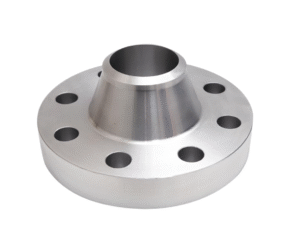
The tapered hub is an important feature. It provides a gradual change in section between the pipe and the flange, helping reduce local stress concentration compared with an abrupt geometric transition. Its performance still depends on the complete piping design, including material properties, weld quality, loading conditions, and installation.
Weld Neck Flange Features
Three features are particularly important:
- Tapered hub: Provides a gradual transition between the pipe and flange body.
- Butt-weld connection: Allows the flange to be joined to the pipe using a qualified welding procedure.
- Standardized flange face and bolt pattern: Allows compatible equipment, valves, and piping components to be connected.
Weld neck flanges are commonly specified for process piping, oil and gas facilities, power plants, chemical plants, and other industrial systems. They are particularly useful when the piping design requires a butt-welded connection and a flange manufactured to a recognized dimensional standard.
Weld Neck Flange Dimensions
Weld neck flange dimensions depend on the nominal pipe size (NPS), pressure class, applicable standard, and flange configuration.
Class 150 Weld Neck Flange Dimensions
| NPS | DN (approx.) | Pipe OD (mm) | Flange OD (mm) | Bolt Circle (mm) | No. of Bolts | Flange Thickness (mm) |
| 1/2″ | 15 | 21.3 | 89 | 60.3 | 4 | 11.2 |
| 3/4″ | 20 | 26.7 | 98 | 69.9 | 4 | 12.7 |
| 1″ | 25 | 33.4 | 108 | 79.4 | 4 | 14.3 |
| 1 1/4″ | 32 | 42.2 | 117 | 88.9 | 4 | 15.9 |
| 1 1/2″ | 40 | 48.3 | 127 | 98.4 | 4 | 17.5 |
| 2″ | 50 | 60.3 | 152 | 120.7 | 4 | 19.1 |
| 2 1/2″ | 65 | 73 | 178 | 139.7 | 4 | 20.7 |
| 3″ | 80 | 88.9 | 191 | 152.4 | 4 | 22.3 |
| 4″ | 100 | 114.3 | 229 | 190.5 | 8 | 22.3 |
| 5″ | 125 | 141.3 | 254 | 215.9 | 8 | 22.3 |
| 6″ | 150 | 168.3 | 279 | 241.3 | 8 | 25.4 |
| 8″ | 200 | 219.1 | 343 | 298.5 | 8 | 29 |
| 10″ | 250 | 273.1 | 406 | 362 | 12 | 30.2 |
| 12″ | 300 | 323.9 | 483 | 431.8 | 12 | 32.5 |
Reference: ASME B16.5 dimensional tables, cross-referenced with published flange dimension charts. Values are representative; confirm the exact dimensions against the applicable standard edition and flange facing before fabrication or purchase.
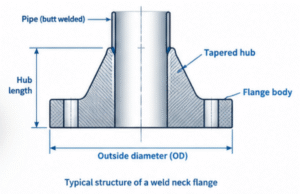
- Flange outside diameter (OD): The overall diameter of the flange body.
- Flange thickness: The thickness of the flange ring, excluding the raised face where applicable.
- Bolt circle diameter (BCD): The diameter of the circle passing through the centers of the bolt holes.
- Number of bolt holes: Determines the bolt pattern.
- Bore diameter: The internal opening through the flange and hub.Hub dimensions: The diameter and length of the tapered neck.
ASME B16.5 includes several pressure classes, commonly designated Class 150, 300, 400, 600, 900, 1500, and 2500. Not every class covers the same range of nominal pipe sizes.
To view dimension tables for various pressure ratings, please visit our Weld Neck Flange Dimensions page or contact us.
Weld Neck Flange Standards and Specifications
Weld neck flanges are governed by two types of standards: one for dimensions and the other for materials. Together, these two standards determine the performance of a weld neck flange.
ASME B16.5 Weld Neck Flange
ASME B16.5 is one of the principal standards for steel pipe flanges and flanged fittings. It covers pressure-temperature ratings, materials, dimensions, tolerances, marking, testing, and related requirements.
Under ASME B16.5, the standard covers flange sizes from NPS 1/2 through NPS 24. The pressure classes include 150, 300, 400, 600, 900, and 1500, as well as Class 2500 for the specified size range up to NPS 12.
For example, an order described as a 6-inch Class 300 weld neck flange to ASME B16.5 identifies the nominal pipe size, pressure class, flange type, and dimensional standard. The material grade must still be specified separately.
ASME B16.47 Weld Neck Flange
ASME B16.47 covers large-diameter steel flanges from NPS 26 through NPS 60. It includes Series A and Series B flanges, which have different dimensional configurations.
| NPS | Series A OD | Series B OD | Series A Bolt Circle | Series B Bolt Circle | A Bolts | B Bolts |
| 26″ | 870 | 785 | 806.4 | 744.5 | 24 | 36 |
| 30″ | 985 | 885 | 914.4 | 846.1 | 28 | 44 |
| 36″ | 1170 | 1055 | 1085.8 | 1009.6 | 32 | 44 |
| 48″ | 1510 | 1,405* | 1422.4 | 1,335.1* | 44 | 44* |
For large-diameter pipelines, the applicable series should be confirmed before ordering. A flange with the correct nominal size and pressure class may still be incompatible if its series or drilling dimensions do not match the mating equipment.
ASTM Material Standards
The following material specifications are commonly relevant to weld neck flanges.
| Material standard | Main scope | Typical selection consideration |
| ASTM A105/A105M | Carbon steel forgings for piping applications | General-purpose pressure piping |
| ASTM A350/A350M | Carbon and low-alloy steel forgings requiring notch-toughness testing | Applications with specified toughness requirements, including certain low-temperature services |
| ASTM A182/A182M | Forged or rolled alloy and stainless steel piping components | Corrosion resistance or elevated-temperature service |
| ASTM A694/A694M | Carbon and alloy steel forgings for high-pressure transmission service | Specified high-pressure pipeline components |
Weld Neck Flange Pressure Classes
Common ASME B16.5 pressure classes include:
- Class 150
- Class 300
- Class 400
- Class 600
- Class 900
- Class 1500
- Class 2500
within its specified size range
The class number is not the actual maximum allowable working pressure in psi. A Class 150 flange does not simply have a maximum working pressure of 150 psi, and a Class 300 flange does not automatically have a maximum working pressure of 300 psi. For detailed pressure data tables, please refer to our Weld Neck Flange Pressure page.
Weld Neck Flange Pressure Classes
Step 1: Confirm the nominal pipe size
Identify the pipe size in NPS or DN. Remember that NPS is a nominal designation, not a direct measurement of the pipe’s outside diameter.
Step 2: Specify the pressure class
Identify the required class, such as Class 150, 300, or 600, based on the design conditions and applicable pressure-temperature ratings.
Step 3: Match the bore and welding end
The flange bore and welding-end preparation must be compatible with the pipe and the approved welding procedure.
A mismatch in wall thickness or bore geometry can create internal steps or welding difficulties. Where the pipe and flange have different wall thicknesses, the design and welding procedure determine whether end preparation or a transition is required.
Step 4: Confirm the material grade
Specify the complete material designation, such as ASTM A105 or ASTM A182 F316, together with any additional requirements for impact testing, heat treatment, or material traceability.
Step 5: Check the mating flange and documentation
Before finalizing an order, verify the standard, size, class, material, facing, bore, bolt-hole arrangement, and any required inspection or documentation.
A practical purchase description could be:
Example: NPS 6, Class 300, weld neck flange, ASME B16.5, ASTM A105, raised face, bore to suit the specified pipe schedule.