



ASME B1.20.1 (NPT) is a widely used standard for pipe threads in industrial piping connections; it primarily specifies thread dimensions and thread forms. The version listed on the official ASME website as B1.20.1-2013 (R2018) remains the current, valid edition. The scope of this standard extends beyond just NPT to include other thread types such as NPSC, NPTR, NPSM, and NPSL. This discussion focuses on NPT, which defines critical thread parameters such as the thread angle, taper, and taper ratio. In industrial piping systems, steel pipes must meet basic requirements regarding outside diameter, wall thickness, material, and length; however, the method of connecting pipe ends also directly impacts installation efficiency, sealing performance, and maintenance costs for the entire system. The parameters and dimensions of ASME B1.20.1 (NPT) are detailed below.
What is ASME B1.20.1 (NPT)
ASME B1.20.1 is a pipe thread standard established by the American Society of Mechanical Engineers (ASME); its official title is “Pipe Threads, General Purpose, Inch.” It primarily specifies the dimensions, forms, series, and designation methods for general-purpose inch-series pipe threads. The most common thread type within this standard is NPT—the American National Standard Taper Pipe Thread.
Key Parameters of ASME B1.20.1 (NPT)
60° Thread Profile Angle
NPT features a 60° thread angle. This is the key parameter distinguishing NPT threads from other thread types. The thread angles for various thread types are listed below for reference.
| Thread Type | Typical Thread Angle |
| NPT | 60° |
| BSPT | 55° |
| BSPP | 55° |
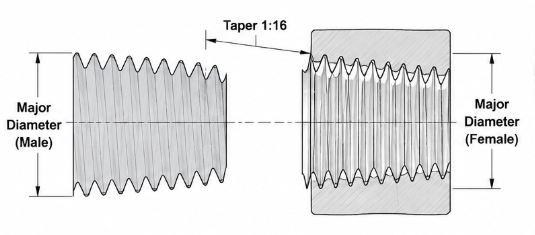
NPT Taper: 1:16
Taper is a critical parameter for threads; specifically, the ASME B1.20.1 (NPT) standard specifies a taper ratio of 1:16, meaning the thread diameter changes by approximately one unit for every 16 units of axial length. In Imperial units, this equates to a diameter change of approximately 3/4 inch over a length of 12 inches.
This taper causes the external and internal threads to gradually create an interference fit as they are screwed together. Compared to standard parallel threads, this NPT geometry provides superior mechanical locking at the connection and, when used with a sealant, ensures a leak-tight seal for the piping system.
NPT Taper: 1:16
TPI stands for “Threads Per Inch”—the number of thread turns per inch of length. The table below lists reference data sourced from standard documents, which can be used with confidence.
| NPT Nominal Size | TPI | Approximate Theoretical Pitch |
| 1/16″ | 27 | 0.941 mm |
| 1/8″ | 27 | 0.941 mm |
| 1/4″ | 18 | 1.411 mm |
| 3/8″ | 18 | 1.411 mm |
| 1/2″ | 14 | 1.814 mm |
| 3/4″ | 14 | 1.814 mm |
| 1 | 11.5 | 2.209 mm |
| 1-1/4″ | 11.5 | 2.209 mm |
| 1-1/2″ | 11.5 | 2.209 mm |
| 2″ | 8 | 3.175 mm |
| 2-1/2″ | 8 | 3.175 mm |
| 3″ | 8 | 3.175 mm |
| 4 | 8 | 3.175 mm |
NPS and Actual Steel Pipe Outside Diameter
Designations such as “1 inch” or “2 inch” in NPT do not mean that the thread’s outside diameter is exactly 1 inch or 2 inches.
For example, for a pipe with 2 NPT threads, the nominal pipe size is NPS 2, but the actual outside diameter of the steel pipe is 2.375 inches (60.3 mm). NPT nominal size is not equal to the actual pipe outside diameter. Below are some typical dimensional data:
| NPS | Pipe OD |
| 1/2″ | 0.840″ |
| 3/4″ | 1.050″ |
| 1 | 1.315″ |
| 1-1/4″ | 1.660″ |
| 1-1/2″ | 1.900″ |
| 2″ | 2.375″ |
| 2-1/2″ | 2.875″ |
| 3“ | 3.500″ |
| 4“ | 4.500″ |
| 6“ | 6.625″ |
Under ASME B1.20.1, the process does not begin by taking a “2-inch steel pipe” and machining threads onto it; instead, the NPS (Nominal Pipe Size) is determined first, and that NPS corresponds to a specific, fixed set of thread geometric parameters.
Major Diameter、Pitch Diameter、Minor Diameter
Major Diameter
The maximum diameter formed by the crests of an external thread.
Pitch Diameter
This is one of the most critical dimensions for thread fit; it determines the geometric engagement between the male and female threads.
Minor Diameter
The diameter corresponding to the roots of an external thread. This parameter is particularly important for steel pipes.
This is because a deeper thread does not necessarily result in a better connection.
If the pipe wall is thin, excessively deep threading can further reduce the effective metal cross-sectional area at the pipe end.
Detailed dimension table for threaded pipes
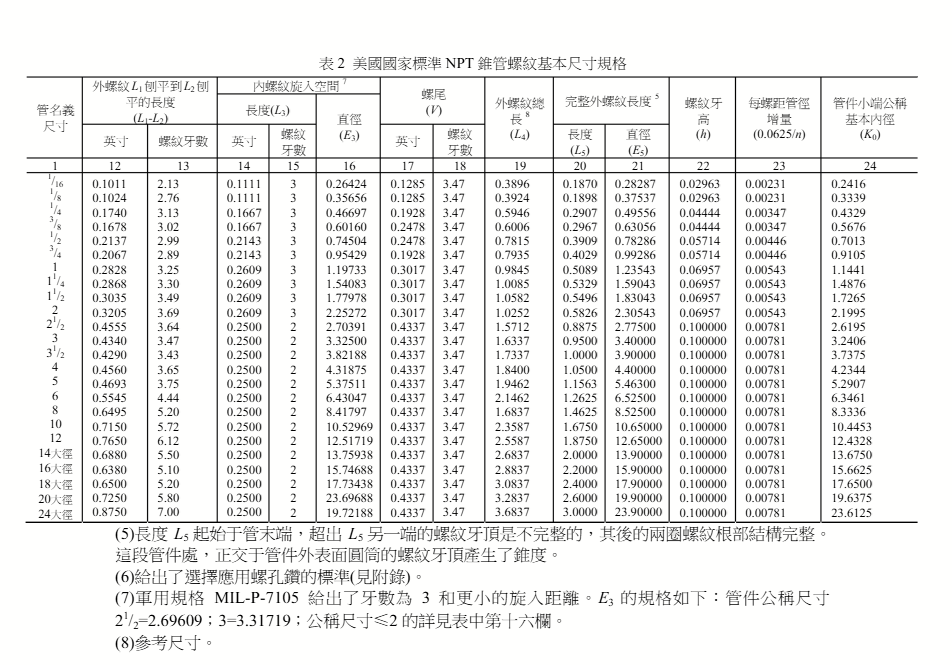
The information in the table is derived from the standard document; in the event of any discrepancy, the standard document shall prevail. Please contact us if you have any requirements for pipe procurement.