


A Pipe Pile is a deep foundation element made of steel pipe. Its primary function is to transfer loads from superstructures such as buildings, bridges, piers, wharves, and offshore platforms into deeper soil layers or rock strata with sufficient bearing capacity. Pipe Piles are commonly used where near-surface soils are too weak to safely support the structural loads.
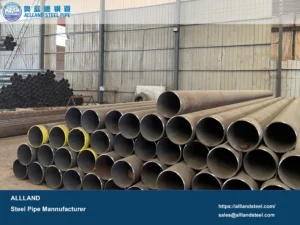
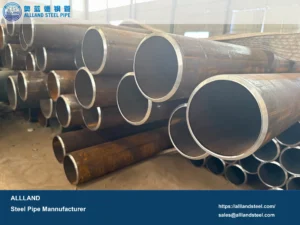
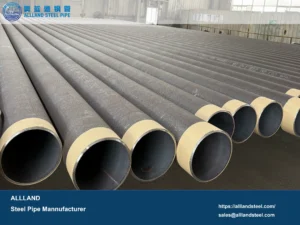
A Pipe Pile is typically a cylindrical welded or seamless steel pipe. Depending on the foundation design, the steel pipe itself can serve as a permanent load-bearing structural member, or it can be used as a permanent casing/shell for a cast-in-place concrete pile.
A Pipe Pile differs fundamentally from a conventional steel pipe. It is not intended for fluid transportation. Instead, it is engineered and installed as a deep foundation element to transfer structural loads into the ground.
Pipe Pile as a Deep Foundation Element
A Pipe Pile is classified as a deep foundation element because it transfers structural loads below the near-surface soil layers.
Deep foundations are commonly considered when shallow foundations cannot safely or economically support the required loads because of:
- Low near-surface soil strength
- High compressibility
- Excessive settlement risk
- Weak or loose surface soils
- Heavy structural loads
- Significant lateral loads
- Difficult groundwater conditions
- Scour in marine or river environments
Instead of relying primarily on the bearing capacity of shallow soil, a Pipe Pile extends deeper into the ground to mobilize resistance from stronger soil or rock.
If the surface of a foundation is a ground surface, soft clay, loose sand, dense sand, weathered rock, etc., the pipe pile may be driven through these layers and embedded into the dense sand or rock.
Pipe Pile Dimensions and Structural Properties
The dimensions of a pipe pile not only determine the weight and material usage of the steel pipe itself, but also directly affect its axial load-bearing capacity, bending resistance, stiffness, stability, and construction performance.
When selecting a pipe pile, the most important dimensional parameters typically include:
- Outside Diameter (OD)
- Wall Thickness (WT)
- Length
- Inside Diameter (ID)
- Cross-Sectional Area
- Moment of Inertia
- Section Modulus
- Weight per Meter
Pipe Pile Dimension Reference Table. Weights are theoretical values, calculated based on a steel density of approximately 7,850 kg/m³. W = 0.02466(OD−t)t
| Outside Diameter (mm) | Wall Thickness (mm) | Inside Diameter (mm) | Weight (kg/m) |
| 406 | 8 | 390 | 78.3 |
| 406 | 10 | 386 | 97.7 |
| 406 | 12 | 382 | 116.9 |
| 508 | 10 | 488 | 123 |
| 508 | 12 | 484 | 147.6 |
| 508 | 16 | 476 | 195 |
| 610 | 10 | 590 | 148.8 |
| 610 | 12 | 586 | 178.4 |
| 610 | 16 | 578 | 236.2 |
| 610 | 20 | 570 | 293 |
| 711 | 12 | 687 | 206.6 |
| 711 | 16 | 679 | 263.7 |
| 711 | 20 | 671 | 327.1 |
| 711 | 25 | 661 | 405.3 |
| 813 | 12 | 789 | 236.5 |
| 813 | 16 | 781 | 314.2 |
| 813 | 20 | 773 | 391.1 |
| 813 | 25 | 763 | 484.2 |
| 914 | 12 | 890 | 266.1 |
| 914 | 16 | 882 | 353.4 |
| 914 | 20 | 874 | 440.1 |
| 914 | 25 | 864 | 548.7 |
| 1016 | 16 | 984 | 393 |
| 1016 | 20 | 976 | 489.4 |
| 1016 | 25 | 966 | 610.3 |
| 1016 | 30 | 956 | 729.8 |
| 1220 | 16 | 1188 | 472.1 |
| 1220 | 20 | 1180 | 588.9 |
| 1220 | 25 | 1170 | 735 |
| 1220 | 30 | 1160 | 878.6 |
| 1422 | 20 | 1382 | 687.4 |
| 1422 | 25 | 1372 | 858.5 |
| 1422 | 30 | 1362 | 1028.5 |
| 1422 | 40 | 1342 | 1359.5 |
| 1524 | 20 | 1484 | 737.1 |
| 1524 | 25 | 1474 | 921.4 |
| 1524 | 30 | 1464 | 1104.4 |
| 1524 | 40 | 1444 | 1461.8 |
How are loads transferred from the structure to the pipe pile?
| parameter | The main impacts of the addition are: |
| Outside Diameter | Increased pile side contact perimeter, pile tip area, and bending performance |
| Wall Thickness | Increased steel cross-sectional area, weight, and section properties |
| Length | Increased pile-soil contact area and embedment depth |
| Cross-Sectional Area | Affected axial structural bearing capacity |
| Moment of Inertia | Affected bending stiffness |
| Section Modulus | Affected bending stress and bending moment bearing capacity |
| Weight per Meter | Affected material usage, transportation, and installation costs |
Pipe Pile as a Deep Foundation Element
A Pipe Pile is classified as a deep foundation element because it transfers structural loads below the near-surface soil layers.
Deep foundations are commonly considered when shallow foundations cannot safely or economically support the required loads because of:
- Low near-surface soil strength
- High compressibility
- Excessive settlement risk
- Weak or loose surface soils
- Heavy structural loads
- Significant lateral loads
- Difficult groundwater conditions
- Scour in marine or river environments
Instead of relying primarily on the bearing capacity of shallow soil, a Pipe Pile extends deeper into the ground to mobilize resistance from stronger soil or rock.
If the surface of a foundation is a ground surface, soft clay, loose sand, dense sand, weathered rock, etc., the pipe pile may be driven through these layers and embedded into the dense sand or rock.
How Does a Pipe Pile Work?
A Pipe Pile works by transferring loads from the supported structure into the surrounding ground through a combination of steel structural resistance and soil resistance.
The structure is: Structural Load–Pile Cap–Pipe Pile–Shaft Resistance + End Bearing–Soil/Rock.
How are loads transferred from the structure to the pipe pile?
Loads from the building or other structure are first transferred to the pile cap, which then distributes the load to one or more pipe piles. The pipe piles then transfer these loads to the surrounding soil and deeper bearing layers. In actual engineering, the load borne by each pile may differ because load distribution is also affected by the following factors:
Number of piles
- Pile spacing
- Soil conditions
- Pile stiffness
- Pile cap design
- Load application location
How do piles interact with the soil?
Once a pipe pile is installed underground, the steel pipe pile and the surrounding soil work together. The surrounding soil resists movement of the steel pipe pile. In most pipe pile projects, the pile side friction and pile end resistance share the load.
1. Shaft Resistance (Pile Side Skin Friction)
Pile side skin friction, also known as pile side friction, refers to the resistance between the outer surface of a pile and the surrounding soil.
Generally speaking:
- Longer pile → Larger contact area with the soil
- Larger pile diameter → Larger pile circumference
- Larger contact area → Greater skin friction resistance provided by the soil
2. End Bearing (Pile End Resistance)
End bearing refers to the supporting force generated between the pile tip at the bottom of the pipe pile and the underlying soil or rock layer. When the steel pipe pile reaches a relatively hard soil or rock layer, part of the structural load can be directly transferred to the underlying strata through the pile tip. The larger the diameter of the pipe pile, the larger its end area.
The pile bearing capacity in actual engineering needs to be calculated based on the specific:
- Soil layer data
- Pipe pile dimensions
- Installation conditions
- Construction method
- Design specifications
Open-Ended / Closed-Ended Pipe Pile
Open-End Pipe Pile
The bottom of the steel pipe remains open. During piling, soil may enter the steel pipe and gradually form a soil plug.
Therefore, an open-end pipe pile may simultaneously generate:
- External wall friction
- Internal wall friction
- Soil plug effect
- Pile end resistance
Open-end pipe piles are widely used in large-diameter driven pile foundation projects.
Closed-End Pipe Pile
The bottom of the steel pipe is closed, typically using:
- Steel plate
- Special pile tip
- Other designed pile end structures
for sealing.
During installation, the closed pile end directly compresses the surrounding soil, creating a larger pile end support area.
The choice between open and closed pipe piles usually requires consideration of:
- Soil conditions
- Required bearing capacity
- Pipe pile diameter
- Installation method
- Piling equipment
- Project requirements
ASTM A252 — Steel Pipe Piles
One of the most important product standards for pipe piles is ASTM A252. ASTM A252 is specifically for steel pipe piles and is applicable to:
- Welded Steel Pipe Piles
- Seamless Steel Pipe Piles
- Cylindrical Pipe Piles
- Permanent Load-Carrying Members
- Cast-in-Place Concrete Pile Shells
| Grade | Minimum Yield Strength | Minimum Tensile Strength |
| Grade 1 | 205 MPa | 330 MPa |
| Grade 2 | 240 MPa | 415 MPa |
| Grade 3 | 310 MPa | 455 MPa |
Pipe Pile dimensions determine its geometry, while structural properties such as cross-sectional area, moment of inertia, and section modulus determine how the pile responds to axial and bending loads. For product requirements, ASTM A252 is one of the key standards for steel pipe piles, while offshore projects may additionally require structural pipe specifications such as API 2B and project-specific design and fabrication requirements.