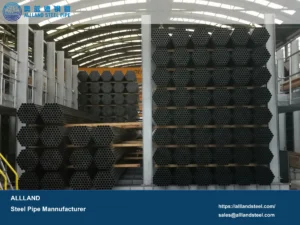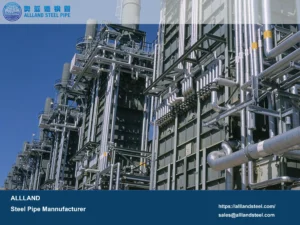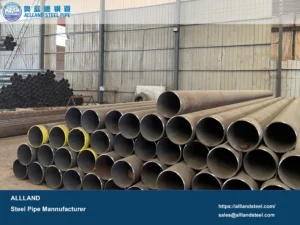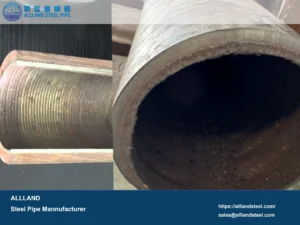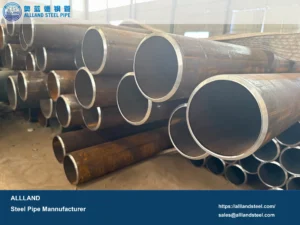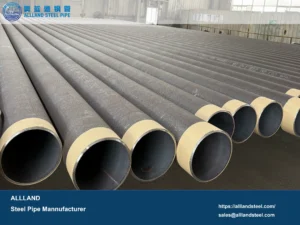

Globally, LSAW (Longitudinal Submerged Arc Welded) steel pipes are widely used in various high-demand industrial projects due to their large diameter, thick wall, high pressure resistance, and strong low-temperature corrosion resistance. LSAW welds offer excellent toughness, plasticity, uniformity, and density. According to API standards, when passing through Class 1 and Class 2 areas such as cold regions, seabeds, and densely populated urban areas, LSAW pipes are the only designated applicable pipe type.
As a professional LSAW steel pipe supplier deeply rooted in the North American market, ALLLAND is committed to providing high-quality steel pipes that meet API and ASTM standards for customers in the United States and globally. This article provides a comprehensive US market LSAW steel pipe procurement guide to help you make strategic decisions that stand the test of time amid complex technical standards and an ever-changing local supply landscape.
What is LSAW Steel Pipe?
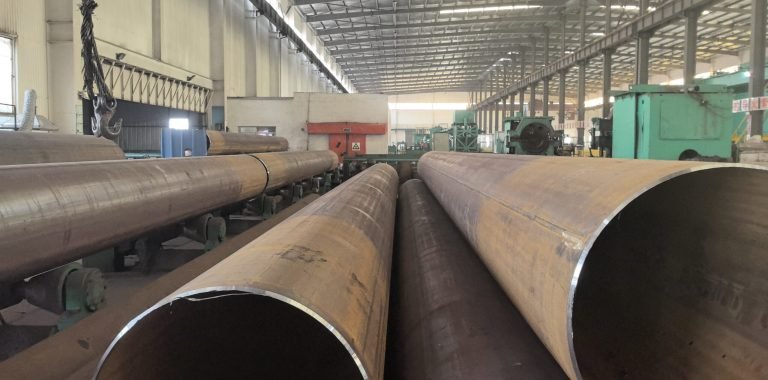
LSAW stands for Longitudinal Submerged Arc Welded steel pipe. LSAW pipes are manufactured using single medium-thick plates as raw material, with wide steel plates gradually formed into cylindrical shapes through JCOE or UOE forming machines, followed by inside and outside double-sided submerged arc welding of the longitudinal seam. Unlike SSAW, LSAW welds are straight and run along the pipe’s axial direction. In large-diameter applications exceeding 24 inches (610mm), seamless pipes cannot be produced due to limitations of piercing equipment, and LSAW technology fills this gap perfectly. Currently, interstate natural gas pipelines, deepwater platforms in the Gulf of Mexico, and LNG export terminals primarily use LSAW pipes.
Technical Parameters Overview:
- Diameter Range: 16 inches – 120 inches (406mm – 3048mm)
- Wall Thickness Range: 5mm – 100mm
- Common Steel Grades: API 5L X42-X80, ASTM A252 Grade 2/3, etc.
For a detailed product description, please click the link.
What Makes LSAW Steel Pipe Superior?
LSAW isn’t a universal solution, but for large-diameter, high-pressure, long-distance projects, it’s currently the most reliable choice. Compared to other pipe types, LSAW offers several distinct advantages.
High Weld Strength
The force direction of the weld is consistent with the axial direction of the pipe. When subjected to internal pressure and axial load, the stress distribution is better than that of spiral welds. This is the core advantage that sets LSAW apart from other pipe types.
High Dimensional Accuracy
JCOE/UOE forming processes combined with mechanical expansion ensure high levels of roundness and straightness at pipe ends. During field fit-up welding, this significantly reduces correction work and shortens construction cycles.
Corrosion Resistance
LSAW pipes themselves are carbon steel; corrosion resistance comes from surface treatment. Coatings such as FBE and 3LPE effectively resist various corrosive environments, ensuring long-term pipeline performance under harsh conditions.
Flexible Specifications
LSAW pipes can be manufactured in various specifications to meet different project requirements for size and wall thickness.
Long-Term Service
Excellent durability allows LSAW pipes to maintain good performance over extended periods, reducing maintenance costs.
Recommended LSAW Steel Pipe Manufacturers in the U.S.
There are many LSAW manufacturers in North America, such as The Shaw Group, which primarily specializes in pipeline corrosion protection and related engineering services; Mattr Corp., a Canadian manufacturer, works closely with LSAW producers to handle post-production support for steel pipe manufacturing; TMK Group: primarily focuses on oil and gas pipelines but does not offer pipeline coating services. Here, I would like to recommend a Chinese manufacturer. If you are looking to purchase LSAW steel pipes that are both manufactured and coated in a single facility, and at a price significantly lower than those of the aforementioned manufacturers, then you may want to consider ALLLAND STEEL PIPE MANUFACTURER.
ALLLAND is a professional steel pipe supplier dedicated to providing high-quality LSAW steel pipes, ERW steel pipes, seamless steel pipes, and related pipe fittings to customers worldwide. We offer customized solutions for a wide range of industrial, infrastructure, and energy projects.
If you have procurement needs for LSAW steel pipes, please provide the following information:
Diameter, wall thickness, length
Steel grade and applicable standards (e.g., API 5L PSL2 X65)
Quantity and delivery schedule
Special requirements (coating, third-party inspection, etc.)
To request a quote: Contact our technical team or submit an inquiry form via our official website. We promise to respond within 24 hours.
ALLLAND Explains How to Choose an LSAW Steel Pipe Supplier
Selecting an LSAW supplier isn’t about comparing prices—it’s about evaluating who can provide reliable guarantees for your project. Choosing the right LSAW steel pipe supplier is crucial for project success. The following checklist, compiled from industry practice, can serve as an evaluation framework.
Qualification Verification (First Line of Defense)
API Monogram Verification: Visit the API official online database, enter the supplier’s certificate number, confirm the status is “Active,” and verify that the certification scope covers your required dimensions, steel grades, and standards.
ISO 9001 Certification: Confirm the quality management system is valid and within the expiration date.
Industry-Specific Certifications: Such as DNV (marine), ABS (offshore engineering), CWB (Canadian Welding Bureau), etc., verify according to project requirements.
Quality Control System Evaluation
Nondestructive Testing Protocol: Do they perform 100% ultrasonic testing and 100% X-ray inspection covering the entire longitudinal weld? Never accept sampling inspection.
Hydrostatic Testing: Is every pipe hydrostatically tested? Does the test pressure meet API 5L or ASTM standard requirements?
Third-Party Inspection: Do they accept independent third-party factory inspections by SGS, BV, Lloyd’s Register, etc.? Refusal or high fees are red flags.
Material Test Certificate Review: Request EN 10204 Type 3.1 certificates. Verify: Can heat numbers be traced back to the steel plate? Are chemical composition and mechanical property data complete and compliant with standards? Are there clear nondestructive testing and hydrostatic test results?
Raw Material Traceability
Technical and Service CapabilitiesSteel Plate Source: Do they use first-grade plates from well-known steel mills? Avoid unidentified “secondary plates.”
Material Certificates: Do the steel plates have independent material certificates? Can they be traced back to the steelmaking heat number?
Technical and Service Capabilities
Technical Support: Do they provide welding procedure specifications, construction technical guidance, and on-site problem response?
Coating Services: Do they offer FBE, 3LPE, concrete weight coating, etc.? This reduces the hassle of multi-party management for buyers.
Delivery Capability: What is the monthly production capacity? Can they meet your project’s critical path schedule requirements?
After-Sales Service: What is their response and handling mechanism for quality issues?
Comprehensive Price and Terms Analysis
Total Cost of Ownership: Consider not just the FOB unit price, but also freight, tariffs, insurance, customs clearance, inland transportation, etc.
Payment Terms: 20-30% advance payment with balance payable against letter of credit or third-party inspection certification is the industry norm. Requiring 100% advance payment is a high-risk signal.
Beware of Ultra-Low Prices: Quotes more than 25% below market average often indicate use of inferior steel, skipped necessary inspections, or falsified test reports.
Trade Terms: CIF provides a definite cost budget, while FOB requires the buyer to bear the risk of the highly fluctuating shipping costs.
Conclusion
LSAW steel pipes play a crucial role in many high-pressure, corrosion-resistant applications, making supplier selection critically important. By collaborating with experienced and high-quality-certified suppliers, you can ensure that your infrastructure projects have a longer lifespan and higher safety standards, whether it is for oil and gas pipelines, construction projects, or other critical applications.