


This article introduces the key parameters and applications of threaded pipe in accordance with ASME B1.20.1. ASME B1.20.1 is one of the most widely used standards for pipe threads in the United States. Other commonly referenced pipe thread standards include ISO 7-1 / ISO 7-2 — BSPT Pipe Threads, widely used in Europe and Asia; ISO 228-1 — BSPP Parallel Pipe Threads; and API 5B — Oil Country Tubular Goods (OCTG) Threads, primarily used for oilfield casing and tubing applications.
These are among the major pipe thread standards used in the steel pipe industry. In the following sections, we will take a closer look at Threaded Pipe ASME B1.20.1 (NPT), including its thread specifications, dimensions, connection methods, and typical applications.
Definition of Threaded Pipe NPT
Threaded Pipe generally refers to pipes with threads machined on one or both ends. In a complete threaded piping system, the pipe is used together with threaded fittings, valves, and couplings to form a mechanical connection.
A typical threaded pipe assembly consists of four key elements:
- Pipe body
- Threaded end
- Threaded connection
- Matching coupling
ASME B1.20.1 – Pipe Threads, General Purpose (Inch) is a standard published by the American Society of Mechanical Engineers (ASME). It specifies the dimensions and gaging requirements for general-purpose inch pipe threads, including NPT and other thread forms covered by the standard.
The following sections will examine Threaded Pipe ASME B1.20.1 (NPT) from the perspectives of thread dimensions, product specifications, connection requirements, and applications. If you have any questions about threaded steel pipe, please contact ALLLAND Manufacturer.
When purchasing threaded steel pipe, it is important to distinguish between the pipe product standard and the thread standard. They are not the same thing.
For example, a complete product specification may be written as:
ASTM A53 Grade B + 2″ NPS + Schedule 40 + NPT Thread
The thread should also be further confirmed according to the applicable thread standard, dimensions, gaging requirements, and machining requirements. This ensures that the threaded pipe can properly match the intended couplings, fittings, valves, or equipment connections.
NPT Threaded Pipe
Threaded pipe can be machined with threads on one end or both ends. Threads can be either internal (female) or external (male). However, for the pipe body itself, external threads are more commonly machined at the pipe ends for connection with couplings, fittings, valves, or equipment with matching internal threads.
A threaded connection is not considered acceptable simply because the pipe can be screwed into the fitting. The finished thread should also be inspected for proper fit, engagement, sealing performance, and thread depth. Excessive or insufficient engagement may affect connection integrity and sealing performance.
The following are some key requirements and dimensions for ASME B1.20.1 (NPT) threads:
- NPT threads use a 60° thread angle.
- The taper is 1:16, meaning the diameter changes by 1 unit for every 16 units of thread length.
- The taper is approximately 3/4 inch per foot.
- ASME B1.20.1 covers nominal thread sizes from 1/16 inch to 24 inches.
Threads Per Inch(TPI)
The tabulated data are sourced from ASME B1.20.1. Click the link below to refer to the official standard and verify the applicable requirements.
| NPT Size | Typical TPI |
| 1/8″ | 27 |
| 1/4″ | 18 |
| 3/8″ | 18 |
| 1/2″ | 14 |
| 3/4″ | 14 |
| 1″ | 11.5 |
| 1-1/4″ | 11.5 |
| 1-1/2″ | 11.5 |
| 2″ | 8 |
| 2-1/2″ | 8 |
| 3″ | 8 |
| 4″ | 8 |
| 5″ | 8 |
| 6″ | 8 |
Note: The TPI values shown here are typical NPT thread parameters. For actual product specifications, the applicable edition of ASME B1.20.1 should be used as the authoritative reference.
The thread pitch can be calculated using the following formula:
Pitch = 25.4 / TPI
Where:
- Pitch = thread pitch, in mm
- TPI = threads per inch (threads/in.)
Threaded Pipe Inspection
Pipe Inspection
The main inspection items include:
- Outside Diameter (OD) and Wall Thickness (WT): Verify that the pipe dimensions comply with the order and applicable standard.
- Length: Check whether the pipe meets the specified fixed or random length requirements.
- Surface Quality: Inspect for cracks, laminations, deep dents, scratches, corrosion, and other defects that may affect service performance.
- Straightness and End Condition: Check the overall straightness of the pipe and ensure that the pipe ends are suitable for subsequent threading.
- Material and Grade: Verify the steel grade, heat number, and relevant material documentation against the purchase requirements.
- Weld Quality: For welded pipes such as ERW pipe, inspect the weld and heat-affected areas according to the applicable pipe product standard.
- Galvanizing or Coating Quality: For galvanized or coated threaded pipe, check coating uniformity, adhesion, and surface integrity where applicable.
Threaded Pipe ASME B1.20.1 (NPT) Inspection
A high-quality thread should have continuous and complete thread profiles, without obvious defects such as missing threads, damaged threads, flattened threads, burrs, tearing, or other machining irregularities.
During threaded assembly, the connection should not be too loose or too tight. It should provide sufficient thread engagement without inadequate engagement, excessive assembly resistance, or other conditions that could make installation difficult or increase the risk of leakage.
At ALLLAND Steel Pipe Factory, threaded pipes undergo dedicated thread inspections. In addition to conventional inspection methods such as caliper measurements and outside-diameter checks, we also use thread gauges to verify thread conformity.
The main gauges include:
- L1 Plug Gauge — used to inspect internal threads
- L1 Ring Gauge — used to inspect external threads
Thread-gauge inspection provides a more reliable method for verifying NPT thread dimensions and fit, helping improve the consistency and acceptance rate of threaded pipe products. This provides greater confidence for both buyers and suppliers in the quality and interchangeability of the finished threaded pipe.
Types of Threaded Steel Pipe- ASME B1.20.1 (NPT)
1. One-End Threaded Pipe
One-End Threaded Pipe refers to a steel pipe with threads machined on only one end, while the other end remains plain or is finished according to the customer’s requirements.
Basic structure:
Plain End → Steel Pipe → Threaded End
Example:
ASTM A53 Grade B, 2″ NPS, SCH 40, One-End NPT Threaded
The main advantage of this configuration is that one end is ready for threaded connection, while the other end remains available for further processing or connection.
2. Both-End Threaded Pipe
Both-End Threaded Pipe refers to a steel pipe with threads machined on both ends.
Basic structure:
Threaded End → Steel Pipe → Threaded End
This is one of the most common configurations of threaded steel pipe.
Example:
2″ ASTM A53 Grade B SCH 40 NPT Threaded Both Ends
This type of threaded pipe generally requires no additional threading work on site, which can accelerate installation and improve the overall efficiency of piping projects.
3. Threaded and Coupled Pipe
Threaded and Coupled Pipe is an important type of threaded steel pipe. It consists of a steel pipe with external threads machined on both ends and a female threaded coupling supplied with the pipe.
Why Is a Coupling Required?
Two steel pipes with external threads cannot be directly connected to each other. A female threaded coupling is therefore required to connect the two pipes.
This combination is convenient for field installation and generally requires no additional pipe-end processing. It also facilitates disassembly and is particularly suitable for modular installation and standardized construction.
4. Galvanized Threaded Steel Pipe
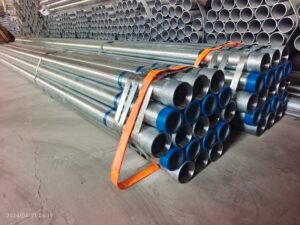
Galvanized Threaded Steel Pipe is steel pipe coated with a layer of zinc to improve corrosion resistance.
A common configuration is:
Galvanized Steel Pipe + Threaded Ends
Compared with ordinary black steel pipe, the galvanized coating provides additional corrosion protection, making it suitable for general atmospheric environments and applications where improved corrosion resistance is required.
One important consideration for galvanized threaded pipe is that the zinc coating increases the surface thickness of the pipe. If the coating and threading processes are not properly controlled, the increased surface thickness may affect thread fit, connection integrity, and sealing performance.
Applications of NPT Threaded Steel Pipe
1. Piping Systems Requiring Maintenance
In piping systems that require frequent maintenance, repair, or temporary disassembly, ASME B1.20.1 (NPT) Threaded Steel Pipe provides a convenient mechanical connection method. Unlike welded pipe connections, threaded connections can be assembled and disassembled without cutting the pipe and performing additional welding work.
2. Modular Piping Systems
NPT threaded steel pipe is well suited for modular and standardized piping assembly. This connection method can reduce the amount of field welding required and allows piping components to be prefabricated and assembled in advance.
For modular piping systems, consistent NPT thread dimensions are essential. Using NPT threads manufactured in accordance with ASME B1.20.1 provides a standardized basis for thread compatibility between steel pipes and matching NPT couplings, fittings, and valves. ASME B1.20.1 establishes the applicable dimensional and gaging requirements for NPT and other covered pipe threads.
3. Equipment Connections
NPT threaded steel pipe is also commonly used for connections between piping and equipment.
Typical configuration:
Equipment → NPT Female Port → NPT Male Threaded Pipe
Typical applications include:
- Pumps
- Compressors
- Instruments
- Valves
- Mechanical equipment
- Auxiliary equipment
For equipment that requires regular inspection, maintenance, or replacement, ASME B1.20.1 (NPT) Threaded Steel Pipe can provide a convenient and removable connection method.