
Welcome to ALLLAND Steel Pipe Co., Ltd.
ALLLAND Steel Pipe Supply
Welcome to ALLLAND Steel Pipe Manufacturing.ASTM A333 Grade 6 is a low-temperature carbon steel pipe designed for service conditions down to -45°C to -50°C, ensuring excellent impact toughness in cryogenic environments.It is widely used in LNG, petrochemical, and oil & gas pipeline systems where safety and fracture resistance are critical.
Alllandsteel is a steel pipe manufacturer based in China with 25 years of experience.
The facility spans 22,000 square meters, represents a RMB 700 million investment, and operates four production lines (JCOE, ERW, SMLS, SSAW) alongside five coating lines.
With an annual production capacity of 250,000 tons, the factory covers specifications ranging from Ø406 to Ø1524 and holds multiple international certifications (API/ASTM/EN/ISO/JIS). Focused on steel pipes, creating value for you!
HOT PRODUCTS
POPULAR ARTICLES
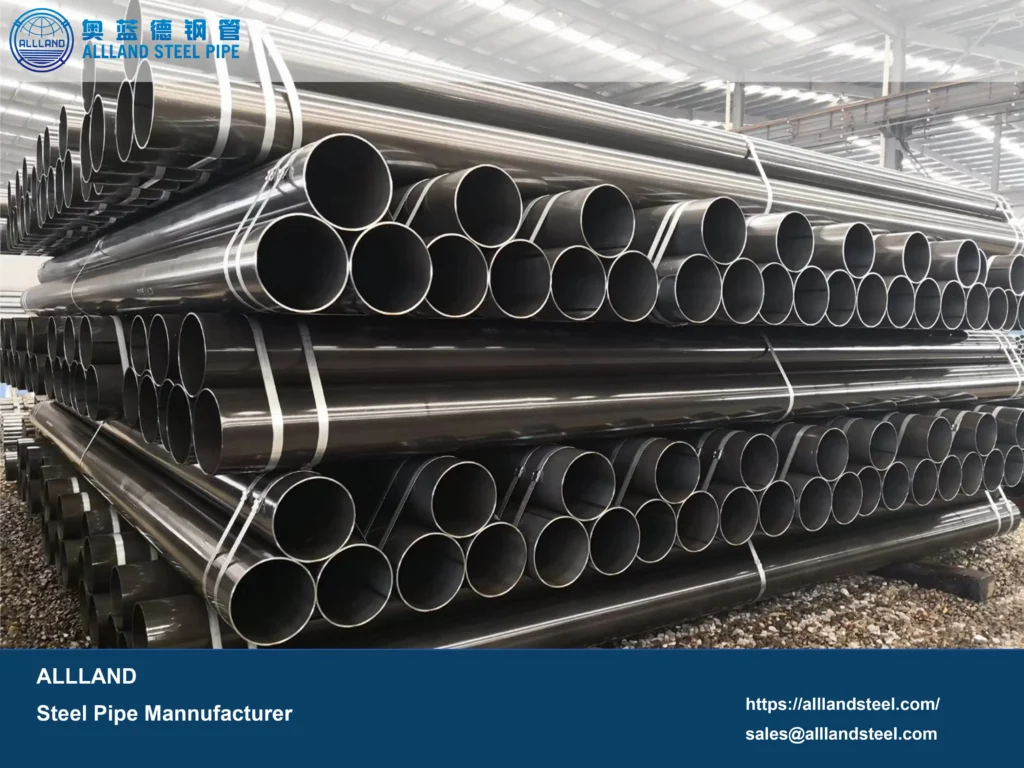
ASTM A333 Grade 6 is a standard material for seamless and welded carbon steel pipes specifically designed for low-temperature applications. It is widely used in oil, natural gas, and low-temperature industrial piping systems.
ASTM A333 Gr. 6 is classified as low-temperature carbon steel. Its key characteristic is that it maintains good toughness and impact resistance even in low-temperature environments (as measured by the Charpy V-notch impact test).
O.D.:
1/8” to 48”+ (DN6 to DN1200+)
Manufacturing:
Seamless / Welded
W.T.:
SCH 10 to SCH XXS
Custom thickness available for project requirements.
Length:
5.8m / 6m / 11.8m / 12m
SRL / DRL / Random length
Application class:
Cryogenic service
Material type:
Low temperature carbon steel
Tube Ends& Surface Treatment:
Square, Chamfered; Black Skin, Pickled, Painted/Oiled for Rust Prevention
| NPS (inch) | OD (mm) | SCH 10 | SCH 20 | SCH 40 | SCH 80 | SCH 160 | XXS |
| 1/8″ | 10.3 | 1.24 | 1.73 | 2.41 | 3.18 | 3.73 | 4.78 |
| 1/4″ | 13.7 | 1.65 | 2.24 | 3.02 | 3.56 | 4.78 | 7.14 |
| 3/8″ | 17.1 | 1.65 | 2.31 | 3.20 | 3.91 | 5.16 | 7.47 |
| 1/2″ | 21.3 | 2.11 | 2.77 | 3.73 | 4.78 | 7.47 | 9.53 |
| 3/4″ | 26.7 | 2.11 | 2.87 | 3.91 | 5.56 | 7.82 | 11.13 |
| 1″ | 33.4 | 2.77 | 3.38 | 4.55 | 6.35 | 9.09 | 12.70 |
| 1 1/4″ | 42.2 | 2.77 | 3.56 | 4.85 | 6.35 | 9.70 | 14.27 |
| 1 1/2″ | 48.3 | 2.77 | 3.68 | 5.08 | 7.14 | 10.15 | 15.09 |
| 2″ | 60.3 | 2.77 | 3.91 | 5.54 | 8.74 | 11.07 | 17.12 |
| 2 1/2″ | 73.0 | 3.05 | 5.16 | 7.01 | 9.53 | 14.02 | 20.62 |
| 3″ | 88.9 | 3.05 | 5.49 | 7.62 | 11.13 | 15.24 | 22.23 |
| 4″ | 114.3 | 3.05 | 6.02 | 8.56 | 13.49 | 17.12 | 22.23 |
| 6″ | 168.3 | 3.40 | 7.11 | 10.97 | 18.26 | 21.95 | 25.40 |
| 8″ | 219.1 | 3.76 | 8.18 | 12.70 | 20.62 | 22.23 | 28.58 |
| 10″ | 273.1 | 4.19 | 9.27 | 15.09 | 25.40 | 28.58 | 30.96 |
| 12″ | 323.9 | 4.57 | 10.31 | 17.48 | 28.58 | 33.32 | 33.32 |
Typical operating temperature range for ASTM A333 Grade 6:
ASTM A333 Grade 6 is a low-temperature steel, and its key distinction lies in its low-temperature impact toughness. In environments below -45°C, A333 Gr. 6 maintains high impact toughness, preventing brittle fracture; in contrast, ordinary carbon steel at room temperature experiences a significant decline in toughness at low temperatures, making it more prone to sudden fracture.
Therefore, the fundamental difference between the two lies not in strength, but in toughness and safety reliability under low-temperature conditions.
| Feature | ASTM A333 Grade 6 | ASTM A106 Grade B |
| Service Temperature | Low temperature (-45°C) | High / normal temperature |
| Main Requirement | Impact toughness (Charpy test) | Strength & pressure resistance |
| Key Risk | None in cryogenic service | Brittle fracture at low temp |
| Application | LNG / cryogenic / refinery low-temp | General industrial piping |
| Testing Requirement | Mandatory impact test | No impact test (standard cases) |
| Engineering Focus | Toughness | Strength |
In low-temperature applications, they are not interchangeable.
| Element | Content (%) | Engineering Function |
| Carbon (C) | ≤ 0.30 | Balances strength and ductility |
| Manganese (Mn) | 0.29 – 1.06 | Improves toughness and hardenability |
| Phosphorus (P) | ≤ 0.025 | Reduces brittleness |
| Sulfur (S) | ≤ 0.025 | Minimizes inclusions and cracking risk |
| Silicon (Si) | 0.10 – 0.35 | Deoxidation and steel cleanliness |
C ≤ 0.30%, low-carbon steel for low-temperature service
P & S ≤ 0.025%, lower impurities → improved low-temperature toughness
| Property | Minimum Value | Engineering Meaning |
| Tensile Strength | ≥ 415 MPa | Basic load-bearing capacity |
| Yield Strength | ≥ 240 MPa | Structural stress limit |
| Elongation | ≥ 30% | Ductility and deformation capacity |
Impact testing is not a “strength test”; it simulates sudden impact combined with low-temperature conditions to prevent “brittle fracture.”
There is no true “equivalent substitute” for A333 Grade 6, but the following can be used as a comparison:
| Standard | Equivalent Logic |
| ASTM A333 Gr.6 | Low-temperature carbon steel pipe |
| ASME SA333 Gr.6 | Same specification (ASME version) |
| EN equivalent (approx.) | EN 10216-4 low temperature steels (depends on grade) |
There is no direct substitute for ASTM A333 Grade 6 in cryogenic service without impact testing requirements.
If the pipeline operates under low-temperature or cryogenic conditions, ASTM A333 Grade 6 must be selected instead of ASTM A106 Grade B to ensure safety and compliance with engineering standards.
![发电厂[00_00_22][20260511-103234]_副本](https://alllandsteel.com/wp-content/uploads/elementor/thumbs/发电厂00_00_2220260511-103234_副本-rnms730vt3atey9nkq2lwcrknd35pbcq9ng30aeero.png)
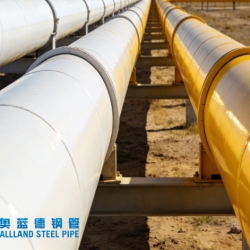
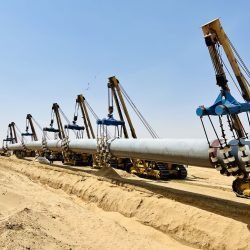
Used in LNG liquefaction, storage, and transport systems due to their high cryogenic toughness.
In LNG receiving and transport systems, pipelines operate at extremely low temperatures approaching -162°C. In cryogenic transmission and buffer sections, ASTM A333 Grade 6 steel pipes are typically selected due to their excellent Charpy impact toughness.
ALLLAND Steel Pipe supplies all ASTM A333 Grade 6 pipes required for LNG, petrochemical, and cryogenic projects, accompanied by complete Mill Test Certificates (MTCs), third-party inspections, and project-specific coating requirements.
Applicable to:
Used in cooling and separation units.
For low-temperature gas and process piping systems.
Used in auxiliary cooling and gas handling systems.
ASTM A333 Grade 6 is typically used in conjunction with compatible low-temperature components to ensure system integrity:
All components in the system must meet the same low-temperature toughness requirements to prevent single points of failure.
It is used for low-temperature and cryogenic piping systems such as LNG and petrochemical plants.
Typically -45°C to -50°C for low-temperature service.
ASME SA333 Grade 6 is identical; no direct substitute exists for cryogenic applications.
Fill in the form below and our team will be happy to assist you