Welcome to ALLLAND Steel Pipe Co., Ltd.
ALLLAND Steel Pipe Supply
Welcome to ALLLAND Steel Pipe Manufacturing. API 5CT L80 casing and tubing offer excellent mechanical properties and corrosion resistance, making them widely used in medium- and deep-well applications, sulfur-bearing gas wells, and offshore drilling projects. ALLLAND Steel Pipe’s L80 OCTG pipes are manufactured in strict compliance with the API 5CT standard. We can customize dimensions, end treatments, and heat treatments to meet project requirements, and we also provide third-party inspection services.
Alllandsteel is a steel pipe manufacturer based in China with 25 years of experience.
The facility spans 22,000 square meters, represents a RMB 700 million investment, and operates four production lines (JCOE, ERW, SMLS, SSAW) alongside five coating lines.
With an annual production capacity of 250,000 tons, the factory covers specifications ranging from Ø406 to Ø1524 and holds multiple international certifications (API/ASTM/EN/ISO/JIS). Focused on steel pipes, creating value for you!
HOT PRODUCTS
POPULAR ARTICLES
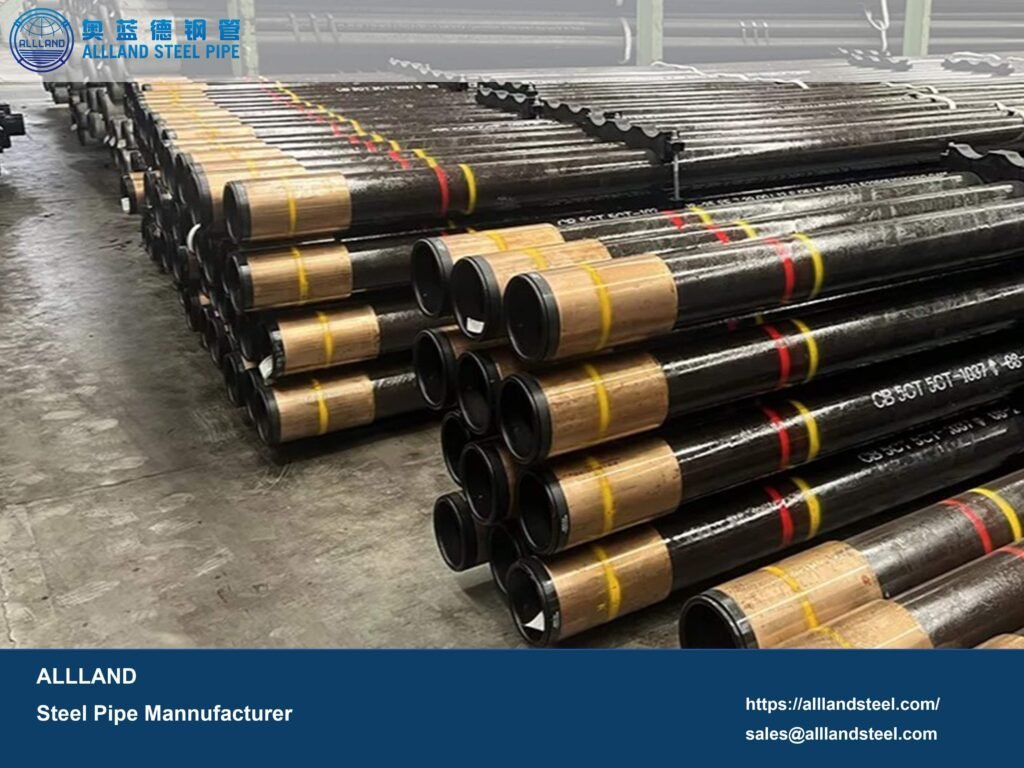
API 5CT L80 is an oil and casing standard established by the American Petroleum Institute (API) for the oil and gas industry. L80 is a commonly used alloy steel grade within the API 5CT standard, specifically designed for wells operating under moderate to high temperatures and pressures.
O.D.:
4 1/2″ – 20″
Standard:
API 5CT
W.T.:
6 mm – 50 mm
Common wall thicknesses: 0.25“ – 1.5”
Length:
9.5–12.2 m (standard)
Customizable: approx. 6–15 m
Heat Treatment:
Quenching + Tempering
Delivery Conditions:
Grade, Specification, Furnace Number, Standard
Thread Type:
· EUE (External Upset Threaded and Coupled)
· NU (Non-Upset, Coupled)
· Premium Threads (e.g., API 8RD, 10RD)
Surface Treatment:
Black Skin, Pickled, Painted/Oiled for Rust Prevention
API 5CT is the American Petroleum Institute’s technical specification for casing and tubing.
In the L80 steel grade, the “L” denotes a grade specifically designed for acidic environments.
In the API 5CT standard, the meanings of the other letters are as follows:
Grade K (e.g., K55): Ordinary carbon steel; suitability for acidic environments is not required.
Grade M (e.g., M65): Has some suitability for acidic environments.
Grade C (e.g., C95): Typically refers to high-strength steel, but is not recommended for use in acidic environments.
Strength Grade Comparison: This is the standard nomenclature used in API standards.
H40: 40,000 psi
J55, K55: 55,000 psi
L80: 80,000 psi
N80: 80,000 psi (but with different grades, heat treatments, and application environments)
To accommodate various downhole environments, L80 is primarily divided into standard carbon steel grades and chromium-containing corrosion-resistant grades.
L80-1 (Standard L80)
A standard low-alloy steel with basic strength and moderate corrosion resistance. It offers good value for money and is suitable for general oil and gas well environments.
L80-9Cr (9% Chromium L80)
Containing 9% chromium, this grade offers superior resistance to H₂S corrosion and high-temperature corrosion compared to ordinary carbon steel. However, it has specific application requirements for acidic environments (the additional requirements for PSL-2 grade in the API 5CT standard may not apply to L80-9Cr). This type is suitable for moderately corrosive environments, such as oil wells containing CO₂.
L80-13Cr (13% Chromium L80)
This is a high-alloy steel with superior corrosion resistance within the L80 series. Containing 13% chromium, it is a martensitic stainless steel primarily designed for H₂S-containing acidic wells and highly corrosive environments.
Due to its high chromium content, 13Cr effectively resists sulfide stress cracking (SSC) in H₂S environments. Compared to L80-1 and L80-9Cr, it offers similar mechanical properties but significantly improved corrosion resistance.
| L80-1(Standard L80) | |
| Elements | Content range (%) |
| C | 0.26 – 0.35 |
| Mn | 0.30 – 1.00 |
| P | ≤ 0.025 |
| S | ≤ 0.015 |
| Cr | 0.50 – 1.50 |
| Mo | 0.20 – 0.50 |
| Ni | ≤ 0.30 |
| L80-9Cr (9% chromium steel) | |
| Elements | Content range (%) |
| C | 0.26 – 0.35 |
| Mn | 0.30 – 1.00 |
| P | ≤ 0.025 |
| S | ≤ 0.015 |
| Cr | 8.50 – 10.50 |
| Mo | 0.20 – 0.50 |
| Ni | ≤ 0.30 |
| L80-13Cr (13% chromium steel) | |
| Elements | Content range (%) |
| C | 0.25 – 0.35 |
| Mn | 0.30 – 1.00 |
| P | ≤ 0.025 |
| S | ≤ 0.015 |
| Cr | 12 – 14 |
| Mo | 0.20 – 0.50 |
| Ni | ≤ 0.30 |
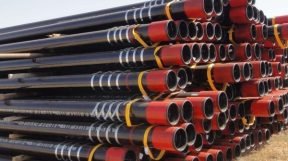
Color coding is used to quickly distinguish between different steel grades and casing/tubing specifications.
Typically, standard-color bands are painted on the pipe ends or markings are applied along the entire length of the pipe.
| Grade | Pipe Body Bands | Coupling Color |
| L80-1 (Type 1) | One red band + one brown band | Entire coupling is red with one brown band |
| L80-9Cr (9% Chromium) | One red band + one brown band + two yellow bands | No overall color requirement, but must have two yellow bands |
| L80-13Cr (13% Chromium) | One red band + one brown band + one yellow band | No overall color requirement, but must have one yellow band |
| Property | API 5CT L80 Requirement |
| Yield Strength | 552–655 MPa |
| Tensile Strength | ≥ 655 MPa |
| Elongation | ≥ 17% |
| Hardness | ≤ 23 HRC (approx. ≤ 241 HBW) |
L80 is a medium-to-high-strength OCTG steel grade that offers a balance of strength and corrosion resistance.
| Grade | Minimum Tensile Strength |
| J55 | 517 MPa |
| N80 | 689 MPa |
| L80 | 655 MPa |
| P110 | 758 MPa |
While L80 does not have the highest tensile strength, it emphasizes a balance of properties; it offers better toughness and more consistent crack resistance than P110.
For deep wells, horizontal wells, and high-temperature wells, elongation is critical. L80 typically requires an elongation of ≥17%, indicating superior ductility; it is less prone to brittle fracture during well deployment and can withstand a certain degree of deformation.
Why does L80 require heat treatment?
As mentioned earlier, API 5CT L80 is a medium-to-high-strength OCTG steel grade suitable for H₂S environments.
Its core requirement is a balance of strength, toughness, and resistance to SSC (Sulfide Stress Cracking).
Therefore, standard hot-rolling typically cannot meet the performance requirements of API 5CT L80, and Q&T (Quenched and Tempered) heat treatment must be used.
Quenching + Tempering: The most critical heat treatment process for L80.
| Process | Purpose |
| Quenching | Improve strength |
| Tempering | Improve toughness and reduce brittleness |
L80 is divided into casing and tubing; casing is used to support the wellbore, isolate the formation, and protect the wellbore, while the primary function of tubing is to transport oil and gas.
Due to its resistance to fatigue and stress-corrosion cracking (SSC), L80 offers long-term operational stability and is particularly suitable for long-term production wells.
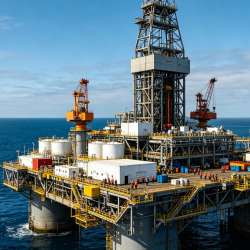
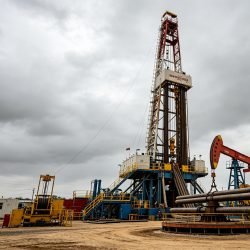
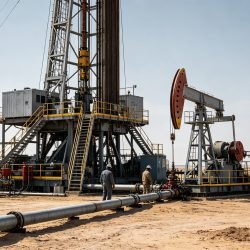
L80 is mainly used for:
J55:Lower strength, general wells
L80:Better SSC resistance and higher strength
L80 is more suitable for corrosive and high-pressure environments.
Available options include:
For more details, please feel free to contact us.
Fill in the form below and our team will be happy to assist you