Welcome to ALLLAND Steel Pipe Co., Ltd.
ALLLAND ASTM A672 Steel Pipe Supply
Welcome to ALLLAND Steel Pipe Manufacturing.ASTM A672 is a standard published by ASTM that specifies the requirements for the manufacture of electrically welded steel pipes (EFW), which are typically used in pipelines operating under low-temperature and high-pressure conditions. ASTM A672 steel pipes are suitable for use in a temperature range of -29°C to 427°C, making them ideal for applications involving extreme temperature conditions. Electrically welded steel pipes (EFW) are manufactured by using an electric current to melt the metal at both ends and fuse them together.
Alllandsteel is a steel pipe manufacturer based in China with 25 years of experience.
The facility spans 22,000 square meters, represents a RMB 700 million investment, and operates four production lines (JCOE, ERW, SMLS, SSAW) alongside five coating lines.
With an annual production capacity of 250,000 tons, the factory covers specifications ranging from Ø406 to Ø1524 and holds multiple international certifications (API/ASTM/EN/ISO/JIS). Focused on steel pipes, creating value for you!
HOT PRODUCTS
POPULAR ARTICLES
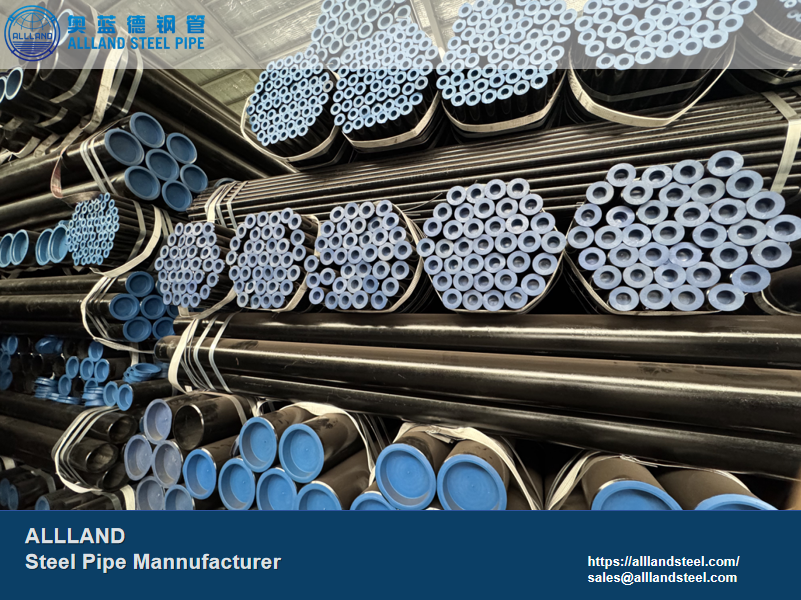
ASTM A672 is a standard for steel pipes intended for medium-temperature, high-pressure service, primarily targeting electric-fusion-welded (EFW) steel pipes. The standard specifies requirements for the pipe’s chemical composition, mechanical properties, dimensional tolerances, and end treatment. It is currently widely used in various piping systems across the oil and gas, power, and chemical industries.
O.D.:
6 inches (152.4 mm) to 60 inches (1524 mm)
W.T.:
0.375 inches (9.53 mm) to 3 inches (76.2 mm)
Length:
6 meters (20 feet) or 12 meters (40 feet).
Process:
LSAW (Longitudinal Submerged Arc Welding), EFW (Electroslag Welding), SAW (Submerged Arc Welding)
Tube Ends:
Plain ends, beveled ends, threaded ends
Surface Treatment:
Black paint/varnish, FBE (fusion-bonded epoxy), 3LPE (three-layer polyethylene), 3LPP (three-layer polypropylene), bitumen coating, hot-dip galvanizing
The ASTM A672 standard specifies clear requirements for the chemical composition, mechanical properties, and processability of the material. During production, ASTM A672 steel pipes must fully comply with these requirements and undergo rigorous testing to ensure reliable product performance.
The chemical composition of ASTM A672 refers to the required proportions of various elements when manufacturing steel pipes in accordance with the standard. The chemical composition can affect the strength and toughness of the steel pipes.
| Elements | Content Range |
| Carbon (C) | ≤0.30% |
| Manganese (Mn) | 0.60% – 1.35% |
| Silicon (Si) | 0.10% – 0.35% |
| Phosphorus (P) | ≤0.035% |
| Sulfur (S) | ≤0.035% |
| Chromium (Cr) | 0.20% – 0.50% |
| Nickel (Ni) | 0.40% – 0.90% |
| Molybdenum (Mo) | 0.15% – 0.25% |
| Vanadium (V) | 0.01% – 0.05% |
According to ALLLAND’s production data, the company implements stricter controls over chemical composition when adhering to the ASTM A672 standard, ensuring that ASTM A672 products deliver outstanding overall performance in terms of strength, toughness, and weldability, thereby meeting the stringent requirements of high-end projects in the power generation, petrochemical, and LNG sectors.
The ASTM A672 standard specifies the mechanical property requirements for electrically welded steel pipes (EFW) under low-temperature and high-pressure conditions, primarily covering tensile and impact properties. Among these, tensile properties are the core indicators for evaluating steel pipes, including yield strength, tensile strength, and elongation.
| Mechanical Properties | Grade B | Grade C | Grade D |
| Tensile Strength | ≥60,000 psi (414 MPa) | ≥65,000 psi (448 MPa) | ≥70,000 psi (483 MPa) |
| Yield Strength | ≥35,000 psi (241 MPa) | ≥40,000 psi (276 MPa) | ≥45,000 psi (310 MPa) |
| Elongation | ≥20% (2-inch specimen) | ≥20% (2-inch specimen) | ≥20% (2-inch specimen) |
| Hardness | Not exceeding 235 HB | Not exceeding 235 HB | Not exceeding 235 HB |
Impact resistance refers to a steel pipe’s ability to withstand impact at low temperatures and serves as the basis for determining whether the pipe will fracture in cold environments. ASTM A672 generally requires an impact energy of ≥27 J; for projects in cold regions (such as Northeast China, Northwest China, and Russia), pipes of Class CL32 or higher must be selected. For cryogenic projects such as LNG (-162°C), more rigorous cryogenic impact testing is required. ALLLAND’s products offer ample impact toughness reserves, capable of meeting the stringent requirements from -29°C to -196°C.
ASTM A672 steel pipes can withstand harsh operating conditions ranging from -162°C to over 600°C. They are commonly used for the long-distance transportation of fluids such as oil and natural gas, as well as for conveying gases and liquids under high-pressure conditions. In chemical plants, the unseen high-temperature, high-pressure pipelines use ASTM A672 steel pipes to transport various chemicals and corrosive fluids, preventing corrosion or leaks. Taking a real-world project as an example, the φ610×28 B65 CL22 pipeline in the Guangdong Petrochemical Integrated Refining and Petrochemical Project has been carrying hot oil at 350°C for two years and continues to operate smoothly without any leaks.
High-temperature, high-pressure steam generated by boilers in thermal power plants is transported via ASTM A672 steel pipes to steam turbines for power generation; these pipes are also used to convey cooling water, ensuring the normal operation of equipment. With excellent corrosion resistance and pressure-bearing capacity, ASTM A672 steel pipes are suitable for offshore platform and subsea pipeline construction, ensuring the long-term stability of energy transmission systems in marine environments.
In ultra-low-temperature environments, such as the transportation and storage of liquefied natural gas (LNG), liquefied petroleum gas (LPG), and other cryogenic liquids, ASTM A672 steel pipes are the preferred choice. These pipes maintain excellent impact toughness and stability in low-temperature conditions, preventing fractures caused by temperature fluctuations.
ASTM A672 steel pipes are typically used in applications that require withstanding high pressure and temperature, such as steam pipelines in power plants and oil and gas pipeline systems. The EFW welding method ensures the uniformity and integrity of the welds in high-pressure and high-temperature environments. During mass production, EFW enables rapid welding of large-diameter steel pipes while reducing manual labor and material waste.
During the EFW welding process, factors such as current, welding speed, and voltage can be precisely controlled to ensure the integrity of the weld. By automating the welding process, EFW minimizes the influence of human error, thereby effectively reducing the occurrence of welding defects. The uniformity of the weld and the overall weld quality are strictly controlled, preventing pipeline leaks or failures caused by welding defects.
Warm regions (Southern China): CL22 is optional;
Cold regions (Northeast, Northwest, Russia): CL32 or higher must be selected, and impact testing is mandatory;
LNG projects (-162°C): Cryogenic impact verification at -196°C is required.
The core difference lies in their operating temperature ranges. ASTM A671 is primarily used for electric resistance welded steel pipes in atmospheric pressure and low-temperature environments, with an operating temperature range down to -46°C. ASTM A672 is primarily used in medium-temperature, high-pressure environments, with an operating temperature range from -29°C to 427°C.
We provide comprehensive quality inspection services: Radiographic Testing (RT) ensures there are no cracks or defects inside the steel pipes; Ultrasonic Testing (UT) examines the internal structure of the steel pipes to ensure there are no porosity or inclusions; Hydrostatic Testing evaluates the sealing performance and pressure resistance of the steel pipes under high-pressure conditions; Tensile Testing and Hardness Testing verify the mechanical properties of the steel pipes to ensure compliance with the ASTM A672 standard; and Impact Testing is conducted on the steel pipes in low-temperature environments to verify their resistance to low-temperature impact.
Through these tests, we ensure that every steel pipe meets strict quality requirements and can operate reliably under extreme conditions such as high pressure and low temperatures.
Fill in the form below and our team will be happy to assist you