Welcome to ALLLAND Steel Pipe Co., Ltd.
ALLLAND ASTM A123 Steel Pipe Supply
Welcome to ALLLAND. We offer hot-dip galvanized steel pipes and various steel structural products that comply with the ASTM A123 standard. ASTM A123 is an internationally recognized galvanizing standard primarily used to specify the quality of zinc coatings on steel products, ensuring exceptional corrosion resistance and extended service life in harsh environments. ALLLAND operates a state-of-the-art galvanizing production line and maintains a rigorous quality control system, enabling us to provide zinc coatings of varying thicknesses to meet customer requirements. Our products feature a uniform surface finish with strong adhesion and comply with international testing standards.
Alllandsteel is a steel pipe manufacturer based in China with 25 years of experience.
The facility spans 22,000 square meters, represents a RMB 700 million investment, and operates four production lines (JCOE, ERW, SMLS, SSAW) alongside five coating lines.
With an annual production capacity of 250,000 tons, the factory covers specifications ranging from Ø406 to Ø1524 and holds multiple international certifications (API/ASTM/EN/ISO/JIS). Focused on steel pipes, creating value for you!
HOT PRODUCTS
POPULAR ARTICLES
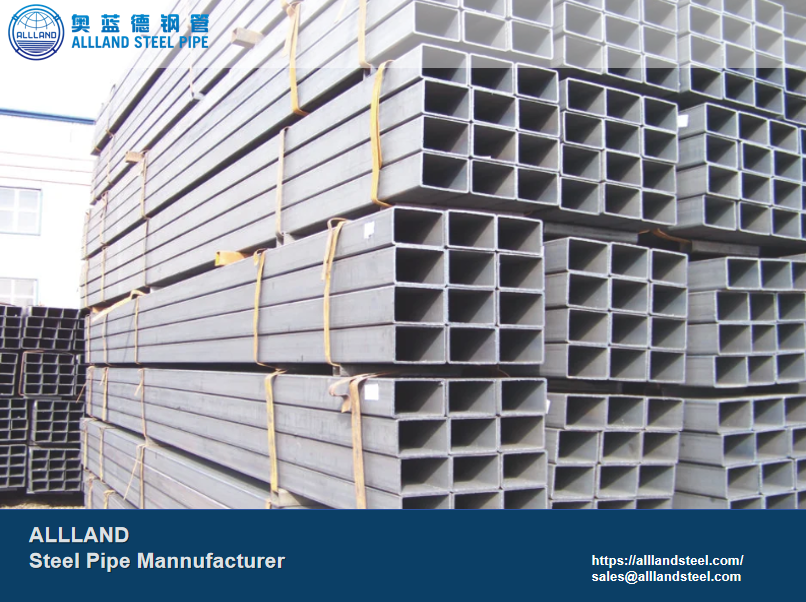
ASTM A123 is a specific standard for hot-dip galvanized coatings on steel products. It specifies the process requirements, zinc coating thickness, testing requirements, and quality control standards for hot-dip galvanized steel products. Its core objective is to ensure that a uniform and dense zinc coating forms on the surface of the steel during the hot-dip galvanizing process, resulting in excellent corrosion resistance. ALLLAND has its own hot-dip galvanizing production line, strictly adhering to the ASTM A123 standard. The zinc coating thickness is controlled between 45μm and 85μm or more depending on the steel type. Galvanized steel pipes can have a service life extended by more than 20 years in corrosive environments such as outdoors, by the sea, and in chemical plants.
Zinc coating parameters:
45 – 100+ μm
Coating weight:
1.610 – 860 g/m²
Galvanizing temperature:
approx. 450°C
Immersion time:
3 – 10 minutes
Material:
Carbon steel, low-alloy steel
standards:
ASTM A106, ASTM A53, API 5L, structural steel
The thickness of the zinc coating varies depending on the size, shape, and operating environment of the steel. Larger steel products require a thicker zinc coating to provide stronger corrosion protection. Different coating thickness grades are specified based on the material type and substrate thickness of the steel product being coated.
| Thickness Grade | μm | mils | g/m² | oz/ft² |
| 35 | 35 | 1.4 | 245 | 0.8 |
| 45 | 45 | 1.8 | 320 | 1.0 |
| 50 | 50 | 2.0 | 355 | 1.2 |
| 55 | 55 | 2.2 | 390 | 1.3 |
| 60 | 60 | 2.4 | 425 | 1.4 |
| 65 | 65 | 2.6 | 460 | 1.5 |
| 75 | 75 | 3.0 | 530 | 1.7 |
| 80 | 80 | 3.1 | 565 | 1.9 |
| 85 | 85 | 3.3 | 600 | 2.0 |
| 100 | 100 | 3.9 | 705 | 2.3 |
Selection Guide: Different usage environments have different requirements for zinc coating thickness:
For indoor use, ≥45μm; for outdoor use, ≥65μm; for more corrosive environments such as coastal industrial areas, use ≥85μm; for buried and underwater use, ≥100μm, long-term maintenance-free, one-step solution. ALLLAND can provide customized galvanizing solutions according to project requirements.
The ASTM A123 standard itself does not directly specify the tensile strength, yield strength, or other mechanical properties of steel pipes. These mechanical properties are specified by the original standards for the base steel (such as ASTM A53, ASTM A795, etc.) The galvanizing process may have some impact on the mechanical properties of the steel base material.
| Mechanical Properties | Influence |
| Tensile Strength | Tensile strength, yield strength, and ductility are slightly affected with no significant changes; toughness may decrease slightly at low temperatures; surface hardness is improved due to the zinc coating; and corrosion resistance is significantly enhanced. |
| Yield Strength | |
| Ductility | |
| Toughness | The galvanized coating may affect the impact toughness of steel at low temperatures, especially when subjected to cold impact, where the hardening of the galvanized coating may lead to increased surface brittleness. |
| Hardness | The zinc layer itself has high hardness, and the surface hardness of the steel increases after galvanizing. |
| Corrosion Resistance | Hot-dip galvanizing can significantly improve the corrosion resistance of steel, especially in seawater, chemical media or acid rain environments, providing long-term protection. |
The hot-dip galvanizing process specified in ASTM A123 is a complete production process in which steel is chemically cleaned and then immersed in molten zinc at approximately 449 °C, forming a coating through a metallurgical reaction. The entire process can be divided into five key steps:
Raw material receiving and inspection
Before galvanizing begins, the steel materials need to be visually inspected to confirm whether there is any deformation or damage during transportation or processing
Surface treatment
Any oil, rust, or scale can cause plating defects or poor adhesion. The treatment process is: alkaline washing → water washing → acid washing → water washing → flux coating.
Hot-dip galvanizing
This is the core step of the process . The temperature of the zinc bath is strictly controlled at approximately 840°F (449°C). If the steel is too large, a second immersion plating is required.
Cooling after galvanizing
Steel products are removed from the zinc pot, they need to be cooled gradually by air or water to lower their temperature. During this process, the galvanized layer gradually solidifies, forming a strong protective layer.
Inspection and Testing
Inspection includes dimensional accuracy checks, surface finish checks, zinc coating adhesion and corrosion resistance tests to ensure that steel products meet ASTM A123 standards.
Hot-dip galvanized steel is commonly used for railings and fences in bridges, overpasses, pedestrian bridges, and public areas to ensure they do not rust even after long-term exposure to rain and sunlight. One-time galvanizing eliminates the need for long-term maintenance.
Substation supports, power towers, and power transmission lines use galvanized steel pipes conforming to ASTM A123 standards. The galvanized coating is protected by sacrificial anodes, eliminating the need for regular painting and reducing maintenance costs.
In chemical plants, steel products are frequently exposed to acidic and alkaline solvents or other chemicals. Using hot-dip galvanized steel can improve its corrosion resistance and reduce the cost of equipment replacement.
ASTM A123 steel is required for greenhouse supports, irrigation systems, and other garden facilities or in humid environments to improve durability. Hot-dip galvanized steel pipes effectively improve corrosion resistance, ensuring long-term stable use.
Welding will damage the galvanized layer in the weld area, requiring post-weld recoating. It is recommended to use zinc-rich paint (zinc content ≥85%) or thermal spray zinc for repair, ensuring the repair thickness is no less than the original galvanized layer thickness. ALLLAND can provide specialized touch-up paint and application advice.
The ASTM A123 standard ensures that the hot-dip galvanized coating on the steel pipe provides excellent corrosion resistance and extends the service life of the pipe. The galvanized coating not only prevents corrosion of the steel pipe in humid, salt spray, and chemical environments, but also guarantees the long-term stability of the piping system.
White rust is zinc hydroxide that forms on the galvanized layer under humid, poorly ventilated conditions. It is a surface phenomenon and does not affect the corrosion resistance lifespan. It usually disappears naturally over time or can be prevented by applying oil or passivation treatment. ALLLAND offers passivation treatment services to reduce white rust formation.
Fill in the form below and our team will be happy to assist you