Welcome to ALLLAND Steel Pipe Co., Ltd.
ALLLAND Steel Pipe Supply
Welcome to ALLLAND. Our ASTM A106 steel pipes are widely used in high-temperature and high-pressure environments, such as oil and gas transmission, chemical plants, power boilers, and mechanical manufacturing. Manufactured in strict accordance with international standards, our products offer excellent high-temperature resistance, superior mechanical strength, and outstanding corrosion resistance, ensuring long-term, stable performance under harsh operating conditions. ALLLAND offers a wide range of specifications and provides custom processing services, including cutting, coating, anti-corrosion treatment, and end finishing, to meet the specific requirements of various projects.
Alllandsteel is a steel pipe manufacturer based in China with 25 years of experience.
The facility spans 22,000 square meters, represents a RMB 700 million investment, and operates four production lines (JCOE, ERW, SMLS, SSAW) alongside five coating lines.
With an annual production capacity of 250,000 tons, the factory covers specifications ranging from Ø406 to Ø1524 and holds multiple international certifications (API/ASTM/EN/ISO/JIS). Focused on steel pipes, creating value for you!
HOT PRODUCTS
POPULAR ARTICLES
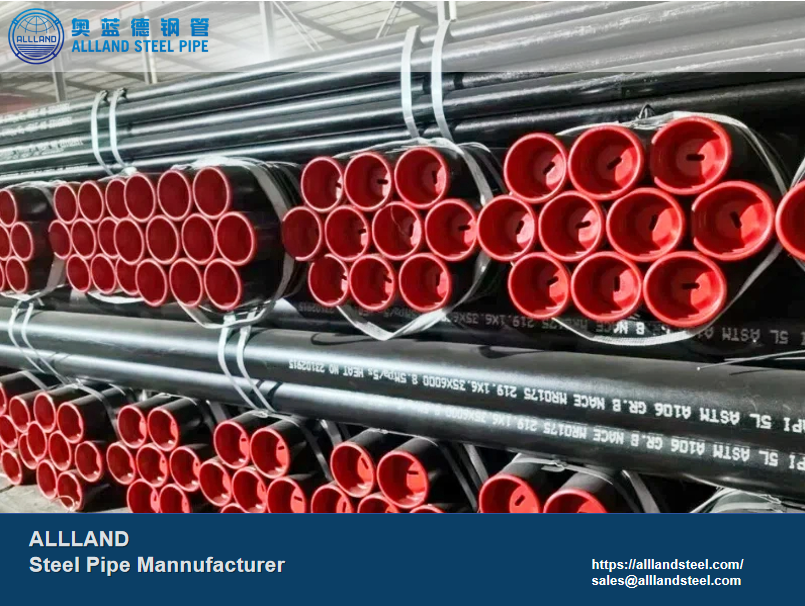
ASTM A106 is a standard published by the American Society for Testing and Materials (ASTM) regarding seamless carbon steel pipes. It specifies requirements for the dimensions, chemical composition, and mechanical properties of seamless carbon steel pipes used in high-temperature environments. The latest version of the ASTM A106 standard is ASTM A106/A106M-19a, which applies only to hot-rolled or cold-drawn seamless steel pipes and has a maximum service temperature of approximately 427°C. The three key points of ASTM A106 are: First, it is limited to seamless pipes; the absence of welds makes them more reliable for high-temperature applications. Second, Grade B is the dominant grade, accounting for over 90% of usage. Third, the silicon content is ≥0.10%; this is the most fundamental difference from ordinary steel pipes, as silicon is essential for ensuring high-temperature performance.
O.D.:
1/8 inch (3.2 mm) to 48 inches (1219.2 mm).
W.T.:
SCH 10, SCH 20, SCH 30, SCH 40, SCH 60; SCH 80, SCH 100, SCH 120, SCH 140, SCH 160; STD, XS , XXS .
Length:
6-12 m, available in fixed or multiple lengths; custom lengths per project requirements.
Process:
Hot-rolled seamless / Cold-drawn seamless; Normalized, Normalized + Tempered, Annealed
Standards:
ASTM A106 / A106M/ ASME B36.10M
Steel Grades:
Grade A, Grade B, Grade C
Tube Ends& Surface Treatment:
Square, Chamfered; Black Skin, Pickled, Painted/Oiled for Rust Prevention
Delivery Conditions:
Grade, Specification, Furnace Number, Standard
ASTM A106 seamless steel pipes use a fixed-outer-diameter and Schedule wall-thickness system, ranging from SCH 10 to SCH 160, and are suitable for a wide range of industrial piping systems, from standard to high-pressure applications.
| NPS | OD (mm) | SCH 10 | SCH 20 | SCH 40 | SCH 60 | SCH 80 | SCH 100 | SCH 120 | SCH 140 | SCH 160 |
| 1/2″ | 21.3 | 2.11 | — | 2.77 | — | 3.73 | — | — | — | 4.78 |
| 3/4″ | 26.7 | 2.11 | — | 2.87 | — | 3.91 | — | — | — | 5.56 |
| 1″ | 33.4 | 2.77 | — | 3.38 | — | 4.55 | — | — | — | 6.35 |
| 1-1/4″ | 42.2 | 2.77 | — | 3.56 | — | 4.85 | — | — | — | 6.35 |
| 1-1/2″ | 48.3 | 2.77 | — | 3.68 | — | 5.08 | — | — | — | 7.14 |
| 2″ | 60.3 | 2.77 | — | 3.91 | — | 5.54 | — | — | — | 8.74 |
| 2-1/2″ | 73 | 3.05 | — | 5.16 | — | 7.01 | — | — | — | 9.53 |
| 3″ | 88.9 | 3.05 | — | 5.49 | — | 7.62 | — | — | — | 11.13 |
| 3-1/2″ | 101.6 | 3.05 | — | 5.74 | — | 8.08 | — | — | — | — |
| 4″ | 114.3 | 3.05 | — | 6.02 | 8.56 | 8.56 | 11.13 | 13.49 | — | 13.49 |
| 5″ | 141.3 | 3.4 | — | 6.55 | 9.53 | 9.53 | 12.7 | 15.88 | — | 15.88 |
| 6″ | 168.3 | 3.4 | — | 7.11 | 10.97 | 10.97 | 14.27 | 18.26 | — | 18.26 |
| 8″ | 219.1 | 3.76 | 6.35 | 8.18 | 12.7 | 12.7 | 15.09 | 18.26 | 20.62 | 23.01 |
| 10″ | 273 | 4.19 | 6.35 | 9.27 | 12.7 | 15.09 | 18.26 | 21.44 | 25.4 | 28.58 |
| 12″ | 323.9 | 4.57 | 6.35 | 10.31 | 14.27 | 17.48 | 21.44 | 25.4 | 28.58 | 33.32 |
| 14″ | 355.6 | 6.35 | 7.92 | 11.13 | 15.09 | 19.05 | 23.83 | 27.79 | 31.75 | 35.71 |
| 16″ | 406.4 | 6.35 | 7.92 | 12.7 | 16.66 | 21.44 | 26.19 | 30.96 | 36.53 | 40.49 |
| 18″ | 457 | 6.35 | 9.53 | 14.27 | 19.05 | 23.83 | 29.36 | 34.93 | 39.67 | 45.24 |
| 20″ | 508 | 6.35 | 9.53 | 15.09 | 20.62 | 26.19 | 32.54 | 38.1 | 44.45 | 50.01 |
| 24″ | 609.6 | 6.35 | 9.53 | 17.48 | 24.61 | 30.96 | 38.89 | 46.02 | 52.37 | 59.54 |
ASTM A106 includes three steel grades: Grade A, Grade B, and Grade C. The core difference between the three grades lies in the carbon content: the higher the carbon content, the higher the strength.
Grade A: Carbon ≤0.25%, lower strength requirements, suitable for applications at temperatures below 400°F (approximately 200°C).
Grade B: Carbon ≤0.30 %, the most common steel grade, suitable for applications with temperatures up to 800°F (427°C).
Grade C: Carbon ≤0.35 %, higher strength, suitable for applications with higher temperatures and pressures, typically used in high temperature and high pressure environments.
The mechanical properties of steel pipes refer to how much force they can withstand, how long they can be stretched, and whether they are safe; these are the core aspects of steel pipe selection.
| Mechanical Properties | Grade A | Grade B | Grade C |
| Tensile strength | Minimum 40,000 psi (275 MPa) | Minimum 60,000 psi (415 MPa) | Minimum 70,000 psi (485 MPa) |
| Yield strength | Minimum 30,000 psi (205 MPa) | Minimum 35,000 psi (240 MPa) | Minimum 40,000 psi (275 MPa) |
| Elongation | Minimum 20% | Minimum 20% | Minimum 20% |
| Hardness | No explicit restrictions | No explicit restrictions | No explicit restrictions |
In addition to its strength and elongation properties, ASTM A106 also possesses high-temperature resistance. A106 maintains stable strength even at high temperatures, hence its designation as “seamless steel pipe for high-temperature applications.” The maximum service temperature of ASTM A106 is approximately 427°C (800°F), with a mandatory silicon content of ≥0.10% to ensure sufficient deoxidation, thereby improving the steel’s density and structural stability at high temperatures.
The chemical composition of a steel pipe determines its material and properties. Carbon determines strength, silicon determines high-temperature performance, and phosphorus and sulfur determine whether it will become brittle. Different grades of ASTM A106 steel have slightly different compositions, but all meet the application requirements for high-temperature, high-pressure, and corrosive environments.
| Element | Grade A | Grade B | Grade C |
| Carbon (C) | ≤ 0.25% | ≤ 0.30% | ≤ 0.30% |
| Manganese (Mn) | 0.60 – 0.90% | 0.60 – 0.90% | 0.60 – 0.90% |
| Silicon (Si) | 0.10 – 0.35% | 0.10 – 0.35% | 0.10 – 0.35% |
| Sulfur (S) | ≤ 0.05% | ≤ 0.05% | ≤ 0.05% |
| Phosphorus (P) | ≤ 0.05% | ≤ 0.05% | ≤ 0.05% |
| Copper (Cu) | ≤ 0.40% | ≤ 0.40% | ≤ 0.40% |
Notice:
ASTM A106 is used in any application requiring seamless pipes at high temperatures, such as hot oil pipelines in refineries, main steam pipelines in power plants, and urban heating networks.
S1: Product Analysis, Requires verification analysis of the chemical composition of the finished pipe.
S2: Transverse Tensile Test, Evaluates tensile properties perpendicular to the rolling direction; selected when requirements regarding material anisotropy apply.
S3: Flattening Test, Verifies the pipe material’s capacity for plastic deformation under flattening conditions.
S4: Metallographic Examination, Inspects the material’s microstructure, including aspects such as grain size and non-metallic inclusions.
S5: Charpy Impact Test, A widely used test, typically employed for low-temperature service conditions or in applications requiring specific fracture resistance properties.
S6: Grain Size Requirements, Specifies the required grain size grade of the material to ensure microstructural uniformity.
S7: Non-Destructive Testing (NDT), Requires the application of ultrasonic, eddy current, or magnetic particle inspection methods, representing a more stringent level of examination than standard routine testing.
| Comparison Items | ASTM A106 | ASTM A53 |
| Manufacturing process | Seamless | Seamless (Type S), ERW (Type E), Furnace Welded (Type F) |
| Silicon content | Mandatory ≥0.10% | No requirements |
| Maximum operating temperature | Approximately 427°C | Approximately 343°C |
| Steel grade | Levels A, B, and C | Levels A and B |
| Grade B strength | 240/415 MPa | 240/415 MPa |
Silicon is a deoxidizer that removes oxygen from molten steel, making the steel denser and more uniform. Fully deoxidized steel (killed steel) has a stable structure at high temperatures, and its strength does not decrease drastically.
Delivery time for steel pipes depends on several factors, including order specifications, quantity, manufacturing process, and manufacturer inventory. For standard ASTM A106 steel pipes, delivery time is typically 2-4 weeks. For custom-made or special-sized pipes, delivery time may extend to 6-8 weeks or longer. Furthermore, urgent orders may require expedited production, leading to price increases.
Fill in the form below and our team will be happy to assist you