Welcome to ALLLAND Steel Pipe Co., Ltd.
ALLLAND API 5CT Steel Pipe Supply
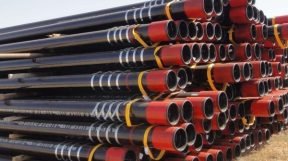
API 5CT is a standard for steel pipes published by the American Petroleum Institute (API). It specifies all technical requirements for casing and tubing and their accessories used in oil and gas wells. API 5CT covers 19 steel grades in 4 groups from H40 to Q125, and sets comprehensive requirements for chemical composition, mechanical properties, dimensional tolerances, manufacturing processes, and threads.
Leveraging resources from major domestic steel pipe manufacturers, ALLLAND can provide API 5CT steel pipes of multiple grades and offers customized processing based on customer needs. If you have specific requirements for API 5CT products, please feel free to contact ALLLAND for detailed technical solutions and quotations.
Alllandsteel is a steel pipe manufacturer based in China with 25 years of experience.
The facility spans 22,000 square meters, represents a RMB 700 million investment, and operates four production lines (JCOE, ERW, SMLS, SSAW) alongside five coating lines.
With an annual production capacity of 250,000 tons, the factory covers specifications ranging from Ø406 to Ø1524 and holds multiple international certifications (API/ASTM/EN/ISO/JIS). Focused on steel pipes, creating value for you!
HOT PRODUCTS
POPULAR ARTICLES
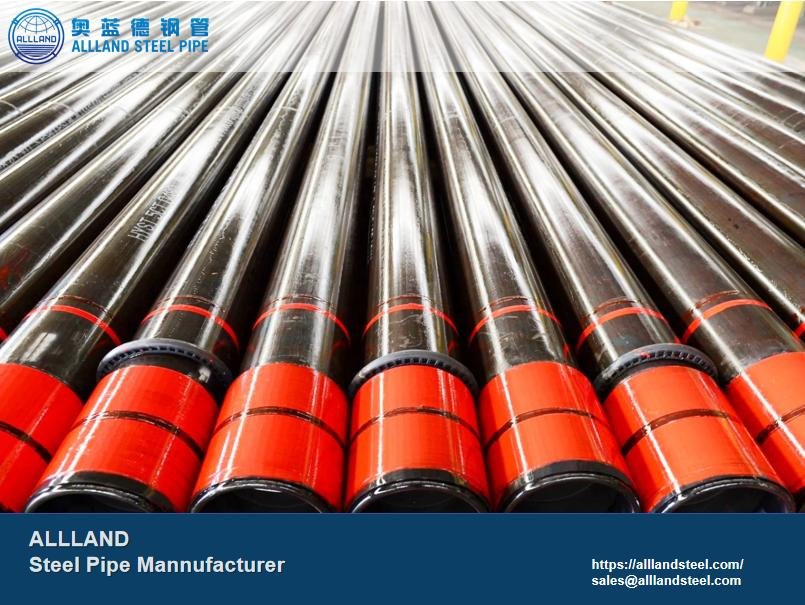
API 5CT is an important technical specification for steel pipe products used in oil and gas extraction. The API 5CT standard defines all requirements for steel pipes used in oil and gas wells—from raw materials to delivery. It ensures pipes can withstand extreme environments like high temperature and pressure, with good corrosion resistance and mechanical properties. The API 5CT standard divides steel pipes into 4 groups, containing 19 steel grades. This grouping is the core framework of the standard, specifying which strength of steel pipe should be used under different working conditions.
If you have a need for API 5CT products, please contact ALLLAND. We will provide a tailored solution based on your technical requirements.
O.D.:
2-3/8″ – 20″ (60.3mm – 508mm).
W.T.:
0.236 inches (6.0 mm) – 0.75 inches (19.05 mm).
Thread type :
STC, LTC, BTC, NU, EU.
Product types :
Casing, Tubing, Short Sections, etc.
Product identification:
Standard Mark, Manufacturer Mark, Steel Grade, Size, Furnace Number, Color Code.
Steel Grade:
H40, J55, K55, N80, L80, C90, T95, P110, Q125.
Length:
Three length specifications: R1 (4.88-7.62 m), R2 (7.62-10.36 m), and R3 (10.36-14.63 m).
Tube Ends& Surface Treatment:
Square, Chamfered; Black Skin, Pickled, Painted/Oiled for Rust Prevention.
ALLLAND has long served the steel pipe manufacturing industry, possessing a comprehensive quality management system and stable supply capabilities. Choosing ALLLAND steel pipes as your trusted partner will eliminate your worries about orders.
Flexible Supply: We can match your requirements with API 5CT casing and tubing resources from major domestic steel mills, covering steel grades such as J55, N80, L80, and P110, with a complete range of specifications.
Service Experience: We have long served numerous pipeline and energy projects in China, and are familiar with bidding processes and technical coordination.
Delivery Guarantee: The company has stable financial and logistical capabilities, with an annual comprehensive supply capacity of 200,000 tons, ensuring on-time order delivery.
Full Process Coverage: We have a dedicated inspection department responsible for every step from raw material arrival to finished product warehousing.
The mechanical properties of API 5CT are a core indicator for evaluating the quality of casing and tubing. Mechanical properties typically include strength (yield strength and tensile strength), plasticity (elongation), and toughness (hardness, impact energy), and the properties vary greatly between different steel grades.
| Steel grade | Minimum yield strength (MPa) | Minimum tensile strength (MPa) | Hardness requirement (HRC) |
| H40 | 276 | 414 | – |
| J55 | 379 | 517 | – |
| K55 | 379 | 655 | – |
| N80 | 552 | 689 | – |
| L80 | 552 | 655 | ≤23 |
| C90 | 621 | 689 | ≤25.4 |
| T95 | 655 | 724 | ≤25.4 |
| P110 | 758 | 862 | – |
| Q125 | 862 | 931 | Depends on wall thickness |
Note:
The specific elongation value depends on the size of the steel pipe and should be consulted in the API 5CT standard.
Different steel grades have different mechanical properties, and selecting the appropriate steel grade can ensure the performance of the steel pipe in the working environment. In acidic environments, steel grades with hardness control requirements, such as L80, C90, and T95, must be selected.
The API 5CT standard requires that different steel grades be selected with appropriate chemical compositions according to different operating conditions to ensure the strength, corrosion resistance and long-term stability of the materials.
| Steel Grade | C (%) | Si (%) | Mn (%) | Cr (%) | Mo (%) |
| J55 /K55 | 0.34~0.39 | 0.20~0.35 | 1.25~1.50 | ≤0.15 | – |
| N80 | 0.34~0.38 | 0.20~0.35 | 1.45~1.70 | ≤0.15 | – |
| L80-13Cr | 0.15~0.22 | ≤1.00 | 0.25~1.00 | 12.0~14.0 | – |
| P110 | 0.26~0.35 | 0.17~0.37 | 0.40~0.70 | 0.80~1.10 | 0.15~0.25 |
| Q125 | 0.28~0.33 | 0.15~0.35 | 0.90~1.20 | 0.50~0.80 | 0.15~0.25 |
Steel grade grouping:
Basic steel grades (J55, K55, N80, etc.): These mainly rely on carbon (C) and manganese (Mn) to ensure strength. As shown in the table, the carbon content of J55/K55 and N80 is between 0.34% and 0.39%, which falls into the category of medium carbon steel.
Sulfide stress cracking(L80-13Cr, etc.): Steel grades specifically designed for acidic environments containing hydrogen sulfide (H₂S). L80-13Cr contains up to 12.0-14.0% chromium (Cr), giving it stainless steel properties and excellent resistance to carbon dioxide and sulfur corrosion.
High-strength steel grade (P110): P110 achieves high strength (yield strength ≥758MPa) by adding alloying elements such as molybdenum (Mo) and vanadium (V).
Ultra-high strength ( Q125 ): The highest strength level, used in extreme conditions such as ultra-deep wells and high-pressure wells.
The API 5CT standard covers the entire production process, from raw material preparation to final delivery. Through precisely controlled processes, it ensures the final product meets stringent requirements for strength, toughness, and corrosion resistance in complex downhole conditions.
According to the API 5CT standard, casing and tubing are divided into two main categories based on their manufacturing methods: seamless pipes and welded pipes. Whether seamless or welded, the production process follows a single main line: starting with steelmaking, through forming, heat treatment, finishing, and inspection.
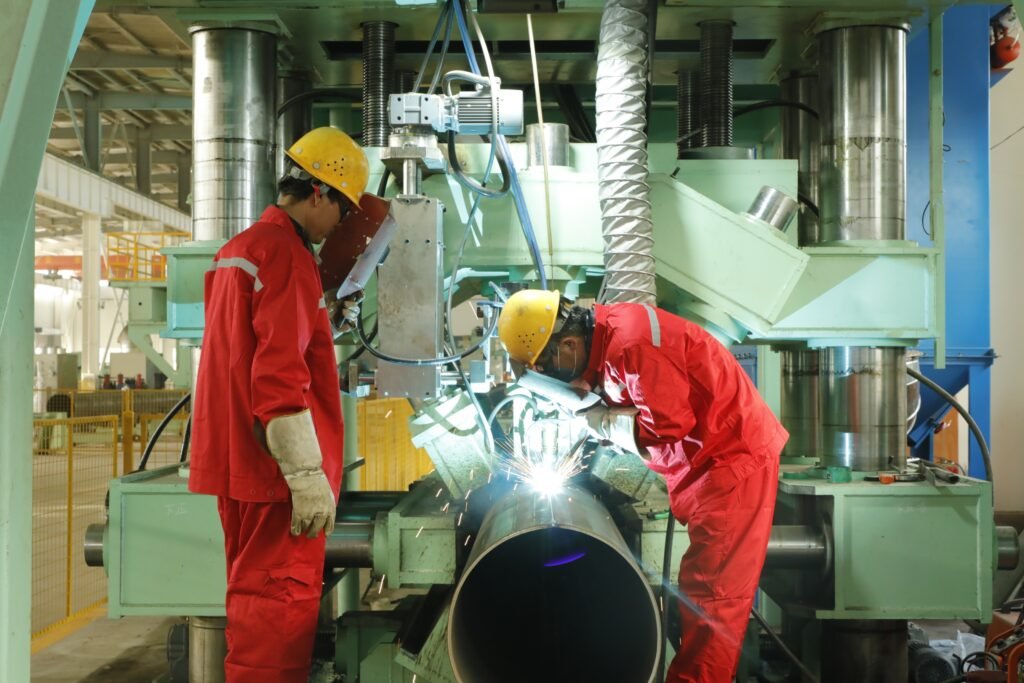
The welded pipe production process under the API 5CT standard involves precisely forming steel plates into high-performance downhole pipes, with the core being the combination of cold bending and efficient welding.
ERW: This method involves heating and extruding the steel plate with high-frequency current. The edges of the steel plate are rapidly heated to a plastic state, and then the metal bodies are fused together through mechanical extrusion.
EFW: Metal pipes are heated by electromagnetic induction and then welded.
The vast majority of API 5CT steel pipes are manufactured using seamless processes, while some steel grades (such as K55 and N80) can be produced using ERW or EFW processes.
API 5CT steel pipes can withstand the harsh environments of high pressure, high temperature, and corrosion during oil and gas extraction, thus exhibiting excellent performance in the exploration, extraction, storage, and transportation of oil and gas resources. Specifically, they can be categorized into several core areas:
Oil and gas well drilling and completion:
Casing: Casing consists of steel pipes that are lowered into the well and fixed to the well wall. Its main function is to support the well wall, prevent formation collapse, and isolate different formations.
Tubing: Tubing is inserted into the casing to form a production channel for extracting oil and gas.
Oil and gas field development in special environments:
Acidic environment (containing H₂S): When the oil and gas well contains hydrogen sulfide (H₂S), ordinary steel pipes are prone to breakage. In this case, sulfide stress cracking must be used.
CO₂ corrosive environment: For well conditions containing carbon dioxide (CO₂), use chromium-containing steel grades such as L80-13Cr.
High-temperature and high-pressure deep wells: For deep and ultra-deep wells, the downhole environment is often high-temperature and high-pressure, so high-strength steel grades such as P110 and Q125 are used.
Unconventional oil and gas extraction:
Geothermal wells: Geothermal wells need to be drilled deep underground. Their well structure and function are similar to those of oil and gas wells. Therefore, they also widely use casing and tubing that meet the API 5CT standard.
Water wells: In some large or deep water wells and underground aquifer extraction projects, API standard casing is also used for well construction.
Underground Gas/Energy Storage: When constructing gas storage facilities using underground caverns (such as salt caverns) or depleted oil and gas reservoirs, API 5CT pipes are the key conduits connecting the surface and underground reservoirs in these projects.
The core difference between the two lies in their different uses:
API 5CT: Pipeline used for constructing oil and gas wells, including casing and tubing, to build the wellbore structure and produce oil and gas. Downhole tubing is made up of individual steel pipes connected by threaded couplings.
API 5L: Pipeline material used for long-distance transportation of oil and gas. It is a line pipe that transports oil and gas from the wellhead to the processing plant or user. During pipeline laying, individual steel pipes are welded end to end to form a continuous pipeline.
The selection of steel grade mainly depends on three factors:
Well depth and pressure: J55/K55 for shallow wells, N80 for medium-deep wells, P110 for deep wells with high pressure, and Q125 for ultra-deep wells.
Corrosive environments: For environments containing hydrogen sulfide (H₂S), sulfide stress cracking such as L80, C90, and T95 must be selected; for environments containing CO₂, L80-13Cr can be selected.
Temperature requirements: For high-temperature environments, select steel grades such as P110 and L80 to ensure that the steel pipes maintain good mechanical properties under high-temperature conditions. For low-temperature environments, select high-toughness steel grades such as L80 and P110.
Both have the same strength, with a minimum yield strength of 552 MPa. N80-1 is delivered in hot-rolled condition without tempering, resulting in lower cost but generally lower toughness. N80-Q requires quenching and tempering (quenching and tempering) treatment, resulting in a more uniform microstructure, higher cost, and better toughness.
In short: if you prioritize cost-effectiveness, choose the N80-1; if you prioritize performance and reliability (especially in deep wells and complex working conditions), choose the N80-Q.
Fill in the form below and our team will be happy to assist you