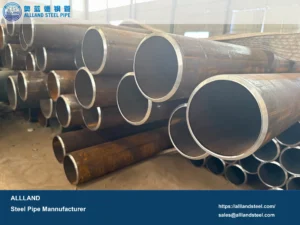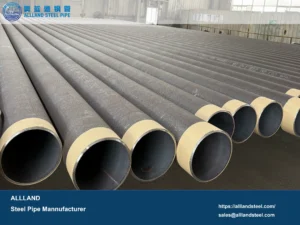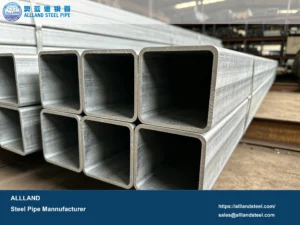




A square tube is a structural steel profile featuring a square hollow cross-section; it consists of four flat steel walls—typically with rounded corners—and is manufactured via cold forming, hot forming, or welding processes. These tubes usually undergo anti-corrosion treatment, such as hot-dip galvanizing or protective coating.
From an engineering perspective, square tubes are classified as Hollow Structural Sections (HSS) rather than standard piping used for fluid conveyance. They are primarily designed to withstand axial loads, bending loads, and torsional loads.
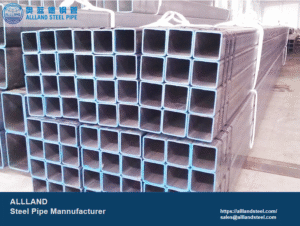
Square Tube Specifications
The specifications of a square tube are primarily determined by the following parameters:
Outside Dimension
Wall Thickness
Length
Material Grade
Manufacturing Standard
Square Tube Size charts
| Size (mm) | Thickness Range | Typical Application |
| 20×20 | 1.5–3.0 mm | Light frame, furniture |
| 25×25 | 1.5–3.0 mm | Small structures |
| 40×40 | 2.0–5.0 mm | Equipment frame |
| 50×50 | 2.0–6.0 mm | General structure |
| 60×60 | 3.0–6.0 mm | Support frame |
| 80×80 | 3.0–8.0 mm | Solar structure |
| 100×100 | 4.0–10 mm | Building & heavy support |
| 120×120 | 5.0–12 mm | Industrial structure |
| 150×150 | 6.0–12 mm | Column application |
| 200×200 | 8.0–16 mm | Heavy structure |
Square Tube Dimension Tolerance
Beyond dimensions, the following factors are also critical for square tubes:
Outer dimension tolerance
Wall thickness tolerance
Straightness
Corner radius
Example:
ASTM A500 requirements:
- Outside Dimension Typically controlled to: Approx. ±1%
- Wall Thickness Typically: Within ±10%
Square Tube Standards and Regions
| Region | Standards | Product Name | Common Material Grades |
| USA | ASTM A500/A500M | Structural Tube / HSS (Hollow Structural Section) | Grade A、B、C、D |
| USA | ASTM A513 | Mechanical Tubing | 1008、1018 |
| Europe | EN 10219 | SHS (Square Hollow Section) | S235、S275、S355 |
| Europe | EN 10210 | Hot Finished SHS | S235、S275、S355、S420 |
| UK | BS EN 10219 / BS EN 10210 | SHS | S235、S355 |
| Australia | AS/NZS 1163 | SHS (Square Hollow Section) | C250、C350、C450 |
| New Zealand | AS/NZS 1163 | SHS | C250、C350、C450 |
| Japan | JIS G3466 | Carbon Steel Square Tube | STKR400、STKR490 |
| China | GB/T 6725 / GB/T 3094 | 方形钢管 | Q235、Q355 |
| Korea | KS D 3568 | Carbon Steel Square Tube | STKR400、STKR490 |
| /CIS | GOST 8639 / GOST 30245 | Square Hollow Section | Ст3、09Г2С |
Basic Characteristics of Square Tubes
Cross-sectional Properties of Square Tubes
Cross-sectional properties form the basis for evaluating the structural capacity of square tubes; these include cross-sectional area, moment of inertia, section modulus, and radius of gyration.
Cross-sectional area: Represents the actual load-bearing area of the steel. This parameter influences the axial load-bearing capacity and the weight of the steel tube. Generally, a larger cross-sectional area results in higher load-bearing capacity and greater weight. Calculation formula: A = B² − (B−2t)², Calculator URL.
· A = Cross-sectional area
· B = Outer side length of the square tube
· t = Wall thickness
Moment of Inertia: Represents the cross-section’s resistance to bending deformation; denoted by the symbol “I.” Typically, a higher “I” value indicates stronger bending resistance. A key advantage of square tubes is that their moments of inertia in the transverse and longitudinal directions are similar.
Formula: I = (B⁴ − (B−2t)⁴) / 12, Calculator URL.
Section Modulus: Used to calculate the maximum bending load-bearing capacity.
Mechanical Properties of Square Tubes
1. Buckling Resistance: When subjected to compressive loads, a square tube may undergo overall buckling rather than material failure. This typically occurs when the tube serves as a column or support member. Key factors influencing this property include length and wall thickness.
2. Torsional Performance: The ability of a square tube to resist torsional deformation, influenced by dimensions, wall thickness, and cross-sectional shape. Generally, the torsional resistance of square tubes is 3 to 10 times that of open-profile structures (such as angle steel).
3. Bending Performance: The ability of a square tube to withstand external bending forces, including wind loads, snow loads, and lateral pressure. This capacity depends on the tube’s dimensions, wall thickness, and length. Square tubes used in large-scale structures can achieve bending resistance ratings of several hundred kN·m.
Square Tube vs pipe
Although the terms “square tube” and “square pipe” are often used interchangeably in general market discussions, they typically represent distinct product categories within the steel industry.
Simply put:
Square Tube = Structural applications
Square Pipe = Pressure/fluid transportation applications
Because their intended uses differ, the mechanical properties, materials, and dimensions that must be considered for each also vary. Square pipes see more extensive use in the transportation sector.
Manufacturing for Square Tubes
The manufacturing process for square tubes primarily includes:
- ERW Welding (Electric Resistance Welding)
- Seamless Manufacturing
- Cold Forming
- Hot Forming
Among these, the most common type in the structural square tube market is the Cold-Formed ERW Square Tube.
Cold-Formed Square Tube
Standards: ASTM A500, EN10219
Characteristics: The steel is formed at ambient temperature.
Advantages: High dimensional accuracy, good surface quality, and high production efficiency.
Disadvantages: Cold working generates residual stress.
Materials for Square Tubes
| Material | Yield Strength | Corrosion Resistance | Weldability |
| Carbon Steel | 228–345 MPa | Low | Excellent |
| S355 Steel | 355 MPa | Low | Good |
| Galvanized Steel | Same as base steel | High | Good |
| 304 SS | 205 MPa | Very High | Good |
| 316 SS | 205 MPa | Excellent | Good |
| Alloy Steel | 460MPa+ | Medium | Medium |
The primary differences between square tubes made of different materials lie in:
· Mechanical properties
· Chemical composition
· Corrosion resistance
· Weldability
· Application environment
Carbon steel square tubes are the most common type in daily production and use; they offer strength and hardness that meet engineering requirements, along with effective control of impurities. Common standards include ASTM A500, EN10219, and AS/NZS1163. Taking ASTM A500 as an example, the mechanical properties and chemical composition of these square tubes are outlined below:
ASTM A500 Mechanical Properties
| Grade | Yield Strength (Min) | Tensile Strength (Min) | Elongation (Min) |
| Grade A | 39 ksi (270 MPa) | 45 ksi (310 MPa) | 25% |
| Grade B | 46 ksi (317 MPa) | 58 ksi (400 MPa) | 23% |
| Grade C | 50 ksi (345 MPa) | 62 ksi (427 MPa) | 21% |
ASTM A500 Chemical Composition
| Grade | Carbon (C) Max | Manganese (Mn) Max | Phosphorus (P) Max | Sulfur (S) Max |
| Grade A | 0.26% | — | 0.04% | 0.04% |
| Grade B | 0.30% | 1.35% | 0.04% | 0.04% |
| Grade C | 0.27% | 1.40% | 0.04% | 0.04% |
Specifications for other standards can be viewed on our product details page; simply click the link to access it.
Application Areas
The solar industry is one of the fastest-growing sectors for square tube applications in recent years. Square tubes are utilized in large-scale ground-mounted PV plants, distributed PV systems, solar carports, and solar tracker structures. Notably, after hot-dip galvanizing, square tubes can withstand harsh environments—such as deserts, high-humidity areas, and coastal regions—over the long term.
Building Structures
Square tubes are frequently used for columns, trusses, structural supports, and framework systems. Due to their closed cross-section, they offer superior bending and torsional resistance compared to many open-profile steel sections. Additionally, their uniform shape and clean aesthetic make them visually appealing in modern architectural design, leading to widespread use in both structural and decorative applications.
Greenhouse Frameworks
Square tubes serve as a primary structural material for greenhouses, livestock fencing, agricultural equipment frames, irrigation supports, and farm infrastructure. Agricultural environments often involve high humidity, significant diurnal temperature fluctuations, and exposure to corrosive soil and fertilizers; consequently, most agricultural square tubes undergo hot-dip galvanizing to enhance corrosion resistance and extend service life.
While both square and round tubes can be used in PV mounting systems, square tubes are far more prevalent in mainstream global designs, particularly for fixed-tilt mounting systems and solar carports.
Advantages of square tubes:
Easier connection and installation
Superior resistance to rotation
Better suited for mounting PV modules
Enhanced structural stability
From a purely structural mechanics perspective, round tubes actually offer higher material efficiency. For a given cross-sectional area, round tubes provide a greater:
Radius of Gyration
Compressive stability
Wind resistance
Consequently, round tubes remain widely used in power transmission towers, wind turbine towers, and certain solar tracking systems.
Why does the PV industry still predominantly choose square tubes?
In any given project, structural performance is just one factor; material costs, connection costs, construction costs, and maintenance costs must also be considered. In most cases, square tubes offer faster installation and lower labor costs, resulting in a lower total project cost. This is why square tubes are typically the preferred structural material for fixed PV mounting systems, solar carports, and distributed PV systems, whereas round tubes are more commonly used for the main shafts of tracking mounts or for specialized load-bearing components.
FAQ
1.Square Tube vs HSS
“Square Tube” refers to the product’s shape, whereas HSS denotes the product category. HSS stands for “Hollow Structural Section,” a term standard in the North American steel construction industry; engineering drawings typically specify it as “HSS 4×4×1/4” rather than simply “Square Tube,” as the HSS designation emphasizes its structural application.
2.Square Tube vs SHS
In most cases, “Square Tube” is equivalent to SHS; they are essentially the same product, simply referred to by different names in different regions.
| Market | Common Name |
| USA | Square Tube / HSS |
| Europe | SHS |
| Australia | SHS |
| China | Square Tube |