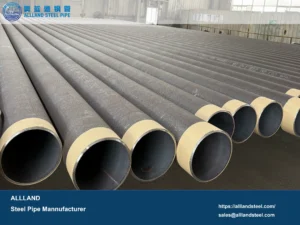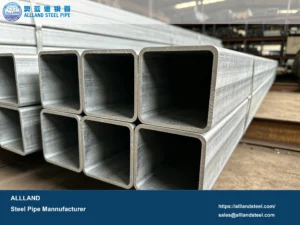




In the steel pipe industry, “Schedule” serves as an indicator of pipe wall thickness rather than merely representing the nominal pipe dimensions. For pipes with the same outer diameter, SCH 40 and SCH 80 designations correspond to different wall thicknesses. For a detailed description, please click to view the SCHEDULE SIZE CHARTS. Common wall thickness grades include SCH 10, SCH 20, SCH 40, SCH 80, SCH 160, and others; the higher the numerical value following the “Schedule” designation, the greater the wall thickness.
SCH 40 vs SCH 80 Pipe
Why are SCH 40 and SCH 80 always compared?
First: SCH 40 vs SCH 80 are the two most commonly used steel pipe specifications on the market, and their wall thicknesses differ only slightly.
Second: Whether in building plumbing and drainage, mechanical manufacturing, or industrial piping systems, these two specifications appear with great frequency; consequently, users naturally prioritize comparing them.
Finally: SCH 40 represents an economical steel pipe option, while SCH 80 represents a high-pressure, safety-oriented option; therefore, projects often involve a comparison between selecting the more economical solution versus the safer one.
SCH 40 vs. SCH 80 Pipe Dimension
| NPS | OD (mm) | W.T. | Inner Diameter | ||
| SCH40 (mm) | SCH80 (mm) | SCH40 (mm) | SCH80 (mm) | ||
| 1/16″ | 6.35 | 1.24 | 1.65 | 3.87 | 3.05 |
| 1/8″ | 10.29 | 1.73 | 2.41 | 6.83 | 5.47 |
| 1/4″ | 13.72 | 2.24 | 3.02 | 9.24 | 7.68 |
| 3/8″ | 17.15 | 2.31 | 3.2 | 12.53 | 10.75 |
| 1/2″ | 21.34 | 2.77 | 3.73 | 15.8 | 13.88 |
| 3/4″ | 26.67 | 2.87 | 3.91 | 20.93 | 18.85 |
| 1″ | 33.4 | 3.38 | 4.55 | 26.64 | 24.3 |
| 1-1/4″ | 42.16 | 3.56 | 4.85 | 35.04 | 32.46 |
| 1-1/2″ | 48.26 | 3.68 | 5.08 | 40.9 | 38.1 |
| 2″ | 60.3 | 3.91 | 5.54 | 52.48 | 49.22 |
| 2-1/2″ | 73.03 | 5.16 | 7.01 | 62.71 | 59.01 |
| 3″ | 88.9 | 5.49 | 7.62 | 77.92 | 73.66 |
| 3-1/2″ | 101.6 | 5.74 | 8.08 | 90.12 | 85.44 |
| 4″ | 114.3 | 6.02 | 8.56 | 102.26 | 97.18 |
| 5″ | 141.3 | 6.55 | 9.52 | 128.2 | 122.26 |
| 6″ | 168.28 | 7.11 | 10.97 | 154.06 | 146.34 |
| 8″ | 219.08 | 8.18 | 12.7 | 202.72 | 193.68 |
| 10″ | 273.05 | 9.27 | 15.09 | 254.51 | 242.87 |
| 12″ | 323.85 | 9.53 | 17.48 | 304.79 | 288.89 |
| 14″ | 355.6 | 9.53 | 19.05 | 336.54 | 317.5 |
| 16″ | 406.4 | 9.53 | 21.44 | 387.34 | 363.52 |
| 18″ | 457.2 | 9.53 | 23.83 | 438.14 | 409.54 |
| 20″ | 508 | 9.53 | 26.19 | 488.94 | 455.62 |
| 24″ | 609.6 | 9.53 | 30.96 | 590.54 | 547.68 |
Schedule 40 vs. Schedule 80 Pipe: Other Comparisons
| schedule 40 | schedule 80 | |
| Wall Thickness | Standard wall thickness, suitable for general operating conditions; wall thickness typically ranges from 3 to 12 mm. | Thick-walled design, suitable for medium-to-high pressure applications; wall thickness typically ranges from 4.5 mm to 15 mm. |
| Pressure-Bearing Capacity | Approx. 1.5 MPa – 7 MPa | Approx. 3 MPa – 11 MPa. |
| Weight | Lightweight construction; generally offers advantages in terms of installation efficiency. | Heavy weight, resulting in high material consumption and transportation costs. |
| Inner Diameter | Large inner diameter, resulting in high flow rates. | Smaller inner diameter (bore size), reduced by approximately 12%–15%. |
| Cost | Requires less steel, making it more cost-effective. | Requires a larger volume of steel, resulting in a higher price point. |
| Service Life | Shorter service life. | Substantial wall thickness ensures a long service life. |
| Safety Factor | 1.5 – 2.0 | 2.0 – 3.0 |
| Maximum Operating Temperature | ~350°C | ~400°C |
| Corrosion Allowance | 1.0 – 1.5 mm | 1.5 – 3.0 mm |
| Minimum Bending Radius | 3D – 4D | 5D – 8D |
| Moment of Inertia | ≈ 13.1 | ≈ 17.8 |
- Wall Thickness: SCH80 is 25%–50% thicker than SCH40
- Pressure Capacity: SCH80 increases pressure rating by 40%–70%
- Flow Rate: SCH40 provides 8%–15% higher flow capacity
- Weight: SCH80 is 30%–40% heavier than SCH40
SCH 40 vs. SCH 80 Pipe Selection
1. Operating Pressure
2. Operating Temperature
3. Medium Type
4. Flow Rate Requirements
5. Corrosion Allowance
All relevant data can be found in the table above. Common pitfalls during the selection process include: focusing solely on pressure requirements while neglecting flow requirements; overlooking the project’s entire lifecycle in favor of short-term economic gains; and over-engineering low-pressure systems—a practice that runs counter to the core principles of sustainable production.
Therefore, when selecting a specific model, it is essential to take a comprehensive approach and avoid selection errors caused by placing excessive emphasis on a single data point.
SCH 40 vs. 80 Applications
Due to its low cost, high flow capacity, and rapid installation, Schedule 40 is ideally suited for applications with modest pressure requirements.
Typical Applications:
- Municipal Drainage
- Interior Building Plumbing
- General Support Structures
- Agricultural Water Systems
Schedule 80 is primarily utilized in high-pressure piping systems and is highly suitable for applications where safety performance is a critical priority.
Typical Applications:
- Oil and Gas Transport
- Chemical Industry
- High-Pressure Steam Systems
- Highly Corrosive Environments