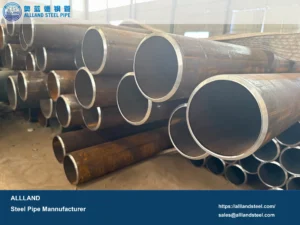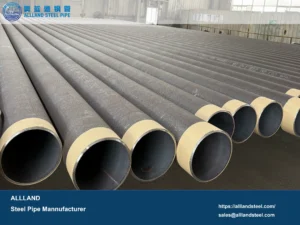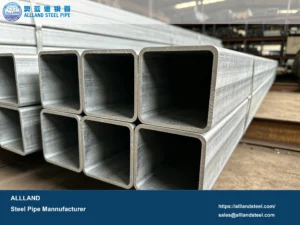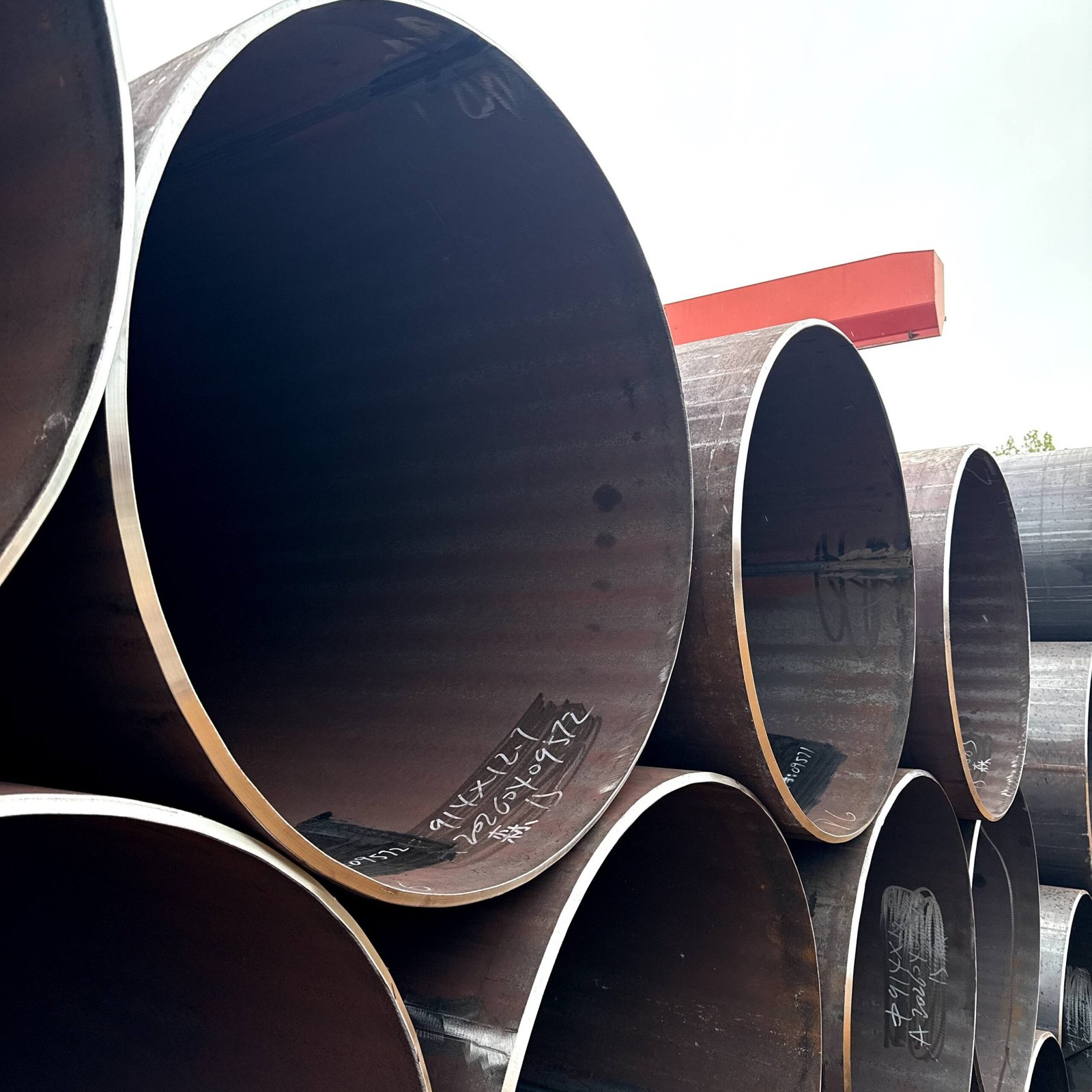



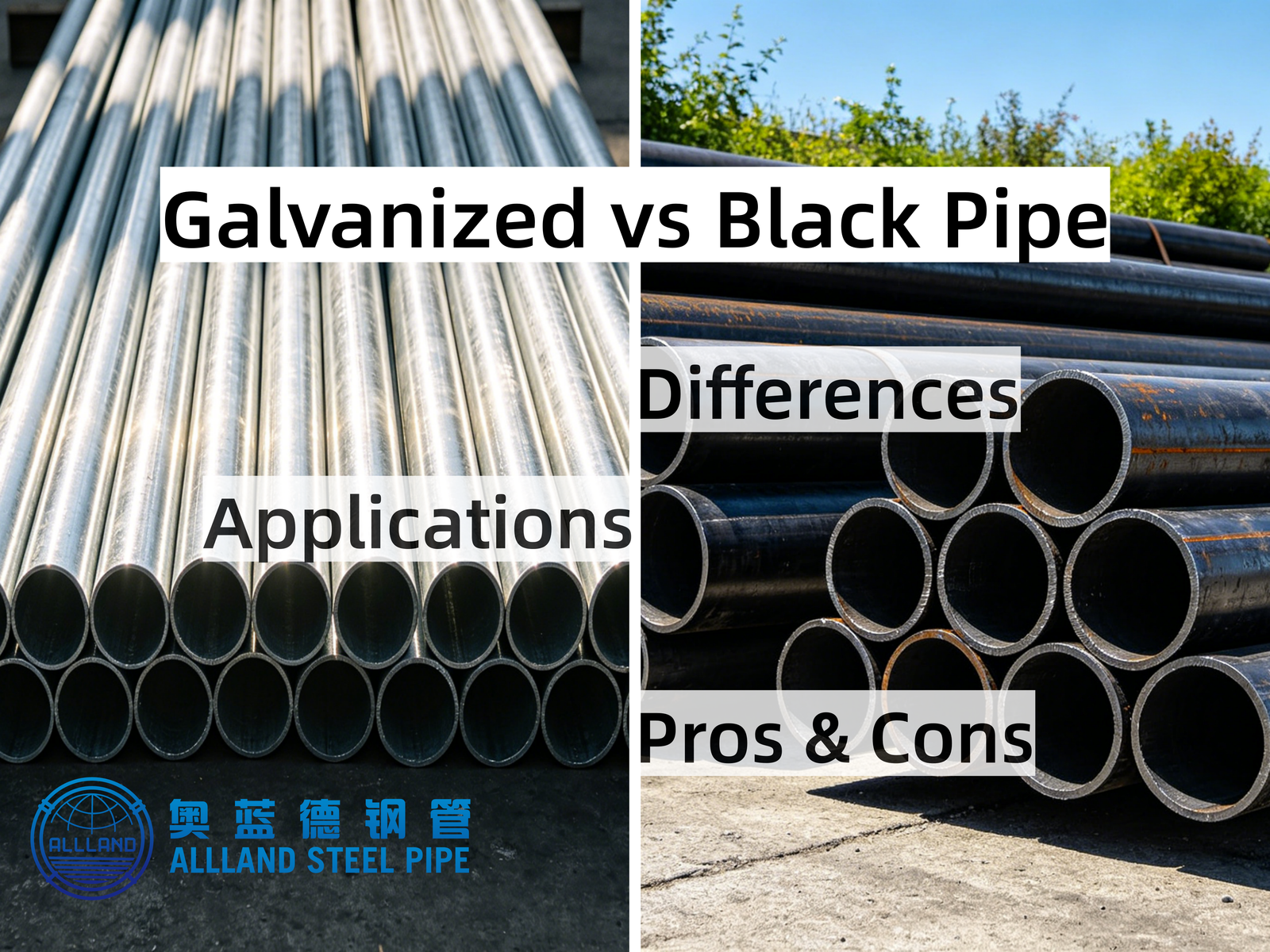
In the Galvanized vs Black Pipe comparison, the main difference lies in their surface treatment. Galvanized pipe is coated with a layer of zinc on its surface, while black pipe has no zinc coating and retains only the black mill scale.
In practical engineering applications, the choice between galvanized vs black pipe depends on factors such as the operating environment, the type of conveyed medium, project budget, and service life requirements.
Galvanized pipes offer superior corrosion resistance and are more suitable for damp, outdoor, and water supply and drainage environments. Black pipes, although less resistant to rust, provide better high-temperature performance and weldability, making them widely used in oil and gas transmission, steam systems, and industrial piping applications.
What Is Galvanized Pipe?
What Is Black Pipe?
Galvanized vs Black Pipe: Key Differences
Galvanized vs Black Pipe Quick Reference Table of Key Differences
| Comparison Item | Galvanized Pipe | Black Pipe |
|---|---|---|
| Surface Treatment | Coated with a zinc layer (Zinc Coating) | No zinc coating, retains black mill scale |
| Appearance Color | Silver gray or bright silver | Black or dark gray |
| Corrosion Resistance | Excellent, strong rust resistance | Moderate, prone to rust |
| High Temperature Resistance | Moderate, zinc coating may be damaged at high temperatures | Excellent, suitable for high-temperature environments |
| Weldability | Zinc coating usually needs to be removed before welding | Easy to weld with stable weld quality |
| Service Life | Longer | Relatively shorter |
| Maintenance Requirements | Low | Usually requires additional anti-corrosion treatment |
| Cost | Higher | Lower |
| Weight | Slightly heavier due to zinc coating | Relatively lighter |
| Main Advantages | Corrosion resistance, rust prevention, suitable for outdoor use | High-temperature resistance, easy welding, cost-effective |
| Main Disadvantages | Higher cost, not suitable for prolonged high-temperature exposure | Weaker corrosion resistance |
| Common Applications | Water supply and drainage, fire protection, outdoor structures, agricultural irrigation | Natural gas, petroleum, steam, industrial piping |
| Suitable Environments | Humid, outdoor, corrosive environments | High-temperature, dry, industrial environments |
| Suitable for Gas Systems | Generally not recommended | Widely used |
| Suitable for Outdoor Use | Highly suitable | Requires additional anti-corrosion protection |
Galvanized vs Black Pipe Applications
Applications of Galvanized Pipes
Applications of Black Pipes
How to Choose the Right Pipe: Galvanized vs Black Pipe
- Rust protection
- Outdoor use
- Long service life
- Operation in humid environments
- High-temperature conveyance
- Natural gas systems
- Extensive welding
- Cost control
Common Sizes and Specifications for Galvanized and Black Steel Pipes
Galvanized pipes are typically produced by applying a galvanizing process to carbon steel welded or seamless pipes.
Common production ranges for industrial projects:
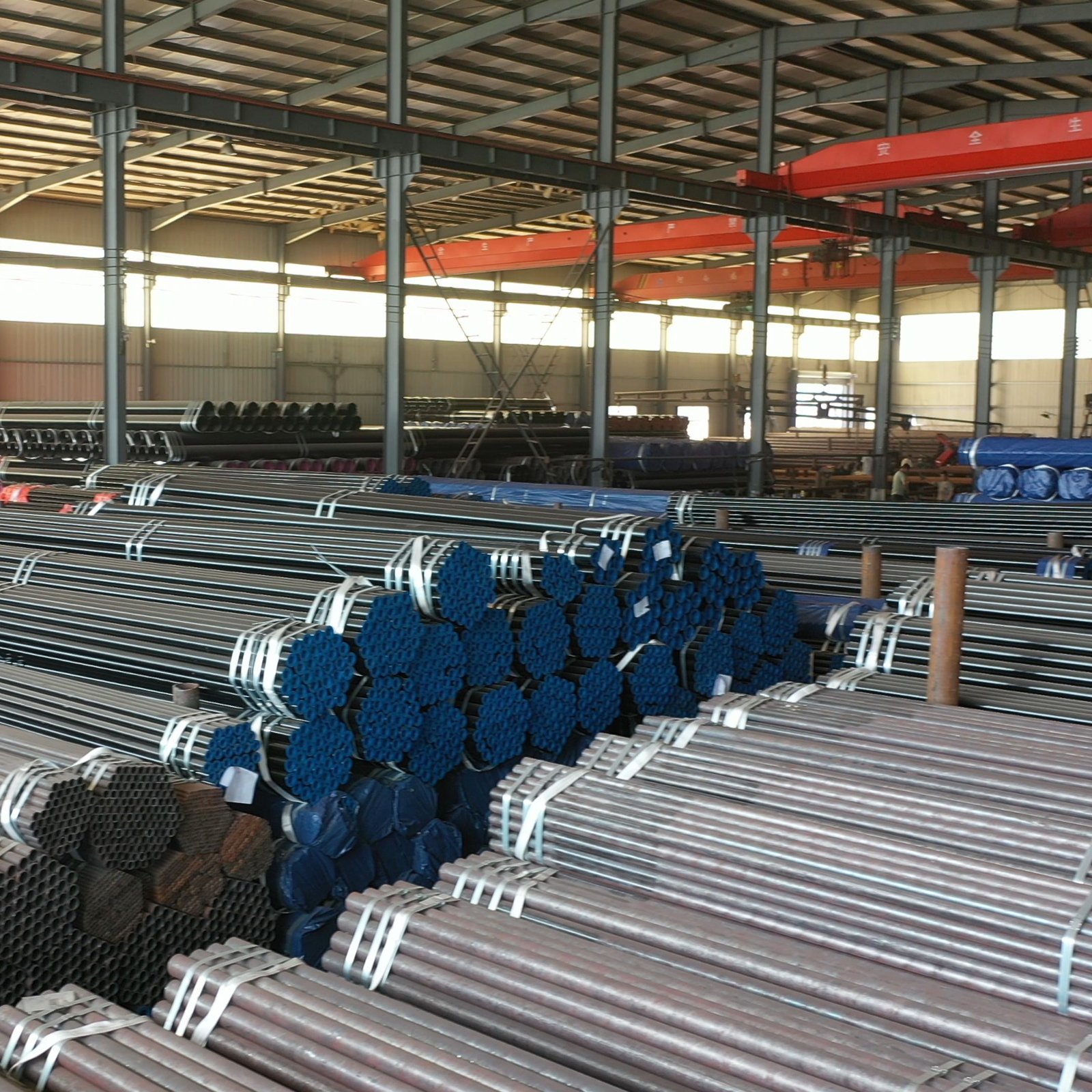
· ERW galvanized/black steel pipes: 1/2“ – 24”
· Seamless steel pipes: 1/8“ – 36”
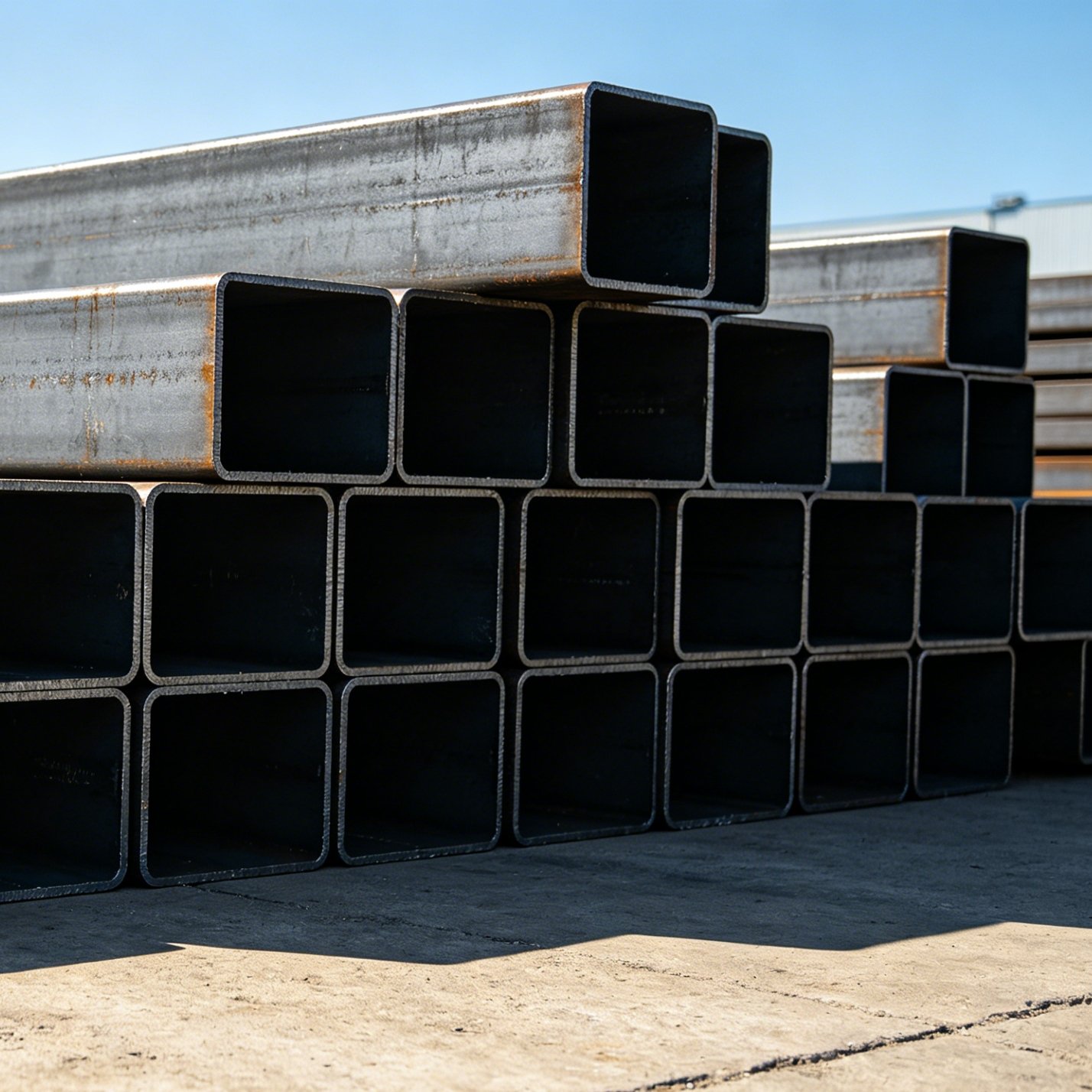
· Square and rectangular tubes: 20×20 mm – 500×500 mm
| NPS (inch) | DN | Actual Outside Diameter OD (mm) | SCH 40 Wall Thickness (mm) | SCH 80 Wall Thickness (mm) |
|---|---|---|---|---|
| 1/8″ | 6 | 10.3 | 1.73 | 2.41 |
| 1/4″ | 8 | 13.7 | 2.24 | 3.02 |
| 3/8″ | 10 | 17.1 | 2.31 | 3.20 |
| 1/2″ | 15 | 21.3 | 2.77 | 3.73 |
| 3/4″ | 20 | 26.7 | 2.87 | 3.91 |
| 1″ | 25 | 33.4 | 3.38 | 4.55 |
| 1-1/4″ | 32 | 42.2 | 3.56 | 4.85 |
| 1-1/2″ | 40 | 48.3 | 3.68 | 5.08 |
| 2″ | 50 | 60.3 | 3.91 | 5.54 |
| 2-1/2″ | 65 | 73.0 | 5.16 | 7.01 |
| 3″ | 80 | 88.9 | 5.49 | 7.62 |
| 3-1/2″ | 90 | 101.6 | 5.74 | 8.08 |
| 4″ | 100 | 114.3 | 6.02 | 8.56 |
| 5″ | 125 | 141.3 | 6.55 | 9.53 |
| 6″ | 150 | 168.3 | 7.11 | 10.97 |
| 8″ | 200 | 219.1 | 8.18 | 12.70 |
| 10″ | 250 | 273.0 | 9.27 | 15.09 |
| 12″ | 300 | 323.9 | 10.31 | 17.48 |
| NPS | OD(mm) |
| 14″ | 355.6 |
| 16″ | 406.4 |
| 18″ | 457.0 |
| 20″ | 508.0 |
| 22″ | 559.0 |
| 24″ | 610.0 |
| 26″ | 660.0 |
| 28″ | 711.0 |
| 30″ | 762.0 |
| 32″ | 813.0 |
| 34″ | 864.0 |
| 36″ | 914.0 |
Why Choose ALLLAND for Steel Pipe Supply
Conclusion
In the Galvanized vs Black Pipe comparison, both types of steel pipe have their own advantages, and neither is absolutely better than the other. In practical applications, the most suitable pipe should be selected based on a comprehensive evaluation of factors such as the operating environment, conveyed medium, project cost, service life, and processing requirements.
FAQ
Are galvanized pipes more durable than black pipes?
Generally, yes. Because the zinc coating effectively prevents rust, galvanized pipes typically have a longer service life than black pipes in damp or outdoor environments.
Do galvanized pipes rust?
Yes, but at a much slower rate than ordinary black steel pipes. Rust may still occur if the zinc coating wears away over time or is exposed to highly corrosive environments.
Do galvanized pipes and black pipes have the same strength?
In most cases, the base steel strength of both is similar; for example, both can be made from ASTM A53 Grade B material. The main difference lies in the surface treatment, not the steel itself.