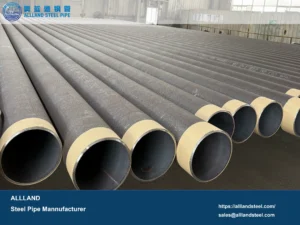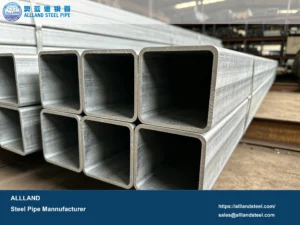




ASME B36.10M Schedule 40 pipe is widely utilized within the steel pipe industry; to begin, let us first clarify its definition. ASME B36.10M is a dimensional standard for carbon and alloy steel pipes published by the American Society of Mechanical Engineers (ASME); it specifies the internal diameter, wall thickness, and applicable conditions for steel pipes. When combined with specific pipe material standards (such as ASTM A500, A53, etc.), ASME B36.10M establishes a complete set of pipe specifications.
“Schedule 40” denotes a wall thickness classification within the American piping system; it represents a medium wall thickness and is a particularly common classification. It is crucial to note that “Schedule 40” does not designate the material composition, pressure rating, or outside diameter—nor does it represent a specific numerical value for the wall thickness itself; rather, “Schedule 40” serves solely as a classification number for wall thickness.
The following sections will provide a detailed overview of ASME B36.10M Schedule 40 pipe, including comprehensive dimensional tables, application guidelines, and dimensional comparisons.
ASME B36.10M Schedule 40 Specification
B36.10M SCH 40 Dimension
| NPS (inch) | OD (mm) | SCH 40 (mm) | ID (mm) |
| 1/8″ | 10.3 | 1.73 | 6.8 |
| 1/4″ | 13.7 | 2.24 | 9.2 |
| 3/8″ | 17.1 | 2.31 | 12.5 |
| 1/2″ | 21.3 | 2.77 | 15.8 |
| 3/4″ | 26.7 | 2.87 | 20.9 |
| 1″ | 33.4 | 3.38 | 26.6 |
| 1-1/4″ | 42.2 | 3.56 | 35.1 |
| 1-1/2″ | 48.3 | 3.68 | 40.9 |
| 2″ | 60.3 | 3.91 | 52.5 |
| 2-1/2″ | 73 | 5.16 | 62.7 |
| 3″ | 88.9 | 5.49 | 77.9 |
| 3-1/2″ | 101.6 | 5.74 | 90.1 |
| 4″ | 114.3 | 6.02 | 102.3 |
| 5″ | 141.3 | 6.55 | 128.2 |
| 6″ | 168.3 | 7.11 | 154.1 |
| 8″ | 219.1 | 8.18 | 202.7 |
| 10″ | 273 | 9.27 | 254.5 |
| 12″ | 323.8 | 9.53 | 304.8 |
| 14″ | 355.6 | 9.53 | 336.5 |
| 16″ | 406.4 | 9.53 | 387.3 |
| 18″ | 457.2 | 9.53 | 438.1 |
| 20″ | 508 | 9.53 | 488.9 |
| 24″ | 610 | 9.53 | 590.9 |
| 30″ | 762 | 10.31 | 741.4 |
| 36″ | 914 | 11.13 | 891.7 |
Schedule 40 represents a commonly used pipe wall thickness; Schedule 80 piping is also widely utilized, and we have published a comparison article regarding these dimensions, which you can view by clicking the provided link. Under the ASME B36.10M dimensional standard, the outer diameter is fixed; consequently, one must refer to the specific wall thickness schedule to determine the pipe’s inner diameter—the greater the wall thickness, the smaller the resulting inner diameter.
Schedule 40 Physical Properties
Pressure Rating of SCH 40
First and foremost, pressure rating depends on three factors: material, temperature, and pipe diameter. For the same SCH 40 designation, the pressure rating varies significantly depending on the specific outside diameter, material, and temperature. For carbon steel pipes, the typical pressure rating range for Schedule 40 is as follows:
Ambient Temperature (approx. 20°C)
- Small Diameter (1/2” – 2”): Approx. 3,000 – 4,000 psi (20 – 27 MPa)
- Medium Diameter (2” – 6”): Approx. 1,500 – 3,000 psi (10 – 20 MPa)
- Large Diameter (>8”): Approx. 800 – 2,000 psi (5 – 14 MPa)
The higher the temperature, the lower the pressure rating. When the temperature reaches 200°C, the pressure rating decreases by 10%–20%; when the temperature reaches 400°C, the pressure rating decreases by 30%–40%. Additionally, prolonged exposure to corrosive environments can lead to wall thickness erosion, thereby reducing the pressure rating.
Strength of ASME B36.10M SCH 40
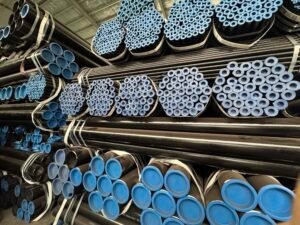
The strength of Schedule 40 pipes varies depending on the material used. Listed below are several commonly utilized standard grades to illustrate the strength characteristics of Schedule 40 piping.
Taking ASTM A106 Gr. B as an example:
· Tensile Strength: ≥ 415 MPa
· Yield Strength: ≥ 240 MPa
ASTM A53 Grade B
· Tensile Strength: ≥ 415 MPa
· Yield Strength: ≥ 240 MPa
ASTM A333 Gr. 6
· Tensile Strength: ≥ 415 MPa
· Yield Strength: ≥ 240 MPa
Weight of Schedule 40
Weight is a critical attribute of piping, as it directly impacts transportation costs, production costs, material consumption, and installation efficiency.
Schedule 40 The formula for calculating pipe weight is:
W = 0.02466(D − t)t
Where D represents the outer diameter and t represents the wall thickness. Below is a weight chart for selected dimensions, provided for reference as needed.
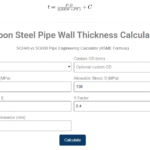
You can view the pressure piping wall thickness calculator here.
| NPS | OD (mm) | SCH 40 (mm) | SCH 40 (kg/m) |
| 1/2″ | 21.3 | 2.77 | 1.27 |
| 3/4″ | 26.7 | 2.87 | 1.69 |
| 1″ | 33.4 | 3.38 | 2.5 |
| 1-1/4″ | 42.2 | 3.56 | 3.38 |
| 1-1/2″ | 48.3 | 3.68 | 4.05 |
| 2″ | 60.3 | 3.91 | 5.44 |
| 2-1/2″ | 73 | 5.16 | 8.63 |
| 3″ | 88.9 | 5.49 | 11.29 |
| 4″ | 114.3 | 6.02 | 16.07 |
| 5″ | 141.3 | 6.55 | 21.77 |
| 6″ | 168.3 | 7.11 | 28.26 |
| 8″ | 219.1 | 8.18 | 42.55 |
| 10″ | 273 | 9.27 | 60.32 |
| 12″ | 323.9 | 10.31 | 73.81 |
ASME B36.10M Schedule 40 Application Scenarios
Industrial Systems
Schedule 40 steel pipe is widely utilized due to its moderate wall thickness, consistent strength, ease of procurement, and the comprehensive availability of fittings. In factory and manufacturing environments, Schedule 40 is frequently used to convey various standard industrial media, such as cooling water, circulating water, compressed air, process water, and certain non-corrosive liquids.
Construction Industry
In commercial buildings, residential complexes, hospitals, schools, and mixed-use developments, Schedule 40 is extensively employed for the conveyance of hot and cold water, drainage branch lines, equipment room connection piping, and general building plumbing systems.
Oil & Gas Extraction
Within the oil, natural gas, and energy sectors, Schedule 40 is often deployed in auxiliary piping systems—such as cooling lines, drainage systems, low-pressure process lines, equipment connection piping, and condensate recovery systems.
Fire Sprinkler Systems
Fire protection systems represent one of the classic application scenarios for Schedule 40 piping. Many fire sprinkler mains, branch lines, and pump room connection systems utilize either Schedule 40 black steel or Schedule 40 galvanized steel pipes.
FAQ
Why do smaller diameter Schedule 40 pipes have higher pressure resistance?
Under the same wall thickness, smaller diameter pipes contain less medium and experience less stress per unit area, thus having a higher pressure resistance. Small-diameter pipes are generally used in high-pressure systems, hydraulic systems, and instrumentation pipelines.
What does Schedule 40 mean?
Schedule 40 refers to a standardized wall thickness classification, widely used in various piping systems. It does not represent the material, fixed pressure value, or specific size, but rather the wall thickness classification corresponding to a given nominal size (NPS).
Is Schedule 40 the same as SCH 40?
Yes, they are exactly the same.
Schedule 40 and SCH 40 represent the same standard, just with different notations.