LSAW Pipe full from is Longitudinal Submerged Arc Welding
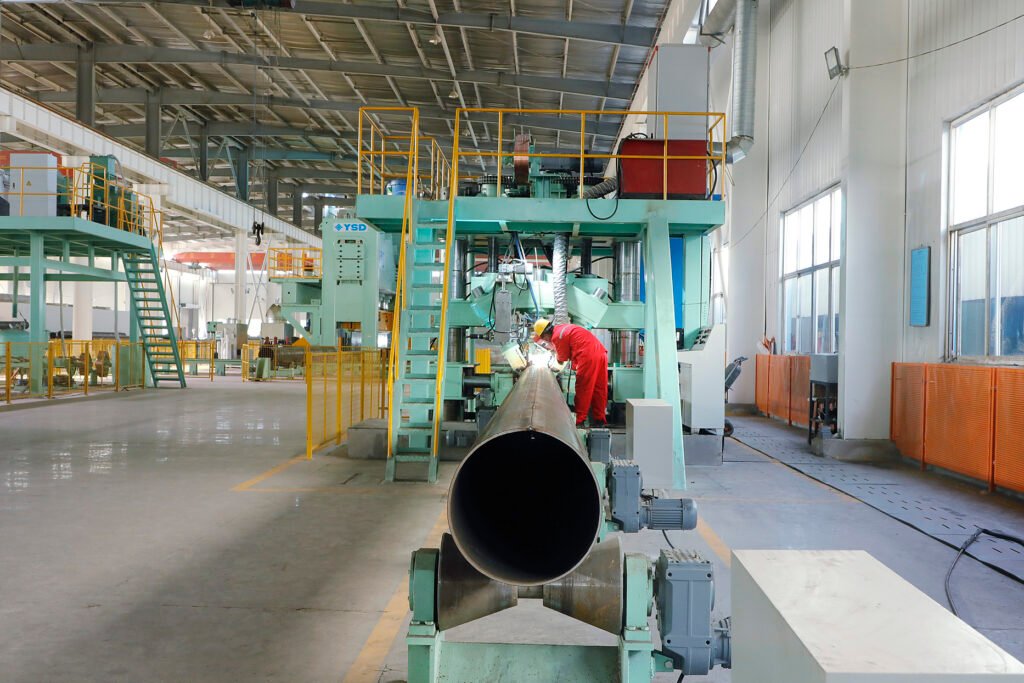
LSAW pipe is a pipe manufacturing process that uses steel plates as raw material and produces steel pipes through longitudinal welding. The weld seam is a straight line, and the process employs submerged arc welding (welding performed under a layer of flux). There are two LSAW production processes: JCOE and UOE.
The most widely used production process is UOE. It offers high dimensional accuracy and is suitable for high-standard oil and gas projects.
The most notable feature of Longitudinal Submerged Arc Welding (LSAW) pipes is their ability to produce ultra-large-diameter pipes, typically ranging from 406 mm to 1,422 mm, with even larger diameters possible. Wall thickness depends on the thickness of the steel plate, and the welds offer greater stability, resulting in performance that significantly exceeds that of Electric Resistance Welded (ERW) pipes.
Typical applications include long-distance oil and gas transportation, offshore projects, and piling pipes.
For more information on LSAW pipes, click here.