
SMLS schedule 80 pipe refers to seamless steel pipe with a wall thickness of SCH80. Seamless pipes are typically used in high-temperature, high-pressure, safety systems, or demanding operating conditions, with Schedule 80 wall thickness pipes being the most widely applied. This specification is commonly used in oil and gas extraction and transportation, chemical equipment, high-pressure steam pipelines, and refinery facilities. Supported standards include ASTM A106 and API 5L. Below, we will introduce this pipe from the perspectives of its dimensions, materials, characteristics, and applications. Please contact us for any inquiries.
SMLS schedule 80 pipe Dimensions
Dimensions for Sch 80 pipes generally comply with ASME B36.10M Steel Pipe Standard.
| NPS | OD (mm) | Sch 80 (mm) | ID (mm) | Weight kg/m |
| 1/8″ | 10.3 | 2.41 | 5.48 | 0.49 |
| 1/4″ | 13.7 | 3.02 | 7.66 | 0.86 |
| 3/8″ | 17.1 | 3.2 | 10.7 | 1.22 |
| 1/2″ | 21.3 | 3.73 | 13.84 | 1.62 |
| 3/4″ | 26.7 | 3.91 | 18.88 | 2.2 |
| 1″ | 33.4 | 4.55 | 24.3 | 3.24 |
| 1-1/4″ | 42.2 | 4.85 | 32.5 | 4.47 |
| 1-1/2″ | 48.3 | 5.08 | 38.14 | 5.41 |
| 2″ | 60.3 | 5.54 | 49.22 | 7.48 |
| 2-1/2″ | 73 | 7.01 | 58.98 | 11.41 |
| 3″ | 88.9 | 7.62 | 73.66 | 15.27 |
| 3-1/2″ | 101.6 | 8.08 | 85.44 | 19.04 |
| 4″ | 114.3 | 8.56 | 97.18 | 23.97 |
| 5″ | 141.3 | 9.53 | 122.24 | 32.3 |
| 6″ | 168.3 | 10.97 | 146.36 | 42.56 |
| 8″ | 219.1 | 12.7 | 193.7 | 64.64 |
| 10″ | 273.1 | 15.09 | 242.92 | 94 |
| 12″ | 323.9 | 17.48 | 288.94 | 126 |
Notes:
NPS: Nominal Pipe Size, not actual outer diameter. Outer diameters within the NPS 1/8″ – 12″ range are fixed standard dimensions.
Weight: Theoretical weight, subject to slight deviation from actual weight.
Pipe Tolerances
Outer Diameter
- Tolerance Range: ±0.25% – ±0.5%. Deviation increases with larger pipe OD.
Wall Thickness
- Tolerance Range: ±0.38 mm – ±0.65 mm. Must comply with standard requirements and withstand working pressure.
Straightness / Bend
- Straightness Deviation ≤ 0.5% L (L = Pipe Length); Maximum Allowable Bend ≤ Pipe Diameter × 0.5%
Materials and Standards of SMLS Schedule 80 Pipe
SMLS Schedule 80 Pipe can be manufactured in various materials to meet different operational requirements, based on customer specifications or standard requirements. These materials include carbon steel, low-alloy steel, stainless steel, and others. Below, we outline the corresponding standards and application scenarios for pipes made from different materials.
Carbon Steel Seamless Schedule 80
Among carbon steel materials, the most common is the ASTM A106 standard, primarily used in oil and gas pipelines and steam pipelines. The next most common is the ASTM A53 standard, applicable to mechanical and pressure equipment, and also used for steam and water transportation. The table below outlines the mechanical properties of these two standards.
ASTM A106 SMLS Schedule 80 Pipe
ASTM A53 SMLS Schedule 80 Pipe
| Grade | Minimum Yield Strength | Minimum Tensile Strength |
| A106 Gr.A | 205 MPa | 330 MPa |
| A106 Gr.B | 240 MPa | 415 MPa |
| A106 Gr.C | 275 MPa | 485 MPa |
| Grade | Yield Strength | Tensile Strength |
| A53 Gr.A | ≥205 MPa | ≥330 MPa |
| A53 Gr.B | ≥240 MPa | ≥415 MPa |
API 5L standards are also employed in oil and gas transportation, while ASTM A333 standards are used in cryogenic environments. Common steel grades and mechanical properties are as follows:
| Grade | Yield Strength |
| API 5L Gr.B | ≥245 MPa |
| API 5L X42 | ≥290 MPa |
| API 5L X52 | ≥360 MPa |
| API 5L X60 | ≥415 MPa |
Alloy Steel Schedule 80
Alloy steel pipes are also employed in high-temperature, high-pressure systems, with the common standard being ASTM A335. Increasing the alloy content in carbon steel enhances the pipe’s high-temperature strength, oxidation resistance, and creep resistance. Below are the steel grades and special alloys under this standard. They are primarily used in boiler piping and refinery equipment.
| Grade | Main Alloy Elements |
| P5 | Cr-Mo |
| P9 | Cr-Mo |
| P11 | Cr-Mo |
| P22 | Cr-Mo |
Stainless Steel of SMLS SCH 80 Pipe
Stainless steel is typically employed in corrosive environments such as food processing, marine, and chemical equipment. The common standard is ASTM A312. Below are the steel grades for this standard.
| Grade | Type |
| 304 | Austenitic Stainless Steel |
| 316 | Corrosion Resistant |
| 321 | High Temperature |
Testing and Surface Treatment of SMLS SCH 80
Test of Seamless Sch 80
Seamless Schedule 80 Pipe is primarily used in medium-to-high pressure pipeline systems, where inspection requirements are stringent. Below are the testing requirements for steel pipes manufactured by ALLLADE. Interested parties may contact us for inquiries.
1. Mechanical Testing
Tensile Test: Measures yield strength, tensile strength, and elongation, as specified in ASTM A106.
Impact Test: Evaluates toughness for cryogenic and pressure piping applications.
Hardness Test: Verifies material strength and heat treatment condition.
2. Non-Destructive Testing
Ultrasonic Testing (UT): Detects internal defects.
Eddy Current Testing: Identifies surface cracks.
Radiographic Testing (RT): Discerns weld defects.
3. Hydrostatic Testing
Conducted on every pipe. Typically performed at pressures exceeding design specifications.
4. Dimensional Inspection
Verifies compliance with standards for:
– Outer diameter
– Wall thickness
– Ellipticity
– Length
Dimensions referenced: ASME B36.10M Steel Pipe Standard.
5. Chemical Composition Analysis
Tests steel chemical composition: C/ Mn/ P/ S.
Surface Treatment of Seamless Sch 80
Common pipe surface treatments include: Untreated – Black pipe; Varnish – Short-term corrosion protection, maritime transport treatment; Galvanized 40–80 μm – Outdoor pipelines or fire protection systems; Epoxy coating – Natural gas pipelines, underground or offshore pipelines; Sandblasting, deoxidation – Pipelines requiring high adhesion.
These treatments are selected based on customer requirements and pipeline operating conditions. Post-treatment pipes exhibit no cracks, pores, mechanical damage, and feature uniform, intact anti-corrosion coatings.
ALLLAND operates three coating lines, offering one-stop solutions for both pipeline procurement and coating requirements. Contact us for inquiries.
SMLS Schedule 80 vs Schedule 40
Schedule 80 and Schedule 40 are two common wall thickness grades widely used in oil and gas transportation and the chemical industry. Below is a comparison of pipes with these two wall thicknesses from different perspectives.
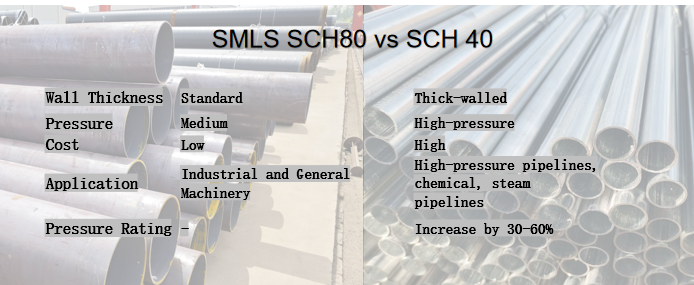
Wall-Thickness-to-Weight Comparison Chart
| NPS (inch) | OD (mm) | Sch40 Wall (mm) | Sch80 Wall (mm) | Wall Thickness Increase Ratio | Sch40 Weight (kg/m) | Sch80 Weight (kg/m) | Weight increase ratio |
| 1/2″ | 21.3 | 2.77 | 3.91 | 41% | – | – | – |
| 1″ | 33.4 | 3.38 | 4.55 | 35% | 2.27 | 3.07 | 35% |
| 2″ | 60.3 | 4.55 | 5.54 | 22% | 5.17 | 6.47 | 25% |
| 4″ | 114.3 | 6.02 | 8.56 | 42% | 16.1 | 22.3 | 38% |
| 6″ | 168.3 | 7.11 | 10.97 | 54% | 28.7 | 42 | 46% |
| 8″ | 219.1 | 8.18 | 12.7 | 55% | 41.7 | 63.4 | 52% |
Allland Steel Pipe Factory Pipeline Marking and Packaging
Manufacturer name and logo, material, dimensional specifications, standard certifications, batch number, furnace number, date of manufacture.
Packaging
Bundling: Bundle 1-5 pipes per bundle according to pipeline project length. Secure using steel strapping or high-strength plastic ties.
End Protection: Use pipe caps or steel collars to prevent mechanical damage.
Surface Protection: Waterproof tarps required for maritime and long-distance transport. Coating treatment available per customer request.
Storage Requirements: Place on dry, ventilated, level ground. Pipes must not contact the ground directly.