
LSAW stands for Longitudinal Submerged Arc Welded pipes, which are primarily used for manufacturing large-diameter welded pipes. They are widely used in the transportation of oil, natural gas, and water, particularly for long-distance transport. Key technical parameters include outer diameter, wall thickness, pressure rating, physical and chemical properties, and tolerances. Among these, LSAW wall thickness is a critical factor, as it directly determines the pipe’s pressure-bearing capacity, service life, and safety performance. Below, we will introduce LSAW wall thickness charts, as well as the importance of wall thickness and wall thickness tolerances. Please feel free to contact us with any questions.
Definition of LSAW Wall Thickness
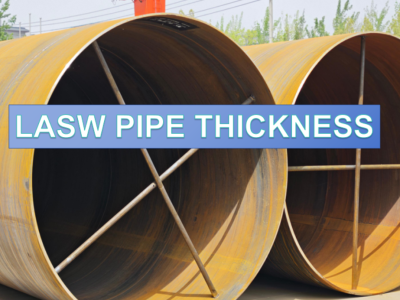
LSAW pipe wall thickness refers to the distance from the outer wall to the inner wall of the pipe. It is expressed in two ways: the international standard uses millimeters (mm), while the U.S. standard uses inches (in). Wall thickness determines the pipe’s pressure-bearing capacity; the thicker the wall, the greater the pressure-bearing capacity.
LSAW Wall Thickness Size Charts
Common wall thickness ranges: 6 mm – 60 mm; heavy-wall pipe ranges: 60 mm – 100 mm. These can be further categorized into the following application ranges:
- Thin-wall: 6–12 mm, suitable for water conveyance.
- Medium wall thickness: 12–25 mm, suitable for urban gas pipelines.
- Thick wall thickness: 25–50 mm, suitable for oil and gas transportation.
- Extra-thick wall: 50–100 mm, suitable for subsea projects.
Note that wall thickness is not a fixed value and may vary depending on specific project requirements. Below are some reference tables showing the relationship between outer diameter and wall thickness.
| OD (mm) | Inch | Common Wall Thickness Range (mm) | Typical Applications |
|---|---|---|---|
| 406 | 16″ | 6 – 20 | Water pipelines / Low pressure |
| 457 | 18″ | 6 – 22 | Water supply and drainage |
| 508 | 20″ | 8 – 25 | Oil & gas / Water |
| 559 | 22″ | 8 – 28 | Pipeline networks |
| 610 | 24″ | 10 – 30 | Water transmission / Gas transmission |
| 660 | 26″ | 10 – 32 | Medium-pressure pipelines |
| 711 | 28″ | 10 – 35 | Oil transportation |
| 762 | 30″ | 10 – 40 | Oil & gas trunk pipelines |
| 813 | 32″ | 12 – 42 | Medium to high pressure |
| 864 | 34″ | 12 – 45 | Engineering pipelines |
| 914 | 36″ | 12 – 45 | Long-distance pipelines |
| 965 | 38″ | 12 – 48 | High-pressure pipelines |
| 1016 | 40″ | 12 – 50 | Oil & gas trunk lines |
| 1067 | 42″ | 14 – 52 | High-pressure transmission |
| 1118 | 44″ | 14 – 55 | Large-scale engineering |
| 1168 | 46″ | 16 – 55 | High-pressure pipelines |
| 1219 | 48″ | 16 – 55 | Trunk pipelines |
| 1270 | 50″ | 16 – 58 | Extra large diameter |
| 1321 | 52″ | 18 – 58 | High-pressure pipelines |
| 1372 | 54″ | 18 – 60 | Offshore engineering |
| 1422 | 56″ | 20 – 60 | Subsea / High-pressure |
LSAW pipes are manufactured by rolling steel plates, so the thickness of the plate determines the wall thickness of the pipe. For wall thicknesses less than 6 mm, the LSAW process is generally not used; instead, the ERW or SMLS processes are employed.
LSAW Wall Thickness Tolerance
During the production of steel pipes, certain dimensional deviations are inevitable. This applies to the outer diameter, wall thickness, and other parameters. While some steel pipe standards permit wall thickness deviations, they generally allow only positive deviations; however, LSAW pipes permit negative wall thickness deviations. Specifically, the actual wall thickness can range from -10% to -12.5%. For example, if the standard wall thickness is 20 mm, the actual wall thickness is permitted to fall between 17.5 mm and 18 mm.
Why are Negative Tolerances Allowed for LSAW Pipes?
Will negative tolerance reduce pressure-bearing capacity and affect pipeline service life? Below is an introduction to wall thickness negative tolerance in LSAW pipes.
Reason 1: A negative deviation in pipe wall thickness does not mean that the entire pipe wall is thinner; rather, it refers to the fact that localized thinning is permitted.
Reason 2: The steel plate rolling process is not entirely stable, resulting in fluctuations in wall thickness. This is an inherent characteristic of the manufacturing process and cannot be avoided.
Reason 3: The LSAW manufacturing process includes two methods—UOE and JCOE—and stretching or bending during processing may cause localized thinning.
Reason 4: If negative deviations were not permitted, costs would increase significantly.
How to Select Steel Pipes When Negative Tolerances Occur
Calculation Methods and Influencing Factors for LSAW Pipe Wall Thickness
In pipeline engineering, the wall thickness of a pipe is generally determined based on the design pressure.The commonly used formula is
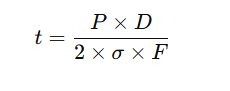
Parameter Explanation: T = Design wall thickness
P = Design internal pressure
D = Outer diameter
F = Design factor (typically 0.6–0.72)
σ = Allowable material stress (MPa)
Factors Affecting Wall Thickness
1. Key Factor: Internal pressure requirements of the pipeline. Higher pressure requires greater wall thickness, as large-diameter pipes are prone to circumferential tensile failure.
2. Common materials such as API 5L X60 and X70: The higher the steel grade, the greater the strength, and the thinner the required wall thickness under the same pressure. However, costs will also increase.
3. Pipe corrosion: Corrosion of varying degrees occurs during pipe use. Common corrosion rates range from 1 to 3 mm, so a margin must be included in the pipe wall thickness.
4. Tolerance compensation: Due to variations in steel plate wall thickness, negative wall thickness deviations must be accounted for.
LSAW Pipe W.T. vs. ERW/ LSAW/ SSAW
| Type | Wall Thickness Range | Wall Thickness Uniformity | Risk of Local Weak Points | Wall Thickness Stability |
|---|---|---|---|---|
| LSAW | 6 – 60 mm (up to 100 mm) | High | Medium | High |
| ERW | 1 – 20 mm | Medium | Medium | Medium |
| SSAW | 6 – 25 mm (typical) | Medium | Relatively High | Medium |
| Seamless | Full range available (ultra-thick wall possible) | Excellent | Low | Very High |
High-End LSAW Pipe Wall Thickness Requirements
- Stricter wall thickness control; negative deviations are not permitted
- Higher material grades: API 5L X65 / X70 / X80
- More rigorous inspection requirements: 100% ultrasonic testing (UT), automatic wall thickness measurement systems, and full weld inspection
- Greater wall thickness uniformity
FAQ
Are the wall thickness and schedule (SCH) of LSAW pipes the same?
No, they are not the same. LSAW pipes typically do not use schedule as a wall thickness designation, especially for large-diameter pipes, which are generally marked directly in millimeters.
Which has greater wall thickness capability: LSAW or ERW?
LSAW pipes are superior to ERW pipes in terms of wall thickness and pressure rating. ERW pipes have a wall thickness range of 1 mm to 20 mm, which is limited. Additionally, since ERW pipes are manufactured from steel strips, they are relatively weaker in terms of wall thickness, hardness, and structural performance.
What wall thicknesses are commonly used for LSAW pipes in oil and gas transportation?
Common wall thicknesses range from 20 mm to 50 mm. Oil and gas transportation demands extremely high safety standards for pipelines, and these wall thicknesses fall within the medium-to-high-pressure category. Below are some commonly used combinations:
· 508 × 12 / 16 / 20 mm
· 610 × 14 / 18 / 22 mm
· 762 × 16 / 20 / 25 mm
· 914 × 18 / 22 / 25 / 30 mm
· 1016 × 20 / 25 / 30 / 32 mm
· 1219 × 22 / 25 / 30 / 35 mm
· 1422 × 25 / 30 / 40 mm