ALLLAND Boiler Steel Pipe Supply
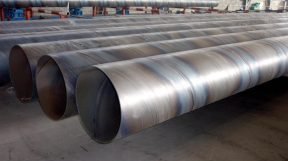
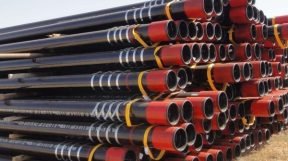
Welcome to ALLLAND. Our ASTM A53 Grade A steel pipes are manufactured in strict accordance with the ASTM A53 standard. We offer both welded and seamless production processes, providing a comprehensive range of sizes with tight tolerances to meet the requirements of most piping applications. Our wall thicknesses cover common grades such as SCH10, SCH40, and SCH80. We also offer coating services, enabling us to provide integrated manufacturing and processing solutions. We are committed to producing compliant products that support global piping projects and contribute to their efficient execution.
Alllandsteel is a steel pipe manufacturer based in China with 25 years of experience.
The facility spans 22,000 square meters, represents a RMB 700 million investment, and operates four production lines (JCOE, ERW, SMLS, SSAW) alongside five coating lines.
With an annual production capacity of 250,000 tons, the factory covers specifications ranging from Ø406 to Ø1524 and holds multiple international certifications (API/ASTM/EN/ISO/JIS). Focused on steel pipes, creating value for you!
HOT PRODUCTS
POPULAR ARTICLES
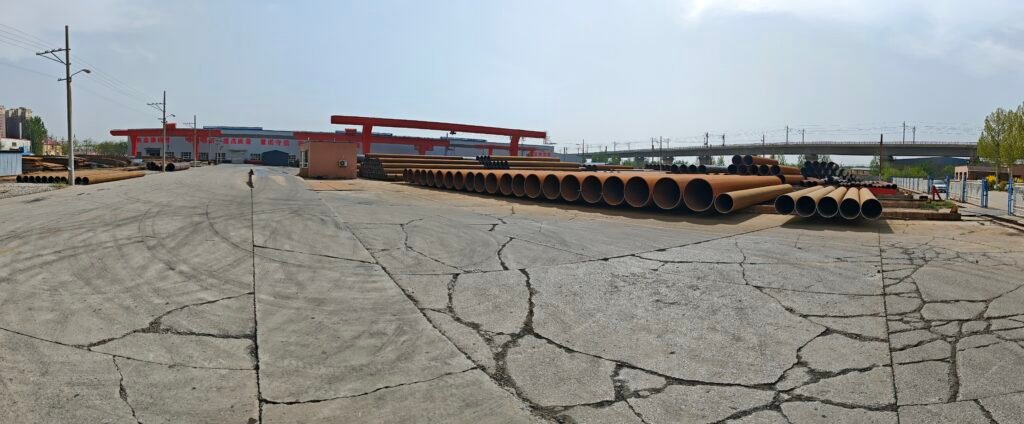
ASTM A53 is a standard specification established by the American Society for Testing and Materials (ASTM) that defines the technical requirements for carbon steel pipes intended for low-pressure and general-purpose applications; these pipes may be either welded or seamless. ASTM A53 Grade A has relatively lower requirements for chemical composition and mechanical properties, offering good weldability and formability. It is primarily used for general structural applications and the conveyance of low-pressure fluids such as water, air, and steam. According to the ASTM A53 standard, steel pipes are classified into three different grades. The most common are Grade A and Grade B, while Grade C is less commonly used.
O.D.:
0.3 mm – 660 mm (nominal sizes NPS 1/8 – NPS 26 or DN 6 – DN 650)
W.T.:
SCH 10 – SCH160, STD, XS, XXS
Length:
6 meters, 12 meters, or random length;
Material:
Low-carbon steel
Surface Treatment:
Paint, galvanized, 3LPE, HDPE, 3LPP, FBE, etc.
Mechanical Properties:
Tensile Strength: ≥ 330 MPa
Yield Strength: ≥ 205 MPa
Delivery Conditions:
Grade, Specification, Furnace Number, Standard
Process:
Type S (Seamless Pipe), Type E (Electric Resistance Welded Pipe), Type F (Induction Welded Pipe)
| Type S | Type E | Type F | |
| (seamless pipe) | (electric-resistance-welded) | (furnace-welded pipe) | |
| Grade A | |||
| Carbon max. % | 0.25 | 0.25 | 0.3 |
| Manganese % | 0.95 | 0.95 | 1.2 |
| Phosphorous, max. % | 0.05 | 0.05 | 0.05 |
| Sulfur, max. % | 0.045 | 0.045 | 0.045 |
| Copper, max.% | 0.4 | 0.4 | 0.4 |
| Nickel, max. % | 0.4 | 0.4 | 0.4 |
| Chromium, max. % | 0.4 | 0.4 | 0.4 |
| Molybdenum, max. % | 0.15 | 0.15 | 0.15 |
| Vanadium, max. % | 0.08 | 0.08 | 0.08 |
For each reduction of 0.01 % below the specified carbon maximum, an increase of 0.06 % of manganese above the specified maximum will be permitted up to a maximum of 1.35 %.
| Seamless & Electric-resistance-welded | Continuous-Welded | |
| Tensile Strength, min., psi | 48,000 | 45,000 |
| Yield Strength, min., psi | 30,000 | 25,000 |
| Elongation | 20-30% | |
Among these, the mandrel process is optimal for boiler tube manufacturing. This method involves elongating the billet in a multi-stand machine to reduce wall thickness, ensuring surface quality and uniform wall thickness.
According to ASTM A53, steel pipes must undergo rigorous inspection and testing, including:
Tensile strength: 330 MPa (48,000 psi)- 500 MPa (72,500 psi).
Yield strength: Minimum 205 MPa (30,000 psi)
Elongation: At least 20%, and the specific value varies depending on the wall thickness of the pipe.
Compared to Grade B, Grade A has lower manufacturing costs.
Grade A has a low carbon content (maximum 0.25%), which provides good weldability and helps prevent excessive hot cracking during the welding process.
Grade A is explicitly specified in ASTM A53 as the preferred steel grade for seamless and resistance-welded pipes when tight coiling or cold bending is required.
It can be easily cut, bent, and formed, offering superior machinability.
Applications requiring extensive cold-formed piping:
Heat exchangers and heating coils requiring coiled tubing.
On-site bending of low-pressure piping.
Low-pressure fluid conveyance
Water, gas, and air piping.
Lightweight structural framing
Supports, guardrails, and frames.
ASTM A53 Grade A and ASTM A53 Grade B are two different grades of carbon steel pipes specified in the ASTM A53.
Their main differences lie in chemical composition, mechanical properties, and application requirements.
| Grade A (max%) | Grade B (max%) | |
| Carbon (C) | 0.25 | 0.30 |
| Manganese (Mn) | 0.95 | 1.25 |
| Phosphorus (P) | 0.05 | 0.05 |
| Sulfur (S) | 0.045 | 0.045 |
| Copper (Cu) | 0.40 | 0.40 |
Mechanical Properties
| Grade A | Grade B | |
| Yield Strength | ≥ 30,000 psi | ≥ 35,000 psi |
| Tensile Strength | ≥ 48,000 psi | ≥ 60,000 psi |
| Elongation | 20-30% | 18-30% |
Application Requirements
| Grade A | Low-pressure, standard environments |
| Grade B | High-pressure, high-stress environments |