Welcome to ALLLAND Steel Pipe Co., Ltd.
ALLLAND Boiler Steel Pipe Supply
Welcome to Allland Steel Pipe Factory. Our Scaffolding Pipe strictly adheres to international standards, ensuring each pipe’s load-bearing capacity, outer diameter tolerance, uniform wall thickness, and cost-effectiveness. Manufactured from premium black carbon steel pipe, the surface undergoes galvanization for enhanced corrosion resistance. Suitable for diverse working environments, our factory maintains stable supply capabilities. Inquiries are welcome.
Alllandsteel is a steel pipe manufacturer based in China with 25 years of experience. The facility spans 22,000 square meters, represents a RMB 700 million investment, and operates four production lines (JCOE, ERW, SMLS, SSAW) alongside five coating lines. With an annual production capacity of 250,000 tons, the factory covers specifications ranging from Ø406 to Ø1524 and holds multiple international certifications (API/ASTM/EN/ISO/JIS). Focused on steel pipes, creating value for you!
HOT PRODUCTS
POPULAR ARTICLES
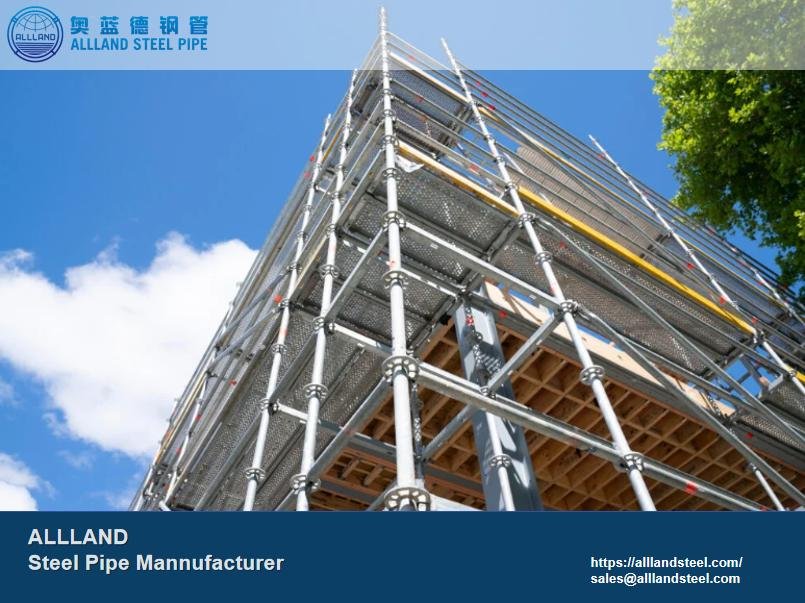
Scaffolding pipe are support structures commonly used in high-altitude work environments such as construction sites and industrial facilities. They are typically employed to erect scaffolding, supporting workers and materials to ensure safety. Scaffolding pipe are usually manufactured from metal materials like steel, guaranteeing construction safety. Their production and design comply with international standards, making them widely applicable in construction, maintenance, and industrial settings.
O.D.:
42.4 mm to 60.3 mm; the international standard outer diameter for scaffolding is typically 48.3 mm
W.T.:
2.0 mm ~ 6.0 mm, 3.2 mm, 4 mm, 4.5 mm, 5 mm, 6 mm, etc.
Length:
6 m, 9 m, 12 m (customizable upon request)
Load Capacity:
≥ 360 MPa (Tensile Strength)
Steel Grades:
Q235 / Q345 / S235JR / S355JR / ASTM A53 / ASTM A500
Surface Treatment:
Black pipe, Galvanized, Painted, Powder-coated
Process:
ERW High-frequency Welding
Scaffolding Pipe Manufactured by ALLLAND
| Nominal Size | Outside Diameter (mm) | Wall Thickness (mm) | Inside Diameter (mm) | Weight (kg/m) | Weight (kg/6m) | Weight (lb/ft) | Type |
| 1-1/2″ | 48.3 | 3.2 | 41.9 | 3.56 | 21.36 | 2.39 | Type 3 |
| 1-1/2″ | 48.3 | 4 | 40.3 | 4.37 | 26.22 | 2.94 | Type 4 |
| 1-1/2″ | 48.3 | 4.5 | 39.3 | 4.83 | 28.98 | 3.25 | Heavy Duty* |
Note: 4.5 mm is not a standard size under BS EN 39 but is a specification adopted in certain countries and for heavy-duty engineering projects.
In contrast, 3.2 mm (Type 3) and 4.0 mm (Type 4) are standard specifications defined by BS EN 39 and BS 1139. BS EN 39 / BS 1139 itself does not include a wide range of OD×WT specifications like ASTM A53 or API 5L.
| OD (mm) | WT (mm) | Weight (kg/m) | Weight (kg/3m) | Weight (kg/4m) | Weight (kg/5m) | Weight (kg/6m) |
| 48.3 | 3.2 | 3.56 | 10.68 | 14.24 | 17.8 | 21.36 |
| 48.3 | 4 | 4.37 | 13.11 | 17.48 | 21.85 | 26.22 |
| 48.3 | 4.5 | 4.83 | 14.49 | 19.32 | 24.15 | 28.98 |
The above tolerances are derived from the requirements for scaffolding steel tubes specified in BS EN 39 and BS 1139.
| Item | Requirement |
| Outside Diameter | 48.3 ±0.5 mm |
| Wall Thickness | -0.1 |
| Ovality | ≤0.4 mm |
| Straightness | 1/500 Length |
| Mass Tolerance (Single Tube) | -0.075 |
| Tube Ends | Plain End, Square Cut |
| Standard Length | 6.0 m (Custom Available) |
| Length | 3.2 mm | 4.0 mm |
|---|---|---|
| 0.5 m | 1.78 kg | 2.19 kg |
| 1.0 m | 3.56 kg | 4.37 kg |
| 1.5 m | 5.34 kg | 6.56 kg |
| 2.0 m | 7.12 kg | 8.74 kg |
| 2.5 m | 8.90 kg | 10.93 kg |
| 3.0 m | 10.68 kg | 13.11 kg |
| 3.5 m | 12.46 kg | 15.30 kg |
| 4.0 m | 14.24 kg | 17.48 kg |
| 4.5 m | 16.02 kg | 19.67 kg |
| 5.0 m | 17.80 kg | 21.85 kg |
| 5.5 m | 19.58 kg | 24.04 kg |
| 6.0 m | 21.36 kg | 26.22 kg |
As load-bearing pipes, scaffolding pipes require a certain level of mechanical strength. They must also comply with local standards and mechanical requirements. Below are some commonly used standards for scaffolding pipes. Please contact us if you have any questions.
EN 39
European standard for scaffolding tubes, applicable to construction, industrial maintenance, and temporary structures. Common outer diameter: 48.3mm. Wall thickness options: 3.2mm/4.0mm. Yield strength: ≥ 235 MPa. Suitable for coupler-type scaffolding systems with stable and reliable performance.
BS 1139
The traditional British scaffolding pipe standard, widely used in Middle Eastern, African, and Southeast Asian markets. Suitable for coupler-type scaffolding systems, including the Zhongxing scaffolding system. Common outer diameter is 48.3 mm with wall thicknesses of 3.2 mm or 4.0 mm. Features strict tolerance control, strong deformation resistance, and reusability.
ASTM A53/A500
Frequently used in North American, South American, and Asian markets. While these standards are not specifically for scaffolding pipes, they meet the 48.3 mm OD requirement, with wall thickness and load-bearing capacity meeting specifications. They are compatible with clamps and thus serve as production standards.
Note: Regardless of tolerance standard, the standard outer diameter for scaffolding pipes is 48.3 mm. Deviations from this diameter may affect clamp tightness, creating safety hazards. Wall thickness ranges from 3.0–4.0 mm to ensure adequate load-bearing capacity.
Clamp Connection
Clamp connection is the most common scaffolding connection method, connecting pipes using clamps. Clamps mainly consist of bolts, nuts, and clips, which securely connect two scaffolding pipes together by tightening the bolts.Suitable for lightweight scaffolding, especially in temporary structures requiring quick assembly and disassembly.
Welded Connection
Welded connection uses welding methods such as arc welding and argon arc welding to weld two or more scaffolding pipes into a single unit. This connection method is usually used in scaffolding systems with higher load-bearing requirements or for long-term use.Suitable for high-strength scaffolding, especially in situations requiring high stability such as bridge construction and factory building construction.
Bolt Connection
Bolt connection uses bolts, nuts, and washers to connect scaffolding pipes. This method is commonly used in scaffolding requiring extra strength and load-bearing capacity.Suitable for heavy-duty scaffolding and heavy-load construction such as bridges and building facades.
(1) Dimensional Inspection:
Outer Diameter and Wall Thickness Measurement: Use calipers, outer diameter gauges, wall thickness gauges, or other professional equipment to measure the outer diameter and wall thickness of each scaffolding pipe, ensuring that the pipes meet the standard size requirements.
Length Measurement: Use a steel tape measure or laser rangefinder to check the length of each scaffolding pipe, ensuring the length is within the tolerance range.
(2) Surface Inspection:
Visual Inspection: Check the surface of the scaffolding pipes for flatness, smoothness, and the presence of defects such as cracks, dents, and scratches. Pay particular attention to galvanized pipes, ensuring the surface coating is uniform.
Coating Inspection: Use a thickness gauge to measure the thickness of the galvanized layer, ensuring the hot-dip galvanized layer thickness meets the standard (generally 50µm or more).
(3) Strength and Hardness Testing:
Tensile Test: Determine the tensile strength of the scaffolding pipes through tensile testing. Common standards require a tensile strength of at least 370 MPa for Q235 steel and at least 470 MPa for Q345 steel.
Hardness Test: Use a Rockwell hardness tester to test the hardness of the pipes, ensuring they meet the required hardness standards, especially at the welded areas.
(4) Welding Quality Inspection:
Weld Inspection: Check the welded areas of the scaffolding pipes for defects such as cracks, pores, and incomplete welds. Non-destructive testing methods such as ultrasonic testing and X-ray testing can be used for weld quality inspection.
Welded Joints: Ensure that the strength of the pipe joints is consistent with the overall strength, preventing problems during the use of the scaffolding pipes due to poor welding.
(5) Corrosion Resistance Testing:
Salt Spray Test: Conduct a salt spray test on hot-dip galvanized scaffolding pipes to check the corrosion resistance of the galvanized layer. The standard requires that the scaffolding pipes can withstand at least 24 hours in a salt spray environment without significant corrosion.
Surface Coating Inspection: For scaffolding pipes with anti-corrosion coatings, check the coating thickness and uniformity.
GB/T 3091-2015 (Galvanized steel pipes for steel structure)
GB/T 13793-2008 (Steel pipes for building scaffolding)
GB 14957-2019 (Scaffolding fittings for construction)
EN 39 (European Standard)
BS 1139 (British Standard)
ASTM A53 (American Standard)
Hot-dip galvanizing, cold galvanizing, spraying, etc. These treatments improve the corrosion resistance and service life of the scaffolding.
Scaffolding types include:
Steel pipe scaffolding: Composed of steel pipes, couplers, etc., it is a common type of scaffolding, suitable for most construction sites.
Coupler scaffolding: Connects steel pipes through couplers, suitable for the erection of complex structures.
Quick-release scaffolding: Also known as modular scaffolding, it uses a locking system for easier installation and disassembly.
Frame scaffolding: Composed of frame units, it has strong stability and is suitable for high-rise buildings.
Fill in the form below and our team will be happy to assist you