Welcome to ALLLAND Steel Pipe Co., Ltd.
ALLLAND Boiler Steel Pipe Supply
Welcome to ALLLAND Steel Pipe Factory. Our Conduit Pipe strictly adheres to international standards, ensuring the produced pipes meet required mechanical strength, dimensional accuracy, and other specifications. The products feature stable chemical properties and excellent corrosion resistance. We offer multiple conduit types and support galvanizing processes to meet diverse application needs. For inquiries, please click to consult.
Alllandsteel is a steel pipe manufacturer based in China with 25 years of experience. The facility spans 22,000 square meters, represents a RMB 700 million investment, and operates four production lines (JCOE, ERW, SMLS, SSAW) alongside five coating lines. With an annual production capacity of 250,000 tons, the factory covers specifications ranging from Ø406 to Ø1524 and holds multiple international certifications (API/ASTM/EN/ISO/JIS). Focused on steel pipes, creating value for you!
HOT PRODUCTS
POPULAR ARTICLES
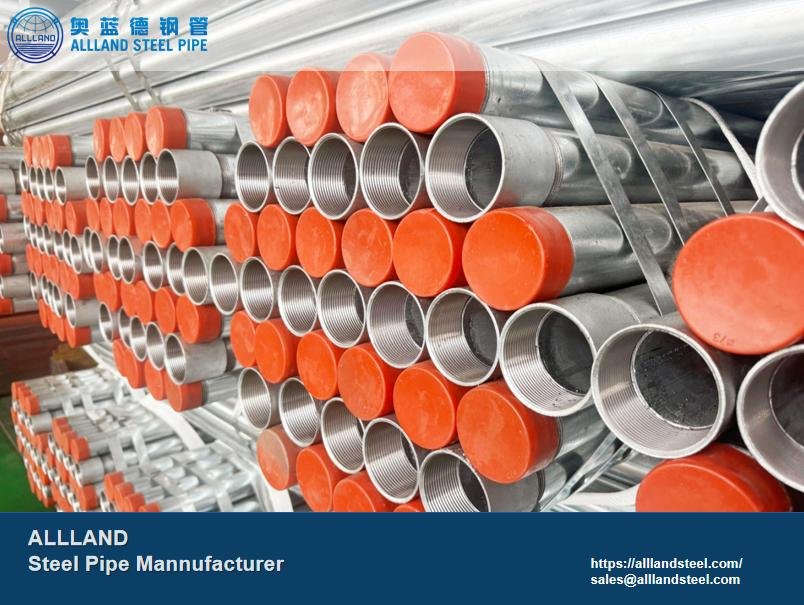
Conduit pipe is a type of conduit used to protect wires, cables, or other electrical systems. It is primarily used in power, telecommunications, data transmission, and other fields to safeguard internal electrical circuits by providing mechanical protection, preventing external interference, and ensuring system safety.
O.D.:
10mm – 1000mm
W.T.:
1mm – 10mm
Length:
Standard Length 10 ft (3.05 m), Customizable 3 – 6 ft
Material:
Carbon steel, low-carbon steel
Standards:
UL 797/1242/6, ANSI C80, BS 4568 / BS EN 61386
Type:
EMT / IMC / RMC
Conduit pipes are categorized into EMT, IMC, RMC/GRC, and Flexible Conduit based on wall thickness, operating environment, and construction. Selecting the appropriate conduit for specific environments and applications is therefore paramount. The characteristics and dimensions of each conduit type are detailed below.
EMT Conduit
IMC Conduit
RMC / GRC Conduit
| NPS | O.D.(mm) | W.T.(mm) |
| 1/2″ | 17.9 | 1.07 |
| 3/4″ | 23.4 | 1.24 |
| 1″ | 29.5 | 1.38 |
| 1-1/4″ | 38.4 | 1.51 |
| 1-1/2″ | 44.2 | 1.65 |
| 2″ | 56 | 1.78 |
| 2-1/2″ | 72.5 | 2.11 |
| 3″ | 88.9 | 2.41 |
| 4″ | 114.3 | 2.79 |
| NPS | O.D.(mm) | W.T.(mm) |
| 1/2″ | 21.3 | 1.65 |
| 3/4″ | 26.7 | 1.83 |
| 1″ | 33.4 | 2.11 |
| 1-1/4″ | 42.2 | 2.41 |
| 1-1/2″ | 48.3 | 2.54 |
| 2″ | 60.3 | 2.77 |
| 2-1/2″ | 76.1 | 3.05 |
| 3″ | 88.9 | 3.3 |
| 4″ | 114.3 | 3.68 |
| NPS | O.D.(mm) | W.T.(mm) |
| 1/2″ | 21.3 | 2.77 |
| 3/4″ | 26.7 | 2.87 |
| 1″ | 33.4 | 3.38 |
| 1-1/4″ | 42.2 | 3.56 |
| 1-1/2″ | 48.3 | 3.68 |
| 2″ | 60.3 | 3.91 |
| 2-1/2″ | 76.1 | 4.19 |
| 3″ | 88.9 | 4.57 |
| 4″ | 114.3 | 4.88 |
Tolerances and Inspection
Outer Diameter: ±0.3mm to ±2mm
Wall Thickness: ±5% to ±10%
Outer Diameter Measurement: Measure the pipe’s outer diameter using calipers or an outer diameter gauge (e.g., laser measuring instrument) to ensure compliance with standard tolerance ranges.
Wall Thickness Measurement: Measure wall thickness using an ultrasonic thickness gauge or mechanical calipers to verify compliance with design requirements.
Straightness and Bend Inspection: Ensure pipe straightness to prevent issues caused by bending or deformation during installation.
X-ray or Ultrasonic Inspection: Examine internal weld integrity to confirm absence of cracks or defects.
Visual Inspection: Conduct visual checks on welded joints to ensure neat welds without obvious flaws.
Pressure Testing: Perform pressure tests to evaluate the pipe’s ability to withstand internal pressure, ensuring operational safety under high-pressure conditions.
Hardness Testing: Conduct hardness tests on pipes to ensure material hardness meets specifications, particularly for high-temperature applications where sufficient strength is required.
Electrical Conductivity Testing: Evaluate the electrical conductivity of metal pipes to ensure reliable conductivity within electrical systems, suitable for power transmission conduits.
It can be connected via threaded, flanged, or butt joints. The pipe is flexible, facilitating installation in complex environments.
Made of galvanized or stainless steel, it effectively prevents rust and is suitable for various harsh environments.
Threaded Connection: Joins pipes using threaded fittings, suitable for smaller diameters.
Welded Connection: Used for larger diameters, providing superior joint strength.
Clamp Connection: Secures pipes with metal clamps or fasteners, ideal for quick installations.
Flange Connection: Connects pipes via flanges and bolts, commonly used in high-pressure applications.
Ensure pipes are not excessively bent during installation and maintain proper sealing integrity.
Fill in the form below and our team will be happy to assist you