
Welcome to ALLLAND Steel Pipe Co., Ltd.
ALLLAND Boiler Steel Pipe Supply
Welcome to ALLLAND Steel Pipe Factory. We specialize in manufacturing hot-dip galvanized steel pipes with a complete production line. Strict adherence to standardized control processes ensures a robust bond between the zinc coating and the pipe, providing long-term protection and corrosion resistance. Hot-dip galvanizing is the most widely adopted process, offering the highest level of zinc coating durability. Our products are extensively used in water supply and drainage, fire protection, structural support, and scaffolding industries. Products are available with EN 10204 3.1 material certificates.
Alllandsteel is a steel pipe manufacturer based in China with 25 years of experience. The facility spans 22,000 square meters, represents a RMB 700 million investment, and operates four production lines (JCOE, ERW, SMLS, SSAW) alongside five coating lines. With an annual production capacity of 250,000 tons, the factory covers specifications ranging from Ø406 to Ø1524 and holds multiple international certifications (API/ASTM/EN/ISO/JIS). Focused on steel pipes, creating value for you!
HOT PRODUCTS
POPULAR ARTICLES
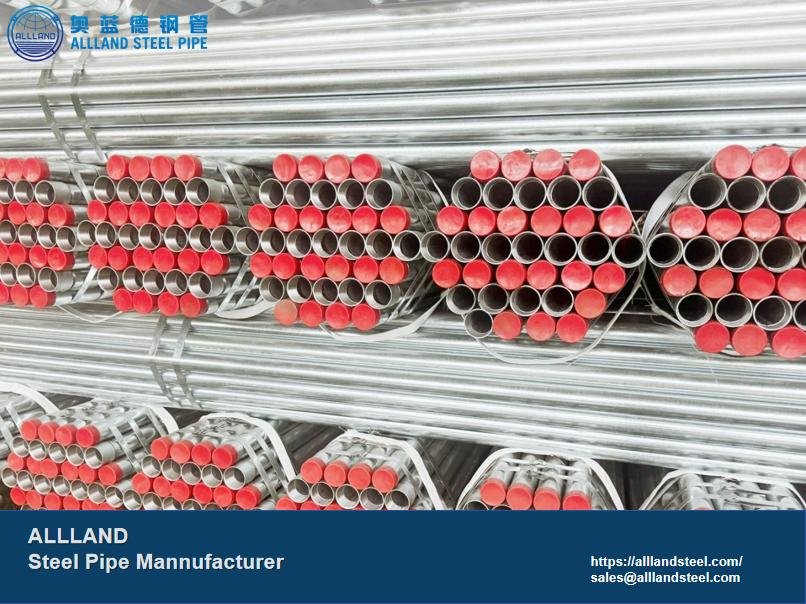
Hot-dip galvanized pipe refer to steel pipes coated with a layer of zinc through the hot-dip galvanizing process, effectively enhancing their corrosion resistance. They are widely used in construction, piping systems, transportation infrastructure, chemical engineering, and other fields. Hot-dip galvanized pipes are produced by immersing manufactured steel pipes into molten zinc baths. This process triggers a reaction between zinc and the pipe surface, forming an alloy layer that creates a robust, corrosion-resistant zinc coating. Due to their outstanding anti-corrosion properties, these pipes exhibit extended service life in harsh environments.
O.D.:
DN15 – DN600, 21.3 mm – 610 mm
W.T.:
1.0 mm – 12 mm (common range)
Length:
6 m, 12 m, 18 m (customizable upon request)
Galvanizing Temperature:
445 – 460 °C
Standards:
SO 1461 / EN ISO 1461; ASTM A123 / ASTM A153; EN 10240; GB/T 13912
Zinc Coating Structure:
Ferroalloy layer + Pure zinc layer
Surface Treatment:
Continuous zinc coating, no missed areas, no large-scale zinc flow
Pipe Ends:
Plain ends, chamfered ends, threaded ends, capped ends
Hot-dip Galvanized Pipe Manufactured by ALLLAND
If you’d like to learn more about galvanized products, please click the link below.
When selecting hot-dip galvanized pipes, it is essential to first determine the pipeline’s operating environment and load requirements. Consider the following factors:
Outer Diameter and Wall Thickness: Select appropriate outer diameter and wall thickness based on the transported medium (e.g., water, gas, chemicals) and the pipeline’s pressure and flow requirements. Larger outer diameters and thicker walls enhance the pipeline’s pressure-bearing capacity.
| OD | WT | Weight(kg/m) |
| 20 mm | 1.2 mm | 0.68 |
| 20 mm | 2.0 mm | 1.06 |
| 25 mm | 1.2 mm | 0.88 |
| 25 mm | 2.0 mm | 1.38 |
| 32 mm | 1.5 mm | 1.25 |
| 32 mm | 2.5 mm | 1.94 |
| 40 mm | 2.0 mm | 1.74 |
| 40 mm | 3.0 mm | 2.6 |
| 50 mm | 2.5 mm | 2.42 |
| 50 mm | 3.0 mm | 2.9 |
| 60 mm | 2.5 mm | 2.91 |
| 60 mm | 4.0 mm | 4.36 |
| 80 mm | 3.0 mm | 4.45 |
| 80 mm | 4.0 mm | 5.86 |
| 100 mm | 3.5 mm | 5.8 |
| 100 mm | 4.5 mm | 7.3 |
| 150 mm | 4.0 mm | 8.8 |
| 150 mm | 5.0 mm | 11 |
| 200 mm | 5.0 mm | 13.7 |
| 200 mm | 6.0 mm | 16.4 |
| 250 mm | 6.0 mm | 20.5 |
| 250 mm | 8.0 mm | 25.9 |
| 300 mm | 7.0 mm | 27.6 |
| 300 mm | 8.0 mm | 32 |
| 350 mm | 8.0 mm | 37.4 |
| 350 mm | 10.0 mm | 45 |
| 400 mm | 10.0 mm | 50 |
To ensure the performance of steel pipes remains unchanged, the temperature for hot-dip galvanizing is controlled between 445-460 degrees Celsius. At this temperature, zinc undergoes a metallurgical reaction with the metal without damaging its internal structure, thereby safeguarding the pipe’s performance. The hot-dip galvanizing process consists of:
Degreasing – Pickling – Water rinsing – Pre-treatment – Drying – Hot-dip galvanizing – Cooling – Post-treatment and inspection
Hot-dip galvanizing is the core process, with immersion duration determined by pipe wall thickness and specifications. This process forms alloy layers (Γ, δ, ζ layers) and a zinc coating on the pipe surface. Zinc acts as an anode, reacting first with corrosive agents to provide extensive protection. Under typical conditions, the coating offers 20-50 years of service life.
Outer Diameter Tolerance: ±0.5mm
Wall Thickness Tolerance: ±10%
Surface Inspection: Check whether the pipe surface is smooth, and whether there are obvious scratches, dents, welding defects, etc. The galvanized coating should be uniform, free of obvious defects, and without bubbles.
Galvanized Coating Inspection: Confirm the integrity and uniformity of the galvanized coating. The quality of the galvanized coating directly affects the pipe’s corrosion resistance.
Outer Diameter and Wall Thickness Measurement: Use tools such as calipers and micrometers to precisely measure the pipe’s outer diameter and wall thickness, ensuring compliance with standard tolerance requirements.
Length Measurement: Employ standard measuring tools to accurately measure the pipe’s length, verifying conformity to design and tolerance specifications.
For seamless hot-dip galvanized pipes, inner diameter measurement is critical to ensure unobstructed fluid flow without blockage or reduced capacity.
Tensile Test: Evaluate mechanical properties such as tensile strength, yield strength, and elongation through tensile testing to ensure the pipe can withstand corresponding loads during actual use.
Impact Test: Evaluates the pipe’s impact resistance under low temperatures or extreme conditions to ensure stability in harsh environments.
Micrometer Inspection: Uses specialized galvanized layer measurement instruments (e.g., electronic thickness gauges) to detect coating thickness. Standard thickness typically ranges from 40µm to 100µm, with specific selections based on application requirements.
Salt Spray Test: Simulates corrosion in marine or acidic environments to evaluate the pipe’s resistance to salt spray exposure. Testing typically ranges from 72 to 1000 hours.
The service life of hot-dip galvanized pipes is closely related to environmental conditions, pipeline maintenance, and the thickness of the galvanized coating. Generally, under normal conditions, the service life of hot-dip galvanized pipes can exceed 50 years.
Hot-dip galvanized pipes are highly suitable for underground installation, particularly in water supply, drainage, and power transmission systems. The galvanized coating effectively prevents corrosion, especially in moist soil or chemically corrosive environments. However, to ensure long-term corrosion protection in highly corrosive conditions, additional measures (such as coatings or protective sleeves) may be required.
Fill in the form below and our team will be happy to assist you